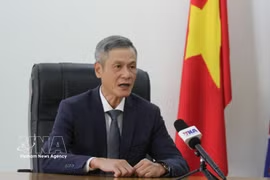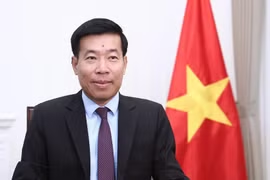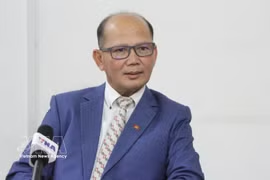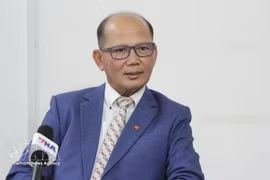
Hanoi (VNA) – Col. Tran Van Thong, deputy head of the liaison board and member of the Standing Board of the Vietnam–Cambodia Friendship Association Central Committee, has highlighted three areas the two countries should focus on to achieve their trade target of 20 billion USD in the coming years.
In an interview with the Vietnam News Agency (VNA) ahead of Prime Minister Le Minh Hung’s official visit to Cambodia, Thong said the visit holds great significance as Vietnam–Cambodia relations are flourishing comprehensively and substantively.
He noted that the visit will provide an opportunity to further consolidate political trust, increase high-level exchanges and concretise the shared perceptions reached by the two countries’ high-ranking leaders.
Vietnam consistently attaches importance and gives high priority to its relations with Cambodia, seeking to build good neighbourliness, traditional friendship, comprehensive cooperation, and long-term sustainability, he said, adding that a peaceful, democratic, neutral, stable and prosperous Cambodia also benefits Vietnam.
Political ties have been strengthened, while defence – security cooperation remains an important pillar. Economic, trade, investment and tourism partnerships have also expanded, alongside education, culture, healthcare and people-to-people exchanges.
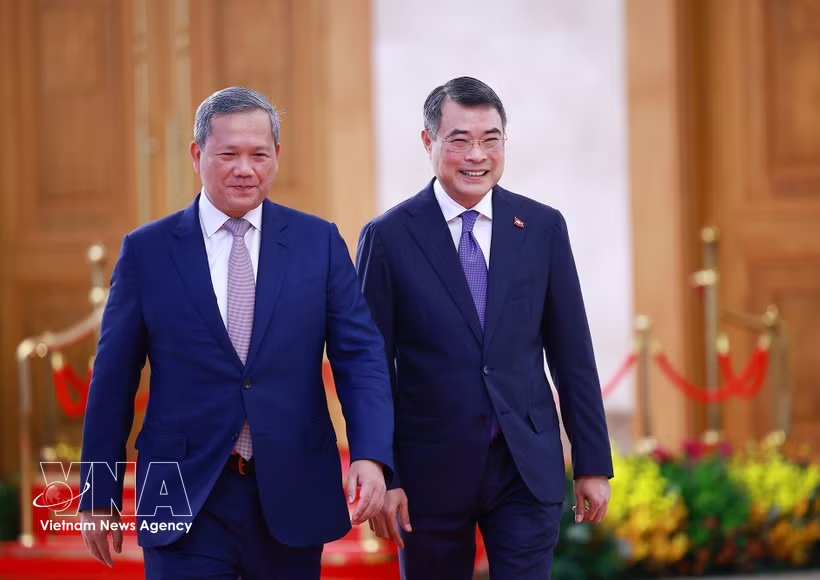
During Cambodian PM Hun Manet’s official visit to Vietnam and attendance at the third ASEAN Future Forum in Hanoi on June 8–9, the two Government leaders discussed orientations to enhance bilateral connectivity, turning “traditional friendship” into a “development driver” and “historical proximity” into “strategic closeness”.
Thong said PM Hung’s upcoming visit will help further nurture the long-standing bilateral relationship and open up a phase of more substantive and effective cooperation, with people’s and businesses’ interests at the centre.
He perceived that economic, trade and investment cooperation will be a key focus of the visit and offers considerable room for breakthroughs.
Bilateral trade reached about 11.33 billion USD in 2025, up 11.7% year on year. In the first eight months of 2026, it stood at 8.67 billion USD, up 8.3% year on year, and is expected to reach 13 billion USD for the full year. The two sides are striving for bilateral trade of 20 billion USD in the coming years.
To achieve the target, Thong identified three priorities.
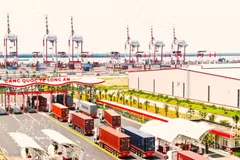
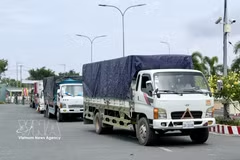
First, the two countries should strengthen transport and logistics connectivity, particularly cross-border routes, border gates and logistics centres. Opening new border gates and upgrading cross-border transport infrastructure will help reduce transport costs and expand development opportunities for businesses.
Second, they should further facilitate border trade. The two countries share a 1,137km border with more than 40 pairs of international, main and auxiliary border gates, while about 70% of bilateral trade is conducted through border areas. It is therefore necessary to accelerate the implementation of the two PMs’ directions on reforming immigration and import-export procedures, expanding electronic customs clearance, and developing warehousing, cold chains, digital payments and border economic cooperation zones.
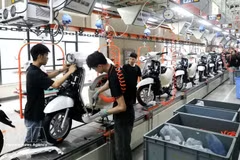
Third, the two sides should strengthen links between production and supply chains, moving beyond trade in goods towards cooperation in production, processing, logistics and distribution to build complementary value chains, according to Thong.
He also highlighted the role of people-to-people diplomacy, describing it as a “soft connecting thread” with enduring vitality.
The official said political ties build trust, economic cooperation creates tangible benefits, while people-to-people exchanges provide a lasting social foundation for bilateral relations.
In 2026, the Vietnam–Cambodia Friendship Association plans to expand exchanges, organise business forums, continue its “Nurturing Friendship” programme, strengthen social welfare activities in border areas and among disadvantaged Vietnamese-origin and Cambodian communities, and promote education on the bilateral friendship, particularly among young people. It also plans to support about 100 Cambodian students in 2026.
Thong called for greater engagement among businesses, intellectuals, artists, social organisations, youth and students, as well as more exchanges among border provinces and greater use of digital platforms to promote Vietnam–Cambodia friendship, especially among younger generations.
He stressed that educating young people about the solidarity and mutual assistance between the two peoples is a strategic long-term task. The “Nurturing Friendship” programme can help Cambodian students better understand Vietnam and eventually become "ambassadors" of the bilateral friendship.
Thong expressed his hope that PM Hung’s visit will provide fresh momentum for more substantive, effective and sustainable bilateral ties, including by expanding trade, investment, infrastructure and logistics connectivity, supply-chain cooperation and people-to-people linkss, thereby helping realise the 20-billion-USD trade target.
He voiced confidence that with the foundation built over generations, the political determination of the two countries’ leaders and contributions from their peoples, the two countries' friendship will remain strong and contribute to peace, stability, cooperation and development in the region./.
VNA