Hanoi (VNA) - Seventy-two years after troops marched into Hanoi to take over the capital, the city has gone from a capital emerging from war to one of Vietnam's main economic hubs.
Hanoi's growth shows up not only in gross regional domestic product (GRDP), state budget revenue and new infrastructure, but in a pivot toward science - technology, innovation and urban quality as growth drivers.
A major economic hub
October 10, 1954 marked a turning point for Hanoi. After years of war, the capital was tasked with restoring production, stabilising lives and laying socio-economic foundations in peacetime.
Starting with limited infrastructure and production capacity, it passed through several growth stages, with the sharpest changes coming during the Doi moi (Renewal) and global economic integration.
The old streets and small workshops of the early post-liberation years gave way to a far larger economic footprint. Industrial parks, new urban areas, malls, banks, services, logistics and transport networks kept expanding, linking Hanoi to the Capital Region, the Red River Delta and the rest of the country.
The city entered 2026 amid global volatility and has kept its momentum, accelerating clearly in the third quarter.
GRDP grew an estimated 10.02% in the third quarter from a year earlier, the first double-digit reading this year and faster than the previous two quarters, according to the Hanoi Statistics Office. Over the first nine months, GRDP expanded an estimated 8.85%, versus 7.92% in the same period of 2025. At current prices, GRDP neared 1.295 quadrillion VND (49.8 billion USD).
The economy retains the profile of a major urban centre. Services made up 67.64% of GRDP, industry and construction 20.60% and agriculture, forestry and fisheries 1.91%. Product taxes less subsidies accounted for the rest.
Services remain the main engine. Added value in the sector rose 9.14% in the first nine months, contributing 6.15 percentage points to overall GRDP growth. Transport and warehousing grew 11.94%, finance, banking and insurance 10.41%, and wholesale and retail 10%.
The figures point to an increasingly modern urban economy in which trade, finance, transport, tourism, technology and quality services are key components.
Investment, infrastructure power growth
Investment is adding momentum. Total development investment neared 451.4 trillion VND in the first nine months, up 19% year on year. Investment from locally managed state budget funds was about 107.8 trillion VND, up 81.2%.
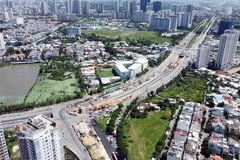
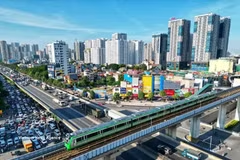
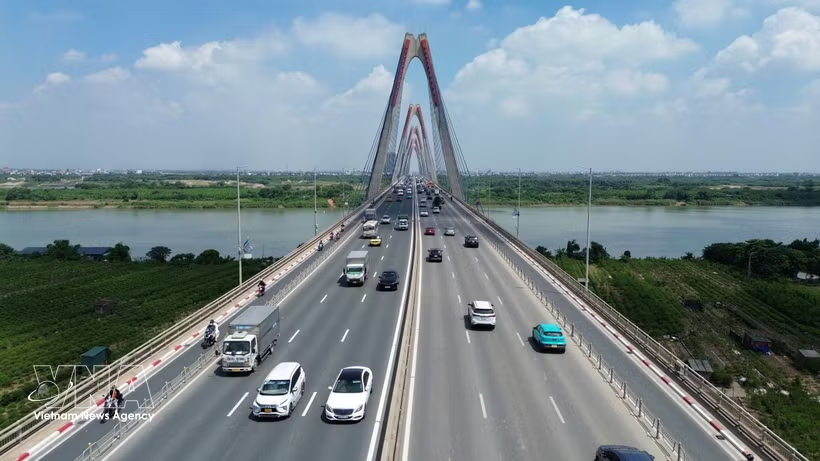
A string of infrastructure projects is being fast-tracked, including ring roads, Red River bridges, urban railways, transport links and flood control works. They address immediate public needs while widening the capital's room to grow. The city has named public investment and construction as direct growth drivers for the final months of 2026.
Hanoi attracted almost 4.067 billion USD in foreign direct investment in the first nine months, up 5.9% year on year. It licensed 500 new projects worth 676 million USD, while 113 projects added 691 million USD in capital. Foreign investors made 281 capital contributions or share purchases in Vietnamese companies, worth about 2.7 billion VND.
About 2.243 billion USD, or 55.2% of the total, went into professional, scientific and technological activities.
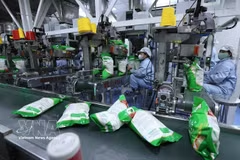
Once focused on restoring factories and industrial facilities after the war, Hanoi is now turning to high technology, semiconductors, digital economy, and research and development.
Exports, budget revenue widen fiscal room
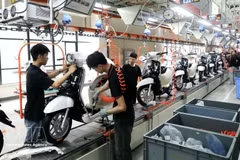
Merchandise exports approached 16.861 billion USD in the first nine months, up 9.3% year on year. Exports by the foreign-invested sector reached 7.742 billion USD, up 17.9%. Computers, electronic products and components brought in about 2.555 billion USD, up 21.7%.
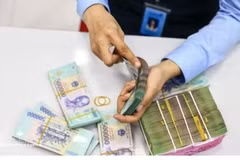
State budget revenue in the period was estimated at 567.597 trillion VND, or 87.3% of the annual estimate, up 5.9% year on year. Domestic revenue topped 528.6 trillion VND.
Strong revenue gives the city more room to reinvest in infrastructure, social welfare, education, healthcare, environment and essential public services.
A capital's economic strength is measured not just by its growth rate but by its ability to generate resources to handle the strains of urbanisation, including traffic congestion, pollution, flooding, housing, schools, hospitals and the quality of public spaces.
Hanoi's next challenge is therefore not just creating more wealth, but turning it into a better quality of life for residents.
Push for green, smart growth
From a capital emerging from war in 1954, Hanoi has become an economic hub with GRDP of nearly 1.3 quadrillion VND in the first nine months of 2026, a trajectory that shows its vitality and capacity for transformation.
After 72 years of development, Hanoi aims not just to grow faster but to grow smarter, more sustainably and more greenly, with science-technology, innovation and workforce as the core drivers of a modern capital in the decades ahead./.