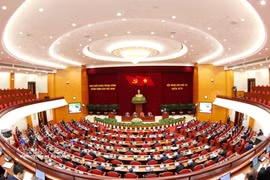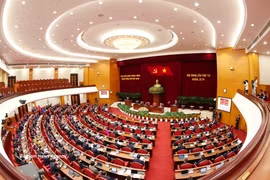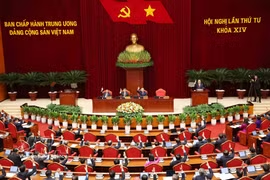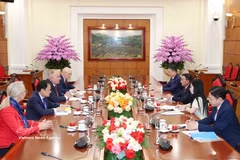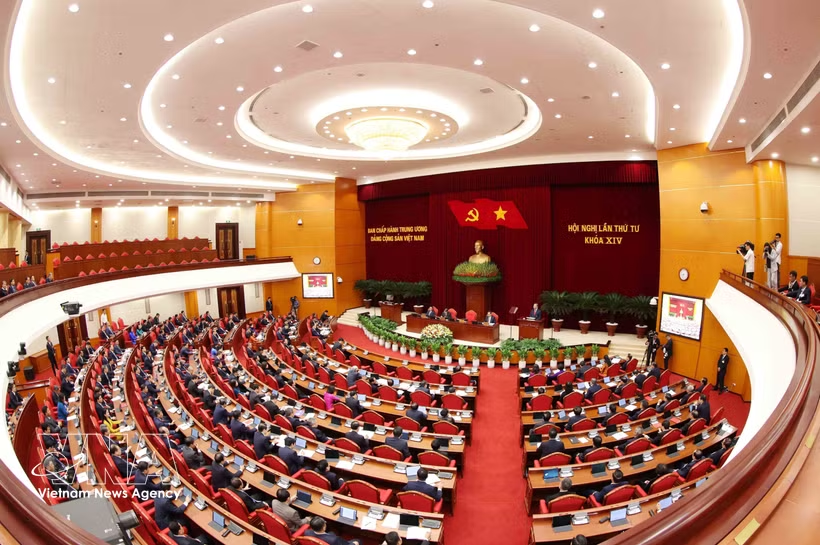
Hanoi (VNA) – Enhancing the Communist Party of Vietnam’s capacity for self-renewal and self-rectification was the first of the four points highlighted by General Secretary of the Party Central Committee and President To Lam in his opening remarks at the fourth meeting of the 14th Party Central Committee on October 5.
Genuine self-renewal and self-rectification are essential to prevent situations in which shortcomings and weaknesses have been identified but remain slow to be addressed, or where procedures are followed correctly but the right people are not selected.
The Party has identified regular self-rectification and self-renewal as a fundamental task as these are decisive to the Party’s and the socialist regime’s survival, helping the Party maintain its leadership and rule under all circumstances.
The Party has been exercising leadership amid a socialist-oriented market economy, deep and extensive international integration and a world undergoing complex and unpredictable changes. Self-renewal helps ensure that its leadership thinking, including economic thinking, working methods and personnel work, keeps pace with new requirements.
As a ruling party, the Party recognises that without continuous self-cultivation, Party officials and members can easily fall into individualism, bureaucracy, corruption and wastefulness, or become detached from their ideals. Self-rectification is a means of keeping the Party clean, encouraging officials and members to examine and correct themselves, preventing manifestations of “self-evolution” and “self-transformation” from within, and safeguarding the Party’s prestige and honour.
For an organisation with millions of members, as for an individual, correcting oneself is much more difficult than correcting others because it requires confronting one’s own ego and deeply ingrained habits.
Psychologically, people tend to defend and justify their own mistakes while readily identifying shortcomings in others.
Changing an outdated habit or altering one’s mindset requires both strict discipline and persistent daily effort, much like “brushing one’s teeth and washing one’s face every day”, rather than relying on sheer willpower or expecting immediate results.
For an individual, “self-examination and self-rectification” means spending time looking back each day at one’s own thoughts, words and actions rather than focusing on the faults of others; having the courage to acknowledge personal weaknesses and mistakes instead of denying them or blaming circumstances; and turning the cultivation of ethics and thinking into a regular habit rather than a short-lived determination to change.
For a large organisation, alongside self-rectification and self-renewal under its internal regulations, the Party also “examines itself through the eyes of the people”. This is both a practical approach and a profound reflection of the close relationship between the Party and the people, affirming that fair and objective public assessment is the clearest mirror for officials and Party members to examine themselves and improve.
The Party has consistently regarded the people as the centre, the key player and the most accurate measure of the effectiveness of the renewal process. It sees its own renewal through public assessment because its policies and reform orientations must not only stem from theoretical thinking but also be tested through real life and reflected in people’s satisfaction. The people are also the force that supervises the exercise of power and the Party’s leadership capacity.
The people are likewise a driving force for self-renewal. Objective and candid feedback from the wider public helps the Party promptly identify inappropriate aspects, correct shortcomings and improve its leadership methods.
The Party “examines itself” through the lens of the people because every action, working method and quality of a Party member is observed and assessed by the people.
The Party relies on the people through the principle of “people know, people discuss, people act, people inspect, people supervise and people benefit.” Public feedback and assessments provide the clearest reflection of shortcomings and mistakes within organisations and among individuals.
When the Party genuinely listens to the people, accepts public oversight and resolutely corrects mistakes, public trust in the Party will be further strengthened.
There are many ways for people to “reflect the image of the Party”, including directly giving feedback to Party committees on personnel work, policies and orientations; making recommendations to Party organisations and authorities; and identifying weaknesses and shortcomings among organisations, officials and Party members, particularly negative practices, corruption, wastefulness and “group interests”.
The people can also participate in the Party building and rectification through activities organised by agencies and sectors, dialogue and citizen-reception mechanisms, complaints, denunciations, as well as legitimate petitions and recommendations, including those concerning the ethics and lifestyles of officials and Party members.
Provincial and municipal Party committees are also responsible for organising direct dialogues between Party committee leaders and the people; handling complaints, denunciations and legitimate aspirations and recommendations; and collecting assessments from residents in the places where officials and Party members live before conducting periodic reviews of Party committees, Party organisations and members.
The people’s self-management groups at grassroots level, people’s inspection boards and community-based supervision groups also provide important channels for public participation in the Party building and rectification. Over the years, the Party and State have adopted numerous policies and measures to further promote the people’s direct and effective participation in this work.
The 15-year process of the Party renewal and rectification, since the fourth plenum of the 11th Party Central Committee to the present, spanning 2012– 2026, has been a strategic, continuous and increasingly resolute process, marking major advances in the thinking, mettle and leadership capacity of the Party.
Across three consecutive Party tenures, the 11th, 12th and 13th, and now the 14th tenure, self-renewal and self-rectification have been expanded comprehensively, moving from addressing urgent issues within the Party to building and rectifying the Party and the political system to make them clean and comprehensively strong in all respects.
Reviewing the 15-year implementation of the resolutions and conclusions on Party renewal and rectification is a key task set for the fourth plenum of the 14th Party Central Committee, aimed at assessing the Party’s leadership capacity and combatant strength in substantive terms.
The review should clarify the extent to which changes in the Party organisation and building have improved leadership quality, the ability to address development challenges and public trust, as well as the areas in which Party organisations and members have become stronger and more mature and those that still require improvement.
General Secretary and President Lam requested the Party Central Committee to look directly at persistent shortcomings in order to enhance its capacity for self-renewal and self-rectification. It must determine why shortcomings remain unresolved, why violations that have been warned against continue to recur, and why some work is carried out in line with procedures but still fails to select the right people or resolve problems effectively.
New resolutions must address the root causes and clearly identify responsibility, including that of central leadership and advisory bodies, he stressed./.
VNA