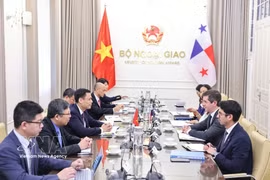
Hanoi (VNA) – The relationship between Vietnam and Panama is built not only through high-level diplomacy and cooperation agreements but also through people-to-people exchanges, cultural experiences and everyday encounters that foster mutual understanding and affinity between the two distant countries.
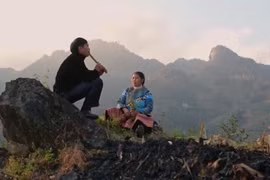
Former Panamanian Ambassador to Vietnam Servio S. Samudio recalled one of his most memorable experiences in Vietnam: hesitating for a moment before taking his first sip of ruou can (Vietnamese rice wine drunk through bamboo straws) in a stilt house in a mountainous area. The local residents sitting around him watched intently, then broke into delighted smiles as the Central American guest overcame his initial hesitation. Without many words, the openness and sincerity of that moment brought the diplomat and the local people closer together, making them feel like old friends.
Talking to Vietnam News Agency correspondents in Mexico, Samudio said some experiences were not part of official work programmes or reports but could help diplomats gain a deeper understanding of the countries to which they are posted.
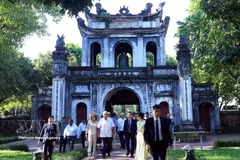
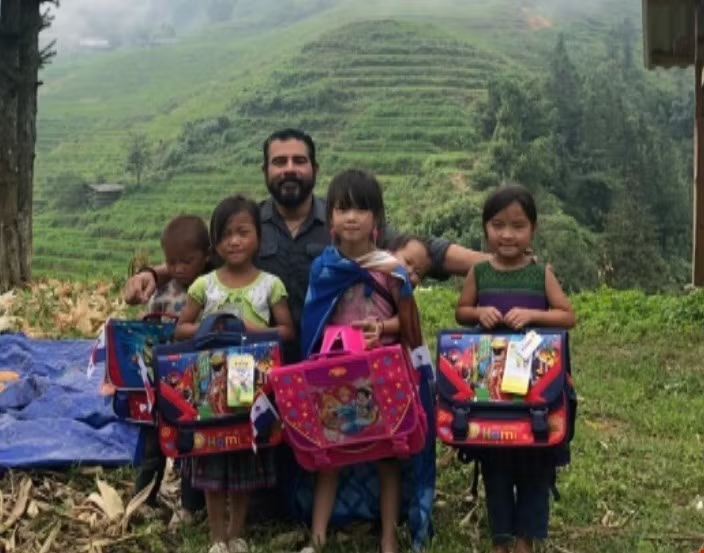
He has traveled to many parts of Vietnam, from Vung Tau to Sa Pa and from Ninh Binh to the northern highlands, meeting mountain children, talking with local people and discovering cultural features that he had previously known only from books.
From these personal experiences, Vietnam-Panama relations can be viewed from a more human perspective: ties between countries are forged not only at negotiating tables but also through encounters between their people, Samudio stressed, noting that this is the strength of people-to-people diplomacy.
He said high-level visits, cooperation agreements and dialogue mechanisms provide a political foundation for bilateral relations, while culture, education, tourism, arts and direct exchanges are needed to deepen mutual understanding in society.
According to Servio, Vietnam and Panama are separated by tens of thousands of kilometres, with differences in geography, history and cultural traditions. Yet such differences can encourage people in each country to learn about and explore the other.
Cuisine is a vivid example, he said, noting that in Panama, Vietnamese dishes have become a natural way of introducing Vietnamese culture, as pho (noodles), nem (spring rolls), bun cha (grilled pork served with rice vermicelli) and cha ca (grilled fish) not only offer diners new flavours but also open up stories about Vietnamese ingredients, customs and way of life.
Likewise, for Vietnamese people, Panama is more than the country associated with its famous canal; it is a multicultural society shaped by diverse communities, with distinctive music, cuisine, festivals and ways of life.
Such everyday connections give bilateral relations a deeper foundation. People begin to know another country not only through general information but through concrete images and personal experiences. Diplomacy then extends beyond State institutions into social life, Samudio said.
More than half a century after establishing diplomatic relations, Vietnam and Panama have expanded cooperation in trade, investment, logistics, maritime affairs, education, tourism and culture.
Panama’s position in Central America and Vietnam’s growing role in Southeast Asia also offer opportunities for cooperation, with Panama serving as a hub for maritime and international trade connectivity and Vietnam becoming an important link in production and supply chains in Asia.
Economic interests can provide strong momentum for bilateral ties, while trust between the two societies can give those links greater depth.
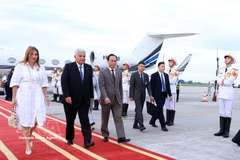
The October 5-8 official visit to Vietnam by Panamanian President José Raúl Mulino and his spouse, Maricel Cohen De Mulino, marks a new milestone in bilateral relations. It is the first visit to Vietnam by a Panamanian President in nearly 15 years, providing an opportunity to advance multi-faceted cooperation.
The visit is expected to create new avenues for collaboration and open more doors for the people of the two countries to meet, for Vietnamese culture to become more familiar to Panamanians, and for Vietnamese people to have more opportunities to discover Panama./.