2026 Annual International Forum on Public Governance opens in Hanoi

Vietnam is reforming its organisational apparatus, operating a two-tier local administration system, promoting decentralisation and delegation of power, and accelerating digital transformation. These are not merely organisational changes, but a systemic transformation requiring comprehensive innovation, from problem identification and policy design to coordination and implementation.

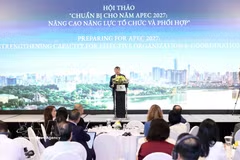
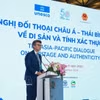
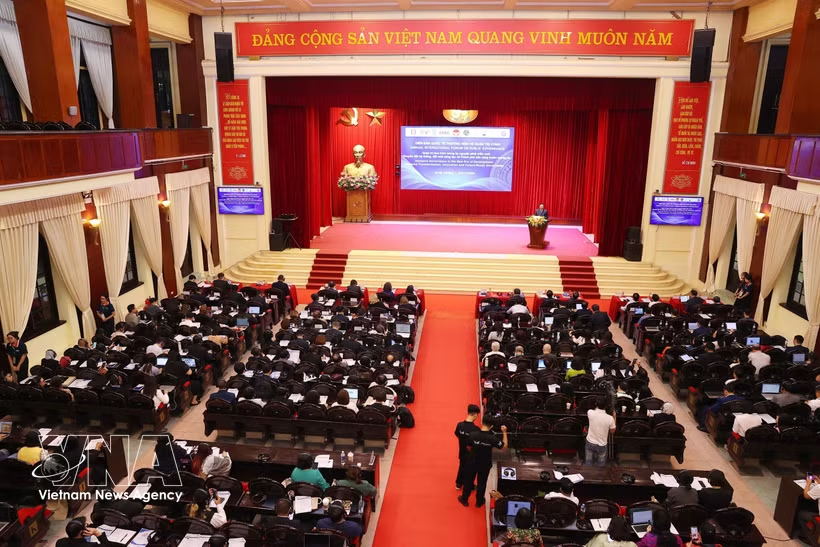
The 2026 Annual International Forum on Public Governance opens in Hanoi on October 5, 2026. (Photo: VNA)

Hanoi (VNA) – The 2026 Annual International Forum on Public Governance opened in Hanoi on October 5 under the theme “Inclusive Governance in the New Era of Development: System Transformation, Innovation, and Future-Ready Government”.

Hosted by the Ho Chi Minh National Academy of Politics (HCMA) and organised by the Academy of Public Administration and Governance, the three-day forum brings together more than 500 delegates, including nearly 300 international participants, ambassadors, representatives of diplomatic missions and international organisations, experts, scholars and authors from more than 20 countries and territories, as well as leaders of central agencies, local administrations, academies, universities, research institutes and businesses in Vietnam.

In his opening remarks, Associate Professor Dr. Nguyen Manh Hung, HCMA Vice President and Vice Chairman of the Central Council for Theoretical Studies, said Vietnam is reforming its organisational apparatus, operating a two-tier local administration system, promoting decentralisation and delegation of power, and accelerating digital transformation.

He stressed that these are not merely organisational changes, but a systemic transformation requiring comprehensive innovation, from problem identification and policy design to coordination and implementation. It also calls for stronger links among the State, the market and society, with shared responsibilities and common development goals.

Hung said a government's capacity is demonstrated not only by its ability to address today's problems, but also by its ability to spot changes early, prepare for future challenges, and seize emerging opportunities.

He called for anticipatory governance that identifies changes and prepares early, while paying attention to “weak signals” - subtle signs that may foreshadow major changes, regularly reviewing familiar assumptions, developing multiple scenarios and testing policy resilience under different circumstances.

According to Hung, the more a country reforms, the more firmly it must uphold inclusiveness. People should not only use public services, but also participate in policy formulation, implementation and oversight. A future-ready government must help people prepare for the future through education, retraining and adaptive social protection.

Associate Professor Dr. Nguyen Ba Chien, President of the Academy of Public Administration and Governance, said inclusive governance puts people and society at the centre of development, adding that changes in organisational structures, authority, procedures, and technology matter only when they improve the ability to address practical issues.

As the new organisational apparatus, two-tier local administration, decentralisation and delegation of power, and digital transformation become operational, attention should be paid to matching authority with the conditions to exercise it, clearly defining responsibilities, ensuring seamless coordination, handling emerging issues promptly and improving services for people and businesses.

According to Chien, governance capacity today is fundamentally the capacity to solve problems amid constant change. Public issues are becoming more complex, cross-sectoral and multi-level, while evolving under the impact of technology, climate change, economic models, employment trends and emerging risks. This requires the ability to identify problems, use data and evidence, coordinate action and make timely adjustments.

Beyond compliance with laws, authorities and procedures, governance quality must be reflected in practical outcomes: problems are resolved, service quality improves, social costs decline, and development opportunities expand.

Professor Dr. Nguyen Xuan Thang, Chairman of the Central Council for Theoretical Studies, said that in an increasingly complex and interconnected economy, the State needs to strengthen its capacity to set priorities, promote coordination across sectors, address emerging issues and adjust policies based on practical experience.

Reforming national governance must help translate strategic choices into development outcomes and build the national capabilities needed to achieve the country's 2045 development goals, he said.

Thang highlighted four strategic orientations for Vietnam's national governance reform in the new development era. They are strengthening the State's capacity to enable development, building high-quality institutions, strengthening strategic learning capacity and national self-reliance, and developing people and social capacity as the long-term foundation of national strength.
vnanet-un-resident-coordinator-in-vietnam-pauline-tamesis.jpg
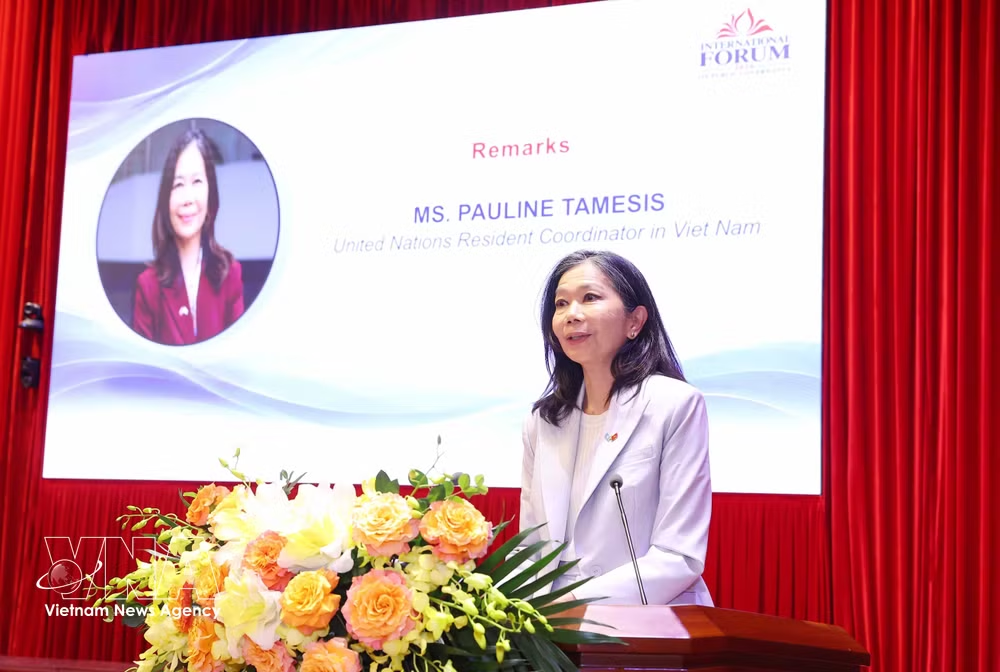
UN Resident Coordinator in Vietnam Pauline Tamesis addresses the 2026 Annual International Forum on Public Governance. (Photo: VNA)

UN Resident Coordinator in Vietnam Pauline Tamesis said the future of public governance would not be shaped solely by the technologies being adopted, but also by the human values guiding their use.

If institutional transformation is grounded in fairness, transparency and a commitment to protecting human rights, countries can build governments capable of keeping pace with change while proactively shaping a fairer and more resilient future, she said.

At the forum, delegates focused on key questions including how to integrate forecasting and scenario planning into government operations, what mechanisms can enable the system to learn and innovate while maintaining discipline and accountability, and how each country's adaptive capacity can strengthen the world's collective ability to respond to challenges./.
VNA

See more

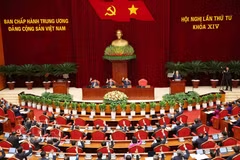
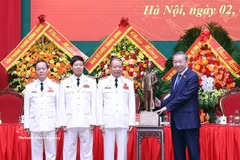
The opening of the 14th CPV Central Committee's fourth plenum on October 5, 2026 (Photo: VNA)

First working day of Party Central Committee's fourth plenum

Delegates held group discussions on the CPV Central Committee resolution calling for stronger building and rectification towards a clean, strong and comprehensive Party and political system able to meet the country's development needs in the new era.

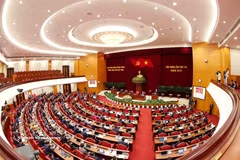
The opening session of the fourth plenum of the 14th Party Central Committee on October 5, 2026 (Photo: VNA)

14th Party Central Committee convenes fourth plenum

General Secretary and President To Lam said that the fourth plenum must focus on creating conditions for effective implementation while preparing the theoretical, organisational and human resources foundations for the country’s long-term development.

The Ministry of Foreign Affairs hosts a workshop titled “Preparing for APEC Year 2027: Strengthening capacity for effective organisation and coordination” on October 1 (Photo: VNA)

Vietnam advances comprehensive international integration

Recent activities in external relations and international cooperation across politics, economy, defence, security and culture demonstrate concrete steps to realise this approach, increasingly linking international integration with national construction, development and defence.

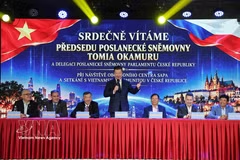
President of the Chamber of Deputies of the Czech Republic Tomio Okamura (standing) in the meeting with representatives of the Vietnamese community, businesses and traders. (Photo: VNA)

Czech lower house speaker visits Vietnamese community in Prague

President of the Chamber of Deputies Okamura praised the community’s integration and contributions to Czech society, noting that its hard work, strong work ethic, emphasis on education and responsibility to family have helped it establish a positive standing in the country.

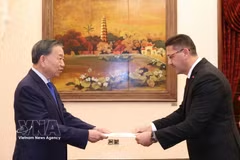
General Secretary of the Communist Party of Vietnam Central Committee and President To Lam (L) receives Palestinian Ambassador Shadi Abu Zarqa in Hanoi on October 3. (Photo; VNA)

General Secretary and President To Lam receives newly accredited ambassadors

Welcoming the ambassadors, General Secretary of the Communist Party of Vietnam Central Committee and President To Lam highlighted their important role in effectively implementing agreements and commitments between Vietnam and their respective countries, helping further deepen bilateral ties in a faster and more substantive manner for the mutual benefit of each country.

Illustrative photo of pangasius fillets, a Vietnamese export to Canada. (Photo: VNA)

Vietnam, Canada unlock new cooperation opportunities

Vietnam has become an increasingly important partner for Canada, not only as a major trading and manufacturing economy in Southeast Asia but also as an active ASEAN member and Chair of the CPTPP Commission in 2026.

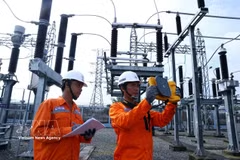
Can Giuoc Power Company (PC Tay Ninh) workers inspect the electrical system at the Can Giuoc 110kV substation. (Photo: VNA)

Measures to be taken to remove barriers for power investment

The Ministry of Industry and Trade plans to submit a revised Law on Electricity to the National Assembly at its October session, aiming to remove investment barriers and facilitate mobilisation of resources for power generation and grid development, said Deputy Minister Truong Thanh Hoai.

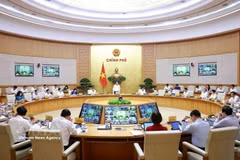
An overview of the meeting (Photo: VNA)

Localities committed to achieving 2026 growth targets

Localities nationwide hailed effective and flexible directions delivered by the Government so far this year, resulting in positive nine-month socio-economic growth, and reaffirmed their commitment to achieving targets set for the whole 2026 at an online Government-locality conference on October 3.

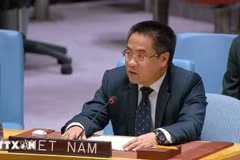
Minister-Counsellor Nguyen Hai Luu, Deputy Permanent Representative of Vietnam to the UN (File photo. Source: VNA)

Vietnam reaffirms support for self-determination, decolonisation process

Vietnam consistently supports the universal objectives of the decolonisation process and the inalienable right to self-determination of the people of the 17 Non-Self-Governing Territories, in line with the UN Charter, General Assembly Resolution 1514 (XV) and other relevant resolutions.

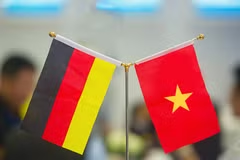
Illustrative Image

Vietnam congratulates Germany on Unity Day

General Secretary of the Communist Party of Vietnam Central Committee and President To Lam on October 3 sent a congratulatory message to German President Frank-Walter Steinmeier on the occasion of the 36th anniversary of the Day of German Unity (October 3, 1990-2026).

Prime Minister Le Minh Hung speaks at the meeting (Photo: VNA)

PM urges high determination, clear roadmaps to achieve 2026 targets

Looking ahead to the final three months of the year, the Prime Minister asked ministries, sectors and localities to conduct specific assessments of the situation, clearly identify remaining difficulties and bottlenecks, and propose concrete and feasible solutions.

General Secretary of the Communist Party of Vietnam Central Committee and President To Lam (right) speaks at a Vietnam-Canada high-level business roundtable in Ottawa on September 25 (Photo: VNA)

Creating new drivers for Vietnam-Canada cooperation

The elevation of bilateral ties to a Strategic Partnership shows that Vietnam and Canada increasingly view each other not simply as trading partners, but as long-term partners in addressing economic, technological and regional challenges.