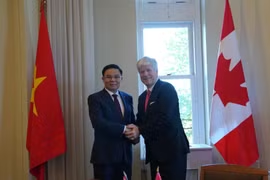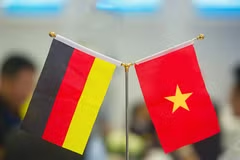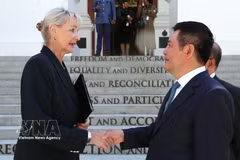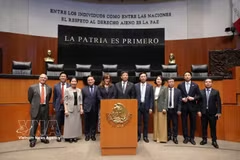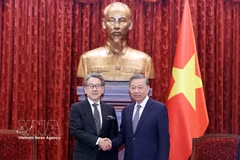
Ottawa (VNA) –Vietnam and Canada are entering a broader phase of strategic cooperation, with their newly established Strategic Partnership opening opportunities beyond trade and people-to-people exchanges to supply chains, advanced technologies, energy security, defence and maritime security.
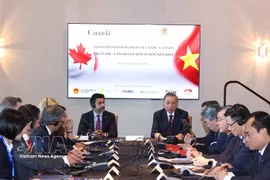
The assessment was made by Vina Nadjibulla, Co-Founder and CEO of the Centre for Strategic Statecraft (CSS), in an interview with Vietnam News Agency (VNA) correspondents in Canada following the State visit to Canada by General Secretary of the Communist Party of Vietnam Central Committee and President To Lam.
She said one of the visit’s key outcomes was the initial institutionalisation of the new partnership framework. The two sides agreed to step up regular high-level contacts, including foreign ministerial dialogue, while strengthening existing mechanisms such as the Joint Economic Committee, Defence Policy Dialogue and Maritime Dialogue.
They also established an Agriculture Dialogue and agreed to discuss the establishment of a new Security and Law Enforcement Dialogue mechanism.
The foreign ministers of the two countries were tasked with developing an Action Plan to implement the Strategic Partnership. Nadjibulla said the plan would be crucial to translating high-level political commitments into concrete cooperation programmes and should be completed in a timely manner.
The visit also delivered tangible outcomes in energy and clean energy transition, maritime transport, environmental protection and agricultural standards. Expanded air transport agreements could pave the way for direct passenger and cargo services between the two countries.
Vietnam also decided to establish a Defence Attaché Office in Canada.
According to Nadjibulla, these developments demonstrate a shift in Vietnam-Canada relations from a broad cooperation framework centred largely on trade towards a more strategic partnership. The two countries share an interest in maintaining an open and rules-based trading system at a time when the system is facing increasing pressure. Both economies are deeply integrated into global trade and rely substantially on external markets, giving them a common interest in reducing the risks of economic interdependence being used as a tool of pressure.
Vietnam has become an increasingly important partner for Canada, not only as a major trading and manufacturing economy in Southeast Asia but also as an active ASEAN member and Chair of the CPTPP Commission in 2026.
Vietnam has a strong interest in maintaining an open and stable trading environment while preserving room for cooperation with diverse partners. Canada, meanwhile, brings complementary strengths and networks, particularly in Europe and the Indo-Pacific, as well as expertise and resources in energy, critical minerals, finance and advanced technologies.
Nadjibulla pointed out that Vietnam and Canada have different geopolitical positions, political systems and international relationships. However, cooperation between middle powers does not require identical positions on every issue, she said.
Instead, the partnership can be built around converging interests, including maintaining rules-based trade, diversifying economic relations, strengthening supply-chain resilience, upholding international law and supporting multilateral institutions.
Vietnam is more than an important bilateral market for Canada, according to Nadjibulla. It is also part of a broader network of countries that share an interest in ensuring that the Indo-Pacific is not shaped solely by great-power competition.
Closer Vietnam-Canada cooperation could therefore help both countries diversify their options while preserving space for rules, openness and strategic autonomy in an increasingly competitive international environment.
Looking ahead, Nadjibulla identified three areas for the realisation of the Strategic Partnership.
Investment and supply chains are the first priority. While bilateral economic ties have grown significantly through trade, the next phase will depend increasingly on two-way investment and deeper participation by Canadian companies in Vietnam’s production and supply-chain networks.
The Joint Economic Committee could play a central role in identifying specific projects, removing barriers and matching Canadian strengths with Vietnam’s development needs, she said.
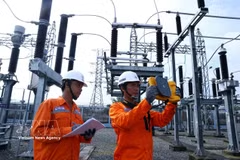
Energy is another area where the visit produced notable results. A new memorandum of understanding covers LNG, hydrogen, renewable energy, carbon management and technologies supporting the energy transition.
The two sides are also discussing potential cooperation in civil nuclear energy. If these commitments are translated into concrete commercial projects, energy could become a major source of substantive economic cooperation under the Strategic Partnership.
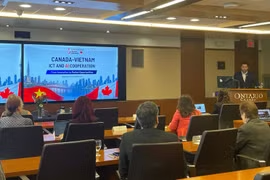
Technology and innovation represent a third priority. Cooperation in artificial intelligence (AI), quantum technology, semiconductors, cybersecurity and digital governance has been outlined at an ambitious level, but the number of concrete bilateral projects remains relatively limited.
Nadjibulla said stronger links among universities, research institutions and businesses, together with talent exchanges and innovation partnerships, would be needed to turn these priorities into practical outcomes.
Ultimately, she said, the key test of the Strategic Partnership will be whether the commitments made during the visit can be translated into regular programmes, concrete projects and durable cooperation mechanisms between Vietnam and Canada./.