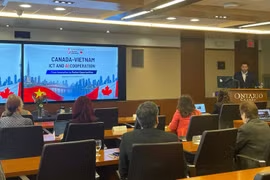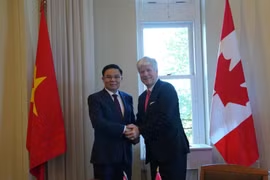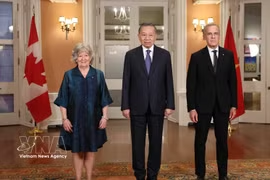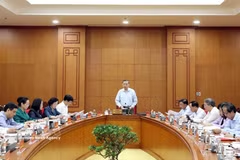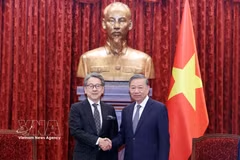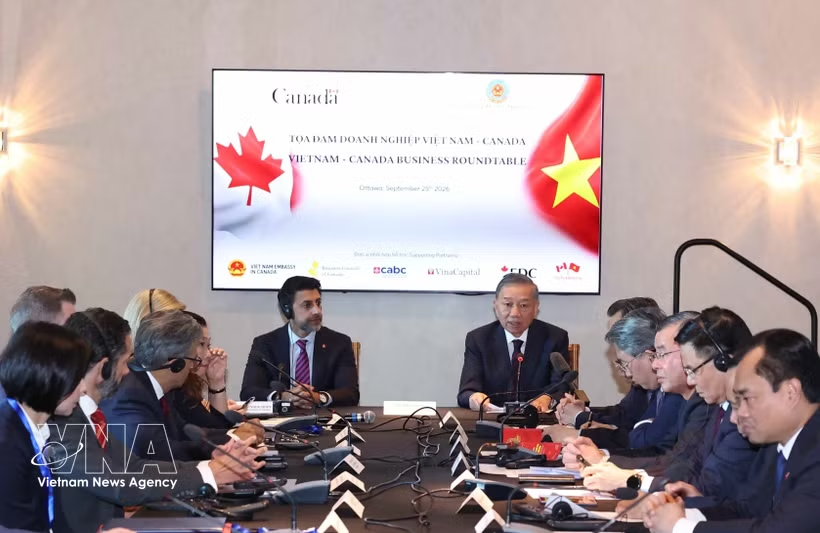
Ottawa (VNA) – During his recent state visit to Canada, General Secretary of the Communist Party of Vietnam Central Committee and President To Lam established a comprehensive framework for long-term cooperation based on major pillars, as noted by former Canadian parliamentarian Bryon Wilfert.
The pillars are trade and investment, transport and supply chains, digital technology and artificial intelligence, energy and food security, defence and maritime cooperation, education, and people-to-people exchanges.
In an interview with Vietnam News Agency correspondents in Canada on the outcomes of the visit, Wilfert said it was the first official visit by a Vietnamese Party chief to Canada since the two countries established diplomatic relations in 1973, giving it both historical and strategic significance.
According to Wilfert, the elevation of bilateral ties to a Strategic Partnership shows that Vietnam and Canada increasingly view each other not simply as trading partners, but as long-term partners in addressing economic, technological and regional challenges.
The agreements reached during the visit added real substance to the new framework. Both sides signed or renewed four memoranda of understanding covering energy, maritime transport, environmental cooperation, and food safety. Another highlight was the expansion of the Vietnam-Canada Air Transport Agreement, making it easier to operate direct passenger and cargo flights.
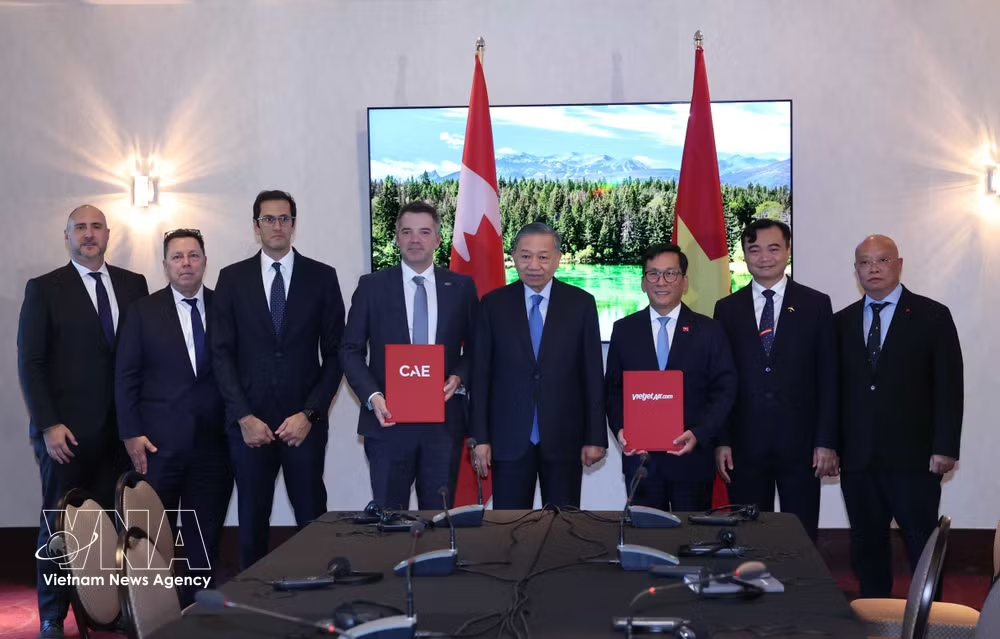
Wilfert said the visit marked a shift from a solid bilateral relationship towards a more ambitious strategic partnership. The key task now is to translate political goodwill into measurable results for both countries.
He noted that the economic foundation for this development is already strong. Vietnam is currently Canada’s largest merchandise trading partner in ASEAN, while bilateral merchandise trade has doubled over the past five years.
Placing Vietnam-Canada relations in a broader context, Wilfert said the Strategic Partnership comes at a particularly important time, as geopolitical uncertainty, shifts in trade flows and the need to strengthen supply-chain resilience are prompting countries such as Canada to diversify their economic and strategic relations.
Against this backdrop, Vietnam is playing an increasingly important role in Canada’s engagement with the Indo-Pacific. Vietnam is a member of ASEAN, the Asia-Pacific Economic Cooperation (APEC) and the Comprehensive and Progressive Agreement for Trans-Pacific Partnership (CPTPP), while also serving as an important link in regional production and supply chains. Canada, meanwhile, has complementary strengths in energy, critical minerals, agriculture, aerospace, artificial intelligence (AI), education, clean technology and financial services.
Wilfert said Canada increasingly needs to view Vietnam not only as an export market, but also as a strategic partner and an important bridge to strengthen its ties with ASEAN and Southeast Asia. For Vietnam, Canada can provide important economic ties in North America, together with access to Canadian expertise, technology, investment, energy and resources.
As countries with strong interests in international trade and multilateral cooperation, both Vietnam and Canada can promote cooperation in areas of shared interest, including trade, energy and food security, maritime cooperation, peacekeeping, climate change and emerging technologies.
Looking ahead, the former Canadian parliamentarian stressed that the post-visit period should focus strongly on implementing commitments, particularly in trade and investment. The two governments should make better use of the CPTPP and the Vietnam-Canada Joint Economic Committee to identify and remove barriers to trade and investment, while continuing to advance negotiations towards a Canada-ASEAN free trade agreement.
Technology and innovation could also become a major area of cooperation. Canada has strengths in AI, quantum technology and advanced research, while Vietnam has a rapidly developing digital economy and manufacturing sector. Wilfert said universities, research institutes and businesses in the two countries should be encouraged to build partnerships in AI, semiconductors, cybersecurity and other advanced technologies.
Energy is another area with significant potential. A new energy cooperation memorandum identifies liquefied natural gas (LNG), hydrogen, renewable energy and technologies supporting the energy transition as areas for cooperation, while the two countries have also agreed to continue discussions on potential cooperation in civil nuclear energy.
The two sides should also identify complementary industries to build diversified and reliable supply chains, including aerospace, agri-food, semiconductors, technology and critical minerals.
Wilfert placed particular emphasis on connectivity. The expanded Air Transport Agreement allows each country to operate up to 14 combined passenger flights and seven cargo flights per week. Direct air links will not only promote tourism and people-to-people exchanges, but also support investment and trade.
The visit has given substantial momentum to bilateral relations. Vietnam and Canada now have an opportunity to build a partnership that contributes not only to the prosperity of both countries but also to greater economic resilience and stability in the Indo-Pacific region, he concluded./.