Ottawa (VNA) - The upgrading of relations between Vietnam and Canada to a Strategic Parnership not only broadens the framework for cooperation but also creates conditions for Vietnam to engage more deeply in Canada’s efforts to strengthen its links with the Indo-Pacific, insiders have said.
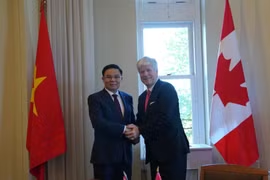
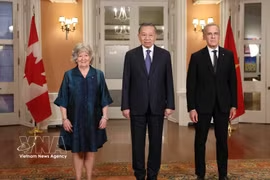
Former Canadian member of parliament Bryon Wilfert said the state visit by General Secretary of the Communist Party of Vietnam Central Committee and President To Lam offers Canada an opportunity to elevate its relationship with one of the Indo-Pacific’s most important emerging economic and strategic partners. In an article published on the Asia Pacific Foundation of Canada website, Wilfert said Canada should seize the “Vietnam opportunity” as it seeks to enhance its presence in the region.
The economic basis for this shift is becoming increasingly clear. Vietnam is currently Canada’s largest merchandise trading partner in ASEAN. According to Canadian media, two-way merchandise trade reached 20.6 billion CAD (over 14.5 billion USD) in 2025, with Canadian exports to Vietnam exceeding 1.3 billion CAD, up 30% year-on-year. Data from Global Affairs Canada also showed that Canada’s imports from Vietnam rose 31% in 2025 to 19.3 billion CAD, making Vietnam Canada’s third-largest source of imports in the entire Indo-Pacific region, after China and Japan.
Another advantage is that the two countries are both members of the Comprehensive and Progressive Agreement for Trans-Pacific Partnership (CPTPP). Canada welcomed Vietnam’s role as Chair of CPTPP Commission in 2026, while the two sides are working to advance negotiations for a Canada-ASEAN free trade agreement. According to Canadian estimates, once implemented, the agreement could add nearly 2 billion CAD to Canada’s GDP and create nearly 14,000 jobs.
Notably, Vietnam’s role extends beyond bilateral trade. The joint statement highlighted coordination between Canada’s Indo-Pacific Strategy and the ASEAN Outlook on the Indo-Pacific, while reaffirming ASEAN centrality. Canada also pledged to coordinate with Vietnam as the latter hosts Asia-Pacific Economic Cooperation (APEC) Economic Leaders’ Week in 2027 and assumes the ASEAN Chair in 2030, while Vietnam welcomed Canada’s hosting of APEC in 2029.
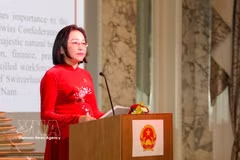
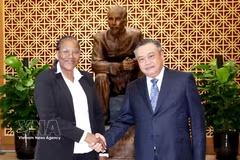
Talking to a Vietnam News Agency (VNA) correspondent in Ottawa, Vina Nadjibulla, Co-founder and CEO of the Centre for Strategic Statescraft (CSS), said there is considerable room for the two countries to cooperate through the CPTPP and Canada’s Indo-Pacific Strategy, as well as in climate action, clean energy, semiconductor supply chains and artificial intelligence governance. She stressed that in an increasingly fragmented world, countries such as Canada and Vietnam have a shared interest in strengthening coordination and safeguarding the rules-based multilateral system.
One emerging area of cooperation following the upgrade of bilateral ties is the development of more resilient and diversified supply chains. The two countries have agreed to promote maritime and air connectivity, reduce market-access barriers and ensure supply-chain continuity. Canada views the expansion of the Vietnam-Canada Air Transport Agreement, allowing direct passenger and cargo flights between the two countries, as a step toward boosting trade, investment and people-to-people links.
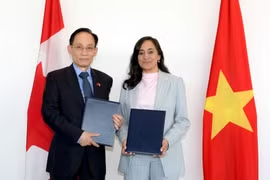
Energy could also become a new pillar of cooperation. Canada is seeking additional markets for its resources and energy products in Asia, while Vietnam faces growing demand for energy security to support economic growth. The two countries have signed a memorandum of understanding on energy and clean energy transition cooperation, expanding opportunities in LNG, hydrogen, renewable energy, carbon management and the exploration of potential cooperation in nuclear power.
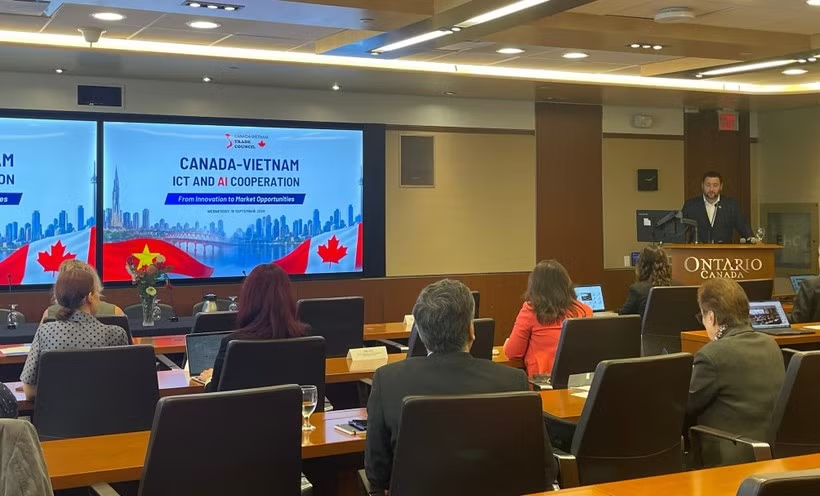
Science, technology and innovation represent another promising area. Assoc. Prof. Vu Viet Hung, Chairman of the Canadian Vietnamese Scientists and Experts Association (CVSEA), highlighted the potential to connect Canada’s strengths in research, technology and innovation ecosystems with Vietnam’s emerging development needs. This direction has been institutionalised under the Strategic Partnership, with specific areas including artificial intelligence, quantum technology, semiconductors, STEM, and cooperation among universities, research institutes and businesses./.