NA, Government’s Party committees meet on legislature’s second session agenda

National Assembly President Tran Thanh Man coordination must go beyond finishing the agenda to improve the quality of NA decisions and Government enforcement; deal with policies rather than just paperwork, especially in the fight against corruption and other negative phenomena; and pin down final responsibility for each product, not just progress.

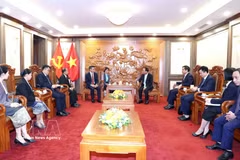
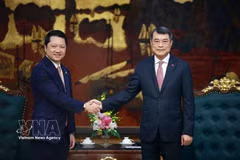
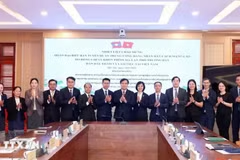
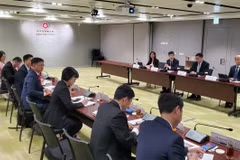
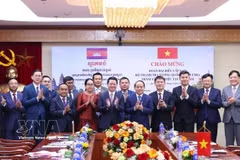
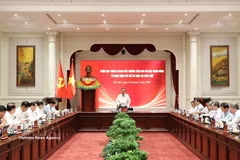
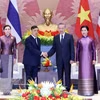
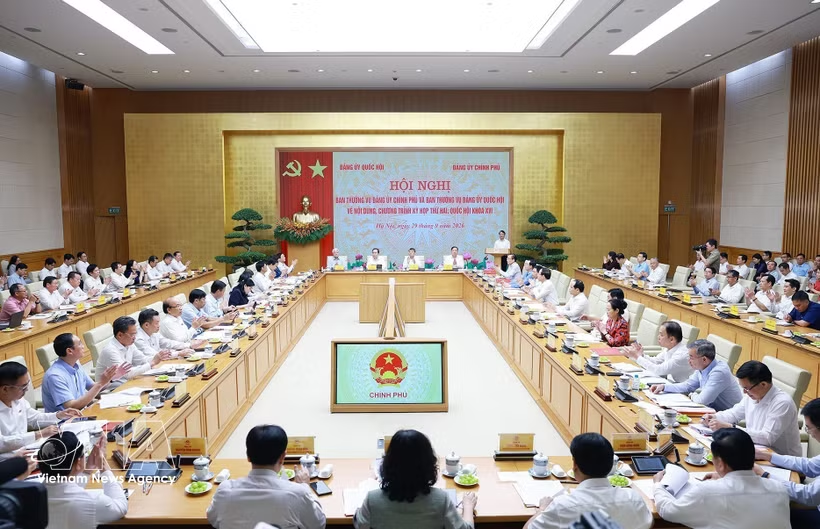
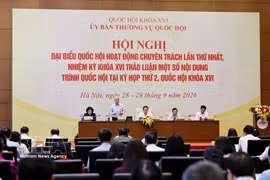
At a meeting between the standing boards of the Government and NA’s Party committees (Photo: VNA)

Hanoi (VNA) - Prime Minister Le Minh Hung and National Assembly President Tran Thanh Man co-chaired a meeting between the standing boards of the Government and NA’s Party committees in Hanoi on September 29 to set agenda for the 16th NA’s second session.

The Government plans to submit 95 documents, submissions and reports to the session.

In his speech, NA President Man asked both sides to identify draft laws and resolutions that can be fast-tracked within a single session, and those that need adoption across multiple sessions.
vnanet-c.jpg
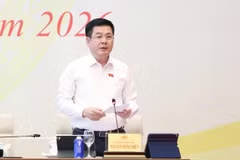
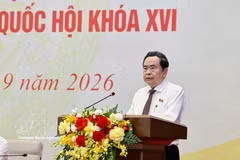
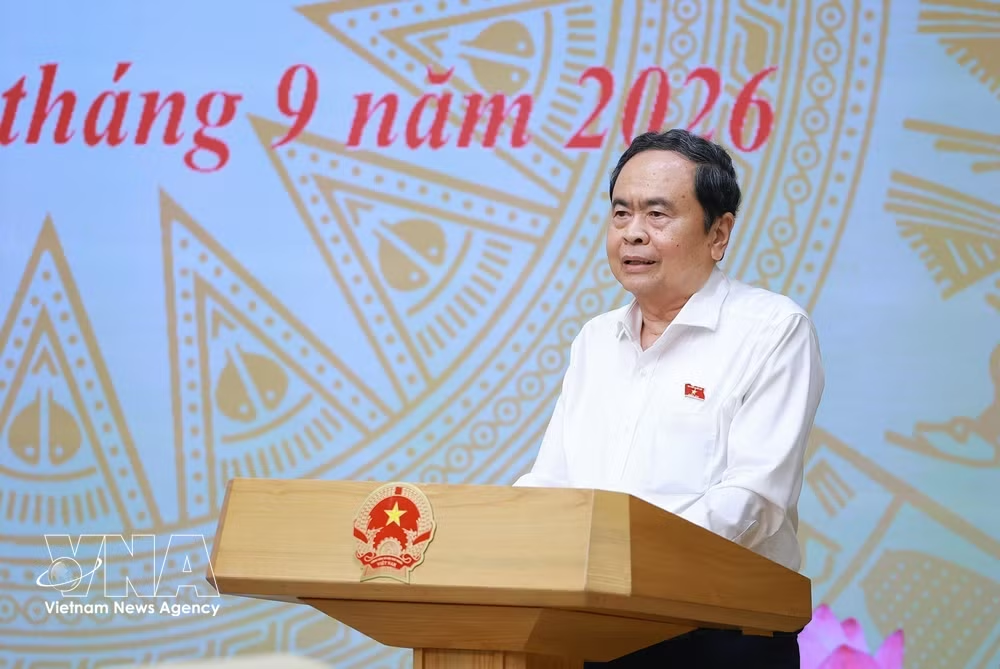
NA President Tran Thanh Man speaks at the meeting (Photo: VNA)

He said the approach should be urgent and proactive but not subjective. Coordination, he said, must go beyond finishing the agenda to improve the quality of NA decisions and Government enforcement; deal with policies rather than just paperwork, especially in the fight against corruption and other negative phenomena; and pin down final responsibility for each product, not just progress.

The top legislator called for a sharp shift from procedural coordination to working together on policy from the outset. Quality must take priority over speed and be built in from the start, work must not be left to pile up at the end of the session, and enforcement must be treated as part of legislative quality from the preparation stage.

The Government must bear the highest responsibility for the quality of policies it submits. The NA agencies, Ethnic Council and committees must be responsible for the quality of appraisal, and the NA Standing Committee for preparing matters for the NA to decide. All three, he said, must converge on final decisions that are correct, feasible and create development value.

He hoped that the meeting will lift coordination between the two Party committees to a new level, moving from handling tasks to steering the overall pace of lawmaking at the second session and laying the groundwork for later ones. Both sides, he said, must share responsibility before the Party, NA and people for the policy quality.
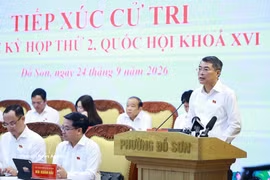
vnanet-l.jpg
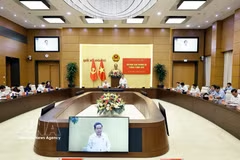
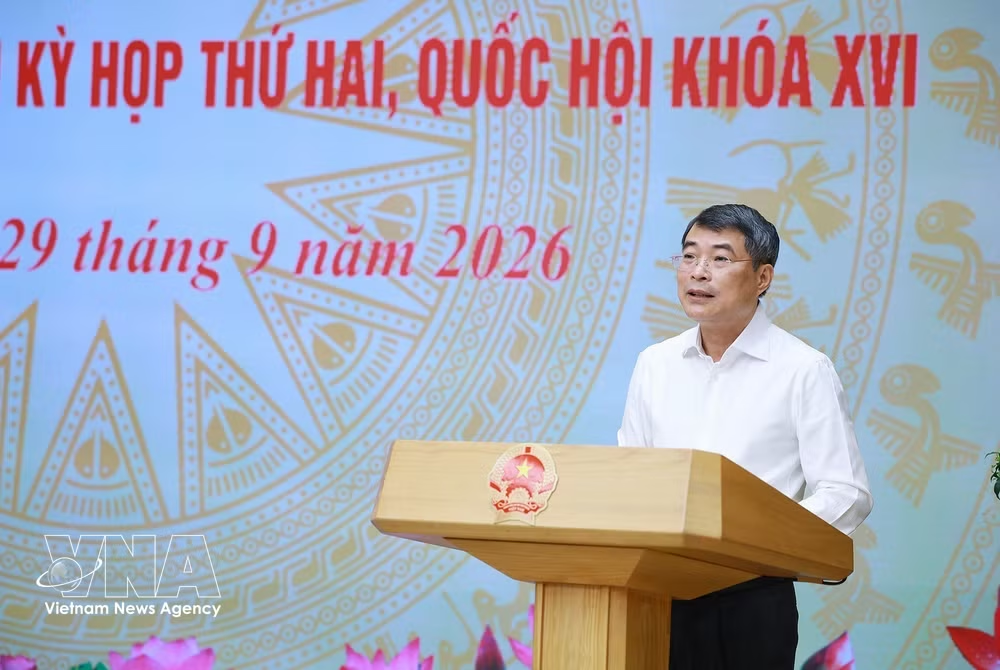
Prime Minister Le Minh Hung speaks at the meeting (Photo: VNA)

PM Hung asked ministers and sector heads to treat preparation for the session as a key political task and take the highest responsibility for directing it. He urged them to keep document preparation on schedule, work closely with NA agencies to revise draft laws, resolutions and reports so that submissions are high-quality and consistent, and prepare detailing regulations to take effect at the same time as the laws and resolutions. They should also attend all meetings, engage with and provide information on issues of concern to deputies and the public in their fields, and promptly report unresolved matters beyond their authority.

He said he has ordered Government agencies to strictly follow Party rules on controlling power in lawmaking and keep sectoral or group interests from dominating legal documents. He asked the Minister of Public Security and the Government Inspector General to instruct advisory units to flag bottlenecks, gaps or loopholes they find in drafts and regulations, and advise the NA and Government promptly and proactively as bills and resolutions are reviewed and finalised./.
​

VNA

See more

Prime Minister Le Minh Hung (R) and Cambodian Minister of Inspection Sok Soken in Hanoi on September 29. (Photo: VNA)

Prime Minister receives Cambodian Minister of Inspection

Prime Minister Le Minh Hung asked the two countries' inspection agencies to build on their achievements by regularly exchanging information and experience, maintaining delegation exchanges, and coordinating inspections in areas related to bilateral economic, trade and investment cooperation.

☕ Afternoon briefing on September 29

☕ Afternoon briefing on September 29

A groundbreaking ceremony for a project on the conservation, restoration and rehabilitation of Kinh Thien Palace; Standard Chartered's upgrade of Vietnam's growth forecast for Q3, and the gold medal in the women’s sepak takraw doubles final at ASIAD 2026 are among news highlights on September 29.

Vietnamese and Lao officials at the event (Photo: VNA)

Vietnam, Laos promote cooperation in personnel training for communications, ideological work

Vietnam and Laos should strengthen experience sharing in political, ideological and ethical affairs, theoretical research, practical reviews, public opinion orientation and protection of the Party’s ideological foundation, while paying greater attention to emerging issues related to digital transformation and the application of science and technology in communications and ideological work

☀️ Morning digest on September 29

☀️ Morning digest on September 29

A meeting exploring ways science and technology, innovation and digital transformation can contribute more to socio-economic growth; the opening of the Asia-Pacific Dialogue on Heritage and Authenticity; and Vietnam winning a bronze medal in the men's sepak takraw at ASIAD 2026 are among news highlights on September 28 evening.

Officials at the talks between the Government Inspectorate of Vietnam and the Cambodian Ministry of Inspection in Hanoi on September 28, 2026 (Photo: VNA)

Vietnamese, Cambodian inspectors reinforce collaboration

The Government Inspectorate of Vietnam broadly accepted the Cambodian ministry's proposals to maintain, renew and make more effective regular meetings between professional units and training establishments, and increase exchanges of senior, expert and specialised working-group delegations.

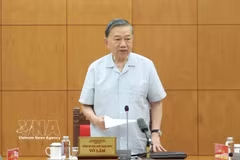
General Secretary of the Communist Party of Vietnam Central Committee and President To Lam speaks at the September meeting of the Standing Board of the central steering committee on institution improvement and law enforcement on September 28. (Photo: VNA)

Urgent action needed to address law enforcement as weak link: Top leader

Chairing the September meeting of the Standing Board of the central steering committee on institution improvement and law enforcement, which also saw the attendance of Politburo members: Prime Minister Le Minh Hung and Standing Member of the Party Central Committee’s Secretariat Tran Cam Tu, General Secretary and President Lam said the effectiveness of lawmaking and enforcement should be measured by the removal of bottlenecks, lower compliance costs, better mobilisation of resources, stronger discipline and the effective protection of the legitimate rights and interests of people and businesses.

National Assembly (NA) President Tran Thanh Man speaks at the first conference of full-time deputies of the 16th-tenure NA. (Photo: VNA)

Top legislator stresses importance of sound policies, robust regulations, consistent legal system, smooth enforcement

National Assembly (NA) President Tran Thanh Man noted that the 16th-tenure NA has handled a substantial legislative workload from the beginning of its term, with about 45 draft laws and resolutions expected to be considered at the second session. Many have a broad scope and directly affect the State apparatus, the investment and business environment, and the rights and interests of people and enterprises.

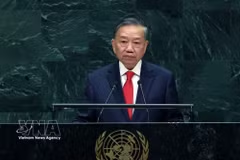
General Secretary of the Communist Party of Vietnam Central Committee and President To Lam delivers remarks at the 81st session of the United Nations General Assembly. (Photo: VNA)

Statecraft leaves strong imprint on Vietnam’s diplomacy

Ton Sinh Thanh, who is former Vietnamese Ambassador to India and senior lecturer at the Diplomatic Academy of Vietnam, said that General Secretary and President Lam’s message at the UNGA that restoring trust does not require countries to eliminate differences but to responsibly manage them was particularly significant amid growing polarisation and divisions worldwide.