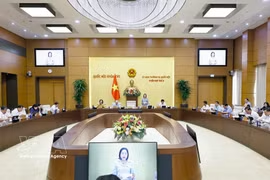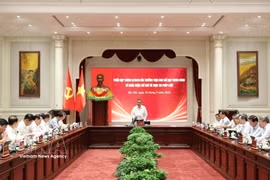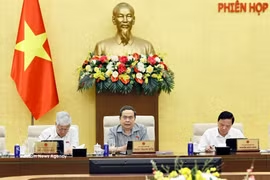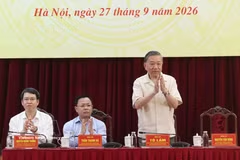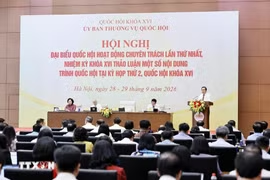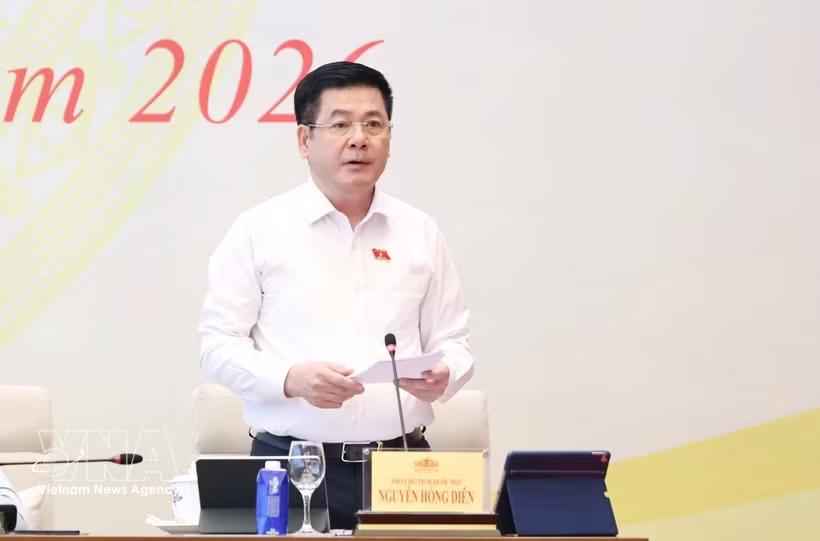
Hanoi (VNA) – The draft law amending and supplementing several articles of the Electricity Law was discussed at the first conference of full-time National Assembly deputies in Hanoi on September 28.
They urged a more transparent electricity pricing mechanism, tighter cost control, fairer risk allocation and stronger protection for consumers.
Pricing reform must balance investor and consumer interests
Deputies broadly backed the amendment necessity, which aims to further improve policies for power sector development and keep the legal system consistent. The changes will also enshrine the Party's electricity development directions in law and refine mechanisms and policies under the 2024 Electricity Law and Resolution 253/2025/QH15 on national energy development for 2026–2030.
Deputy Nguyen Thi Viet Nga from Hai Phong city said an effective mechanism is needed to draw investment into power generation and transmission, secure supply and protect national energy security. She cautioned, however, that any change to pricing must be weighed carefully against the interests of both consumers and the nation.
On the principles of setting prices and containing the impact of the new mechanism, she said the law must define which costs are reasonable and recoverable, which risks investors must bear, and when costs can be passed on to households and businesses.
She proposed empowering the Government to set detailed rules on pricing methods, profit margins and procedures. Priority, she said, should go to cost inspection and auditing, excluding unreasonable costs stemming from poor management or inefficient investment, and clear rules on handling additional costs that affect retail prices.
The proposed roadmap should introduce peak, off-peak and normal-hour retail pricing for residential customers once technical conditions allow, and phase out cross-subsidisation. Nga said both steps could encourage more efficient use and better reflect supply costs, but warned the impact would differ across households.
On project development and power market, deputy To Ai Vang from Can Tho city said progress in direct power purchasing and competitive market development has not cleared bottlenecks in pricing and power purchase agreement (PPA) negotiations. Some major generation projects have stalled for lack of an adequate legal framework, while power trading still leans heavily on the Vietnam Electricity (EVN).
Vang urged the Government to introduce a special mechanism allowing long-term commitments on minimum contracted output and a fuel-input price adjustment clause in PPAs.
Ensuring consistency from waste classification to treatment
Regarding the draft law amending and supplementing several articles of the Environmental Protection Law, deputy Dang Ngoc Huy from Quang Ngai province noted that the requirement for households and individuals to sort solid waste at source took effect on January 1, 2025. Nearly two years on, enforcement remains patchy in many localities. The gap shows that policy design and enforcement matter as much as citizens' responsibilities.
Huy said the draft should spell out the duties of waste collection, transport and treatment units so that sorted waste is not remixed downstream.
Deputy Nguyen Dang An from Lang Son province proposed that for mountainous and disadvantaged provinces, where treatment facilities are lacking and investors are hard to attract, the State should prioritise investment support or direct budget funding. Inter-provincial and inter-regional treatment facilities should also be encouraged in line with local conditions.
For projects unlikely to recoup costs but essential to meeting environmental requirements, he called for a mechanism blending central and local budgets with other lawful sources of funding.
At the afternoon session the same day, deputies also took up the draft revised Law on Marine and Island Resources and Environment and the draft amended Postal Law./.