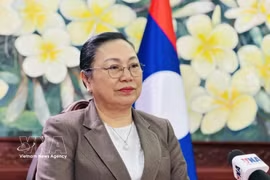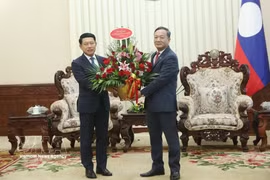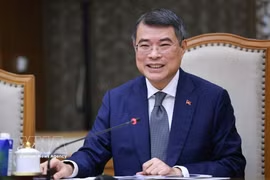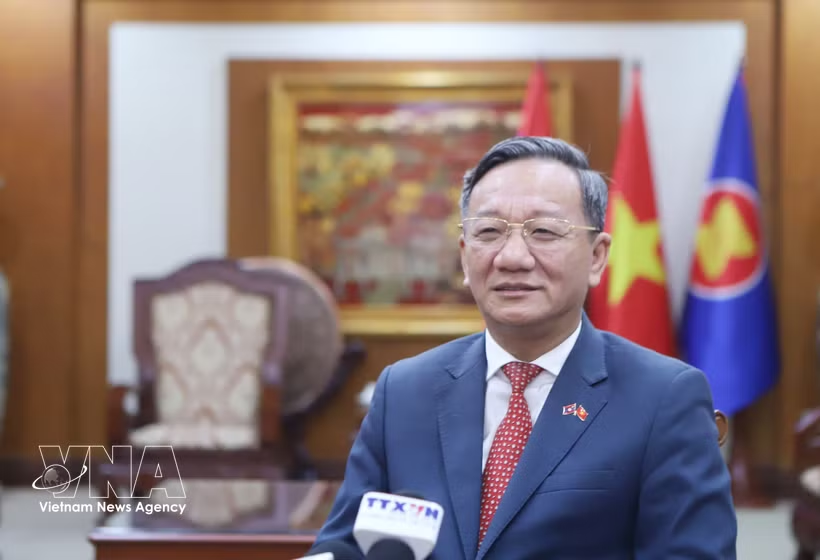
Hanoi (VNA) – Prime Minister Le Minh Hung’s official visit to Laos from October 8-9 will concretise “strategic cohesion” as a guiding principle in Vietnam–Laos relations, Vietnamese Ambassador to Laos Nguyen Minh Tam has said.
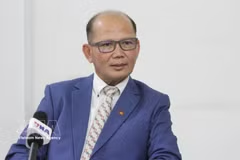
In an interview granted to Vietnam News Agency (VNA) correspondents in Vientiane ahead of the trip, the Ambassador said that the visit comes at a time when the two Parties and countries are implementing the resolutions of the 14th National Congress of the Communist Party of Vietnam (CPV) and the 12th National Congress of the Lao People’s Revolutionary Party (LPRP), putting each country's development goals in the new phase into practice.
He noted that the rapidly changing regional and international situation requires closer coordination, greater self-reliance and mutual support.
According to the diplomat, this is the first official visit to Laos by Hung as the PM and his first bilateral overseas visit since he assumed office. He is also among the first high-ranking guests to be received by Lao Prime Minister Saleumxay Kommasith and National Assembly President Sonexay Siphandone in their new positions.
The visit reaffirms the importance both sides attach to their great friendship, special solidarity, comprehensive cooperation and strategic cohesion, Tam said.
The two PMs are expected to discuss measures to implement existing commitments and agreements, address difficulties and set orientations to boost cooperation, particularly in trade and investment. They will also focus on connectivity in transport, logistics, energy, telecommunications, digital transformation, tourism, education and human resources.
The visit will also anhance direct exchanges between senior leaders and coordination among ministries, sectors and localities. At the multilateral level, the two sides will exchange views on regional and international issues and enhance coordination at the Association of Southeast Asian Nations (ASEAN), the United Nations and other mechanisms.
The Ambassador said the key goal aims to turn political resolve into concrete projects, progress and benefits. While political trust is high, greater efforts are needed to ensure that special political ties are matched by stronger economic cooperation.
In the first eight months of 2026, Vietnam invested in 21 projects in Laos with nearly 700 million USD in registered capital, bringing the total to 301 projects worth more than 7 billion USD. Vietnam is Laos’s second-largest foreign investor. Bilateral trade exceeded 1.6 billion USD, creating a basis for higher targets of 5 billion USD in trade in the near term and 10 billion USD in trade and more than 10 billion USD in investment by 2030.
The Ambassador stressed the need to accelerate strategic projects and remove institutional and implementation bottlenecks, particularly in transport, logistics, energy and large-scale investments. The two countries should build long-term links in production, energy, raw materials, logistics, markets and supply chains rather than measure cooperation solely through trade turnover or project numbers.
He identified four key links for building genuine economic corridors between the two countries: transport and logistics infrastructure; energy and production; institutions and digital infrastructure; and human resources.
Laos’s central location in the Mekong subregion gives it connectivity with China, Thailand, Cambodia and Myanmar, while Vietnam’s coastline and seaports provide access to international shipping routes. Better integration could create economic corridors linking the two countries more closely with the region. In the first eight months of 2026, Lao goods accounted for 40.2% of cargo handled by three berths managed by Lao-Viet International Port JSC at Vung Ang, highlighting the potential of stronger infrastructure and logistics links.
The two sides should also connect transport infrastructure with logistics centres, border-gate economic zones, production, processing and energy systems. Laos has strong potential in hydropower, wind and solar energy, while Vietnam has growing energy demand. Electricity trade, transmission lines and cross-border fuel infrastructure could create a stable energy partnership.
Institutional, financial and digital connectivity is equally important. The two nations need to simplify import-export procedures, modernise customs and border gates, share data, expand local-currency payments and promote cross-border e-commerce. Physical infrastructure must go hand in hand with institutional and digital connectivity to reduce costs and enhance competitiveness.
Human-resource training should be aligned with development needs and bilateral projects, particularly in logistics, transport, energy, digital technology, high-tech agriculture, processing, finance and management.
If these links are developed in tandem, Vietnam–Laos connectivity can shift from individual projects to an interconnected economic space, allowing Laos to leverage its regional position and Vietnam make full use of its markets, production capacity and maritime gateway, while both countries participate more deeply in regional supply and value chains.
The diplomat said “strategic cohesion” marks a new step in the bilateral relations, moving beyond political solidarity towards closely intertwined national interests, in which the prosperity and development of one country serve as an impetus for the other./.