Vietnam, Cambodia strengthen connectivity, create new momentum for growth

The visit’s focus is expected to be on translating high-level agreements into economic and infrastructure connectivity projects and practical cooperation that benefit people and businesses, said Uch Leang, Acting Director of the Department of Asia, Africa and Middle East Studies at the Royal Academy of Cambodia’s Institute of International Relations.

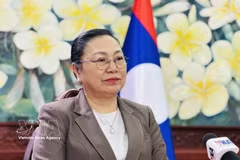
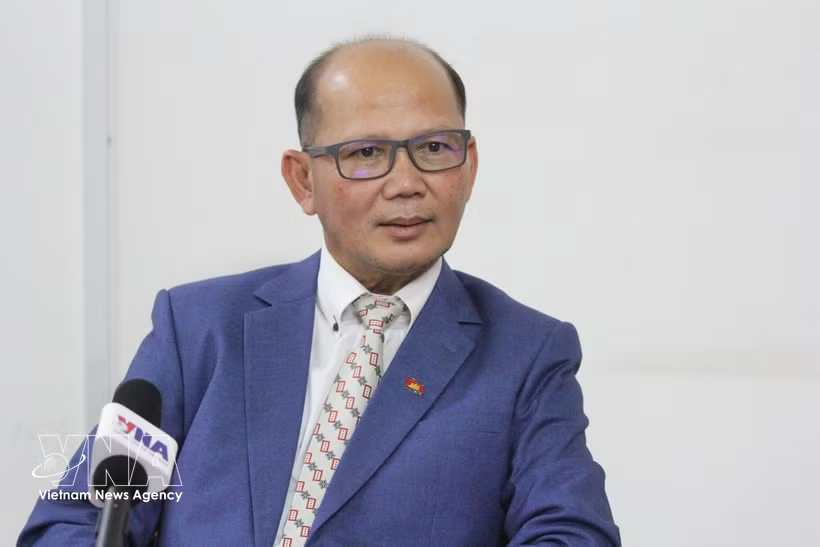
Uch Leang, Acting Director of the Department of Asia, Africa and Middle East Studies at the Royal Academy of Cambodia’s Institute of International Relations speaks to Vietnam News Agency correspondents in Phnom Penh (Photo: VNA)

Phnom Penh (VNA) – Vietnamese Prime Minister Le Minh Hung’s official visit to Cambodia is seen as a significant step in strengthening Cambodia-Vietnam relations, moving from “political trust” to “development momentum” and from “historical proximity” to “strategic closeness,” according to Uch Leang, Acting Director of the Department of Asia, Africa and Middle East Studies at the Royal Academy of Cambodia’s Institute of International Relations.

Uch Leang, who is also President of the Association of Cambodian Alumni who studied in Vietnam, held that the visit’s focus is expected to be on translating high-level agreements into economic and infrastructure connectivity projects and practical cooperation that benefit people and businesses.

According to the scholar, the visit should be viewed from a long-term and regional perspective, as Cambodia-Vietnam relations are important not only to the two countries but also to peace, stability, connectivity and cooperation within ASEAN. High-level contacts in 2026 have demonstrated a solid foundation of political trust, while cooperation in the economy, defence and security, border affairs and people-to-people exchanges has continued to expand.

He said the most important breakthrough in the coming period would be to shift from expanding cooperation to improving its quality and substance. The two sides should first prioritise connectivity between their economies, particularly in transport infrastructure, border gates, logistics, trade and investment, and economic zones, creating conditions for closer links among goods, businesses and production chains.

Connectivity projects such as the Ho Chi Minh City-Moc Bai-Bavet-Phnom Penh expressway could become important growth drivers if implemented effectively, he said.

Alongside economic connectivity, defence and security cooperation and border management should also be deepened, particularly in combating transnational crime, addressing non-traditional security challenges and building a border of peace, stability, cooperation and development, he said.

Another driver highlighted by Uch Leang was people-to-people exchanges, education, culture and youth engagement. He described these as the social foundation for strengthening long-term understanding and trust between the two peoples, particularly as the two countries prepare to celebrate the 60th anniversary of their diplomatic relations in 2027.

Elaborating on people-to-people exchanges, the Cambodian scholar said such exchanges, particularly among young people, are not merely a complementary aspect of Cambodia-Vietnam relations but one of the most important social foundations determining the long-term vitality of bilateral ties.

For young people, he said this area is particularly important because today’s youth will become the leaders, diplomats, entrepreneurs, scholars and others who directly shape Cambodia-Vietnam relations in the decades ahead. Investing in youth exchanges is therefore effectively an investment in the future of bilateral ties.

Uch Leang placed particular emphasis on the role of Cambodian alumni who studied in Vietnam, describing them as a unique resource.

However, he said people-to-people exchanges in the new period also need to renew their content and methods. They should move beyond ceremonial or traditional exchanges towards programmes that are substantive, interactive and capable of producing lasting results. Digital platforms and social media should also be leveraged to enable young people from the two countries to communicate regularly and share knowledge and understanding.

As the two countries prepare to mark the 60th anniversary of diplomatic relations in 2027, he said the time is right to develop a long-term people-to-people exchange programme in which young people, students, scholars and alumni networks become active participants, helping take bilateral ties from “historical closeness” to “future-oriented connectivity”.

Regarding Prime Minister Le Minh Hung’s visit to Cambodia, Uch Leang said the official visit would not only consolidate and deepen the foundation of political trust between the two countries, but also create momentum for turning high-level consensus into concrete results.

Against a backdrop of rapid regional changes and intertwined interests, maintaining regular, frank and constructive high-level dialogue is particularly important for both Cambodia and Vietnam, he said.

The Cambodian scholar expects the visit to generate momentum in three key areas.

First, it should strengthen mechanisms for dialogue and strategic coordination. The two sides should continue regular exchanges between senior leaders and relevant agencies, covering not only bilateral relations but also regional and international issues of shared concern. This would help them better understand each other’s priorities, address differences, and maintain an environment of trust and stability.

Second, political relations should be translated into more substantive cooperation programmes. Political trust can only remain sustainable when reflected in tangible benefits, he said. The visit should therefore provide fresh impetus to economic, trade and investment cooperation, infrastructure connectivity, border-area development, defence and security, and people-to-people exchanges.

Particular attention should be paid to projects capable of linking the two economies, facilitating business activities, promoting trade and bringing practical benefits to people, he added.

Third, the visit should establish an appropriate framework for addressing issues that require continued coordination. For matters relating to the border, security, transnational crime, water-resource management and non-traditional challenges, it is important to maintain professional-level exchanges and dialogue mechanisms at various levels./.

VNA
See more

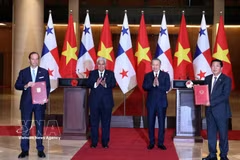
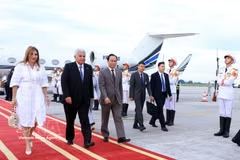
General Secretary of the Communist Party of Vietnam Central Committee and President To Lam (second, right) and Panama President José Raúl Mulino (second, left) witness the exchange of an agreement on maritime transport cooperation between the Governments of Vietnam and Panama (Photo: VNA)

Vietnam, Panama exchange cooperation documents witnessed by top leaders

The documents include an agreement on maritime transport cooperation between the Governments of Vietnam and Panama, an agreement on cooperation in combating transnational crime, a memorandum of understanding (MoU) on agricultural cooperation, and an MoU on tourism cooperation between the Vietnam National Authority of Tourism and the Panama Tourism Authority.

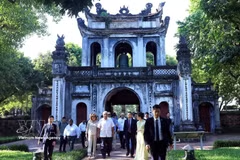
President of the Republic of Panama José Raúl Mulino and his spouse, Maricel Cohen De Mulino, visit Hanoi's Van Mieu - Quoc Tu Giam on October 6, 2026 (Photo: VNA)

Panamanian President and spouse visit Temple of Literature

Visiting Van Mieu - Quoc Tu Giam (Temple of Literature - Imperial Academy) in Hanoi, Panamanian President José Raúl Mulino showed keen interest in the historical, cultural and artistic values of the World Documentary Heritage site, which houses 82 stone steles honouring doctoral laureates. He praised Vietnam’s tradition of learning, respect for teachers and appreciation of talent.

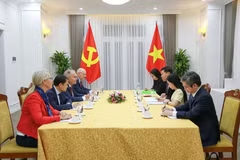
Member of the Communist Party of Vietnam (CPV) Central Committee, Standing Deputy Secretary of the Ministry of Foreign Affairs Party Committee and Deputy Minister of Foreign Affairs Nguyen Manh Cuong holds talks with visiting President of the Hungarian Workers' Party Gyula Thürmer in Hanoi. (Photo courtesy of the Ministry of Foreign Affairs)

CPV, Hungarian Workers' Party seek to deepen ties

The CPV pursues a policy of expanding relations with political parties, including the Hungarian Workers' Party, a traditional partner that has consistently shown interest in and supported Vietnam.

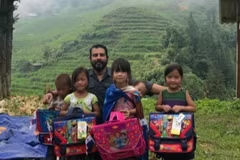
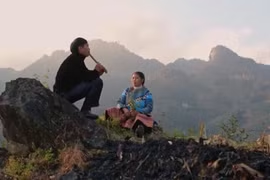
Former Panamanian Ambassador to Vietnam Servio S. Samudio with Vietnamese children he met during his trip to a Vietnamese northern mountainous region (Photo courtesy of Former Panamanian Ambassador to Vietnam Servio S. Samudio)

People-to-people exchanges forge stronger Vietnam-Panama ties

The October 5-8 official visit to Vietnam by Panamanian President José Raúl Mulino and his spouse is expected to create new avenues for collaboration and open more doors for the people of the two countries to meet, for Vietnamese culture to become more familiar to Panamanians, and for Vietnamese people to have more opportunities to discover Panama.

The meeting between Politburo Member and Standing Member of the Communist Party of Vietnam (CPV) Central Committee’s Secretariat Tran Cam Tu and President of the Hungarian Workers’ Party Gyula Thürmer in Hanoi on October 5, 2026 (Photo: VNA)

Key Party leader hosts Hungarian Workers’ Party chief

The Communist Party of Vietnam always values its solidarity and friendship with the Hungarian Workers' Party and communist and workers' parties worldwide, which helps build political trust and supports Vietnam's relations with other countries, said key Party leader Tran Cam Tu.

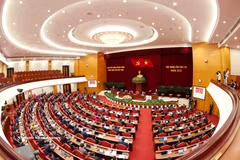
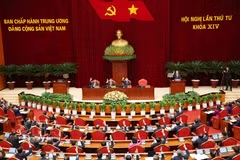
The opening of the 14th CPV Central Committee's fourth plenum on October 5, 2026 (Photo: VNA)

First working day of Party Central Committee's fourth plenum

Delegates held group discussions on the CPV Central Committee resolution calling for stronger building and rectification towards a clean, strong and comprehensive Party and political system able to meet the country's development needs in the new era.

The 2026 Annual International Forum on Public Governance opens in Hanoi on October 5, 2026. (Photo: VNA)

2026 Annual International Forum on Public Governance opens in Hanoi

Vietnam is reforming its organisational apparatus, operating a two-tier local administration system, promoting decentralisation and delegation of power, and accelerating digital transformation. These are not merely organisational changes, but a systemic transformation requiring comprehensive innovation, from problem identification and policy design to coordination and implementation.

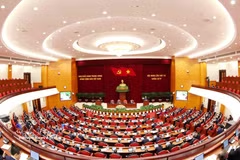
The opening session of the fourth plenum of the 14th Party Central Committee on October 5, 2026 (Photo: VNA)

14th Party Central Committee convenes fourth plenum

General Secretary and President To Lam said that the fourth plenum must focus on creating conditions for effective implementation while preparing the theoretical, organisational and human resources foundations for the country’s long-term development.

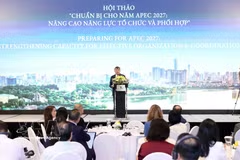
The Ministry of Foreign Affairs hosts a workshop titled “Preparing for APEC Year 2027: Strengthening capacity for effective organisation and coordination” on October 1 (Photo: VNA)

Vietnam advances comprehensive international integration

Recent activities in external relations and international cooperation across politics, economy, defence, security and culture demonstrate concrete steps to realise this approach, increasingly linking international integration with national construction, development and defence.