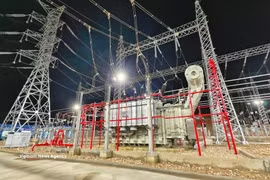
Hanoi (VNA) – Ensuring a safe, stable, and continuous power supply for Hanoi in its new development phase requires more than investment in power lines, substations, and system capacity.
At the Hanoi Power Corporation (EVN Hanoi), a consistent power supply is pursued through renewed management methods, the application of science and technology, digital transformation, and the gradual development of a smart power grid. These moves align with the Politburo’s Resolutions No. 57-NQ/TW on breakthroughs in science and technology development, innovation, and national digital transformation, and No. 70-NQ/TW on ensuring future energy security.
As the national political and administrative centre and a major hub for economic, scientific, technological and innovation activities, Hanoi is seeing growing demand for energy infrastructure. Rapid urbanisation and the development of industry, services, modern transport, data centres and the digital economy require the capital’s power system to ensure not only daily consumption but also reliable electricity for production and business activities, operations of central agencies, and major political and diplomatic events.
Resolution No. 70-NQ/TW, issued on August 20, 2025, sets the goal of ensuring national energy security and developing a modern, synchronous, competitive, transparent, and efficient energy system. Meanwhile, Resolution No. 57-NQ/TW, dated December 22, 2024, identifies science and technology, innovation and national digital transformation as key breakthroughs and major drivers of socio-economic development.
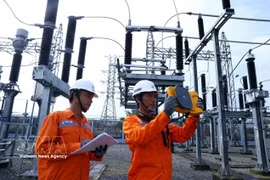
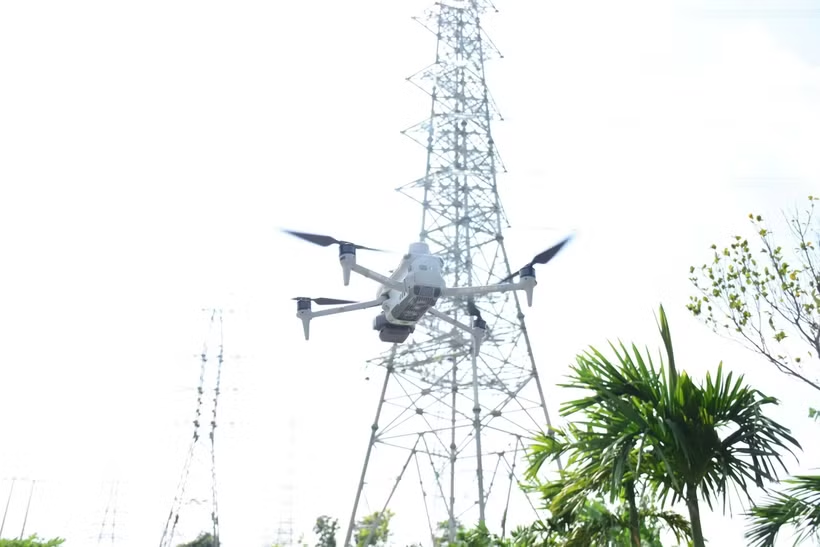
For EVN Hanoi, these orientations are increasingly reflected in daily operations. Accurate and comprehensive data improve forecasting, monitoring, and early detection of abnormalities, remote control, and automation. The use of unmanned aerial vehicles (UAVs) to inspect power lines, remote monitoring and control systems, and digitalised technical data demonstrates the growing role of technology in addressing practical challenges.
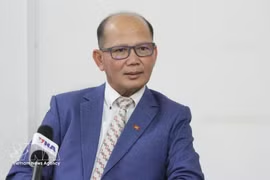
At the Hanoi power system dispatch centre, digital transformation is visible in every shift. Dispatchers continuously monitor grid conditions, assess changes in load and equipment status, and respond to abnormal situations. Deputy Director of the centre Ngoc Long said science, technology and digital transformation have provided increasingly effective tools for dispatching and operation, improving data access, grid monitoring and remote control.
However, technology does not replace people. Vu Duy Dai, an operator at the centre, noted that increasingly advanced technologies require personnel to strengthen both professional expertise and digital skills, understand the system and respond effectively to emerging situations.
EVN Hanoi's experience shows that Resolutions No. 57 and No. 70 are closely linked in modernising the capital’s power system. While Resolution No. 70 sets requirements for a safe, modern and efficient energy system, Resolution No. 57 provides an important technological driving force to achieve them.
In the coming period, science and technology, data, automation and high-quality human resources will remain key to building a smart, modern and resilient power grid capable of meeting Hanoi’s growing development needs./.
See more
Over 50 international scientists attend 45th symposium on physics in collision
Participants are discussing the latest experimental and theoretical findings in particle physics, covering Higgs and electroweak physics, quantum chromodynamics (QCD), physics beyond the Standard Model, neutrinos and heavy ions, as well as dark matter, gravitational waves and cosmology.
Digital technology gives Vietnamese businesses an edge in market access
When data is standardised, transparent and updated, digital platforms can help businesses more effectively reach buyers, investors and international partners. Data thus becomes not merely a promotional tool but part of a business’s competitive capacity.
Vietnam turns AI ambitions into tangible business results
AI has become a high or top priority for 69% of surveyed Vietnamese businesses, while 84% expect their use of AI to increase over the next year. Although 61% of adopters remain at the experimentation stage, 71% said their AI investments have already broken even or generated returns.
Vietnam, Canada look to turn strategic partnership into tech projects
Canada's research strength paired with Vietnam's manpower, market size and speed of adoption could address national-level challenges and help small- and medium-sized enterprises modernise production and tap into the international innovation ecosystem, said Assoc. Prof. Vu Viet Hung.
Public security ministry eyes AI, cyber training ties with Canada's Concordia University
Concordia is ready to step up exchanges with the Vietnamese Ministry of Public Security's training and research facilities to identify areas that fit both sides' strengths and needs and gradually turn training and research opportunities into concrete initiatives, said Prof. Graham Carr, Concordia University's President and Vice-Chancellor.
Vietnam’s approach to innovation inspires countries worldwide: WIPO
Vietnam's approach to adopting the GII and coordinating with government agencies at both central and local levels is an invaluable lesson many other countries are studying and trying to replicate.
Overseas Vietnamese intellectuals drive innovation
Overseas Vietnamese scientists do not have to return to Vietnam for long-term work to make an impact. They can contribute by joining collaborative research teams, sharing analytical techniques, facilitating access to modern equipment, and linking Vietnam with international labs and universities.
Better Choice Awards 2026 honours innovative Vietnamese businesses, tech products
The fourth edition of the awards featured a complete restructuring into four award tracks: Innovative Choice Awards, Smart Choice Awards, Car Choice Awards and the newly introduced Nation Builders Awards. The latter honours businesses contributing to national development by building infrastructure, energy systems and technological capacity for the national economy.
Localities apply AI, data to drive practical digital transformation
In the central province of Quang Tri, an AI-powered “People’s Assistant” is being piloted from October 1 to 31 at the provincial Public Administration Service Centre and the centres of this kind in Dong Thuan and Dong Ha wards. The system provides information on procedures, required documents, forms and fees, while also supporting declaration and preliminary checks.
Businesses must be at heart of innovation: Deputy PM
“Businesses must be placed at the centre of this process,” he said, noting that enterprises understand market demand, formulate practical requirements, invest resources, adopt and master technologies, organise production and bring products to consumers.
Hanoi tops 2026 Provincial Innovation Index
Hanoi led in 18 of the 52 component indicators – the highest number among the 34 localities assessed.
WIPO innovation report viewed through Resolution 57 perspective
He said the GII 2026 results should be viewed in the broader context of Vietnam’s implementation of Resolution No. 57-NQ/TW, which identifies science and technology, innovation and national digital transformation as key breakthroughs and major drivers for developing modern productive forces and enhancing economic competitiveness.
Vietnam, Japan expand cooperation in strategic technology fields
Meeting with Japanese Minister of Education, Culture, Sports, Science and Technology Seki Yoshihiro on October 2, Minister of Science and Technology Vu Hai Quan proposed the Japanese side continue providing postgraduate scholarships, particularly at master's and doctoral levels in strategic technological sectors, facilitate exchanges among students and researchers, and maintain support for the Vietnam Japan University (VJU).
Vietnamese intellectuals in China: AI offers chance to narrow development gap
The resolution offers a broader approach, with contributions possible through knowledge, experience or by connecting businesses, universities and research institutes in Vietnam and abroad. Individual contributions may be small, but when multiplied, they can create significant strength.
Vietnam, WIPO seek stronger cooperation in intellectual property enforcement
After three months of intensive enforcement, Vietnamese police had identified and verified 600 cases, initiated legal proceedings in 205 cases involving 293 suspects, and seized goods worth more than 300 million VND (11,400 USD).
Vietnamese-learning app presented to community in RoK
The initiative aims to support language learning among children growing up in more than 100,000 Vietnamese-Korean multicultural families, while helping preserve Vietnamese cultural identity and strengthen their ties with their homeland.
Strategic technologies expand space for Vietnam - Australia cooperation
Vietnamese Deputy Minister of Science and Technology Tran Trung Tinh said that amid global uncertainties, strategic technologies are becoming a decisive driver of national competitiveness and sustainable development. Vietnam has identified science, technology, innovation and digital transformation as key strategic breakthroughs.
National ecosystem needed for Vietnam to master quantum technology: Israeli expert
Dr Nissan Maskil said Vietnam should place particular emphasis on developing human resources, research infrastructure, and technical capabilities, while gradually putting quantum technologies into practical use and moving toward commercialisation.
National cybersecurity architecture framework issued
The framework aims to establish a national master plan for technologies, data and defence processes, and specify shared cybersecurity components under the National Digital Architecture Framework.
Cross-border QR payments: Efforts must go beyond expanding coverage
Data from the State Bank of Vietnam’s Payment Department shows that Vietnam currently has more than 2.5 million domestic payment-accepting units. However, the number accepting VietQR Global remains relatively small, at around 154,000, or just over 6%.