WB raises Vietnam’s 2026 growth forecast to 7.4% on strong AI-related exports

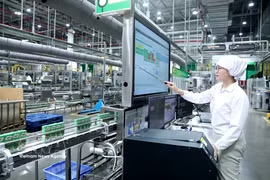
The upgrade reflects the stronger performance of the manufacturing and export sectors, particularly the production and shipment of high-tech and AI-related products.

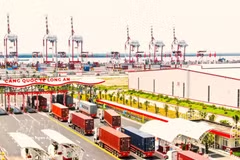
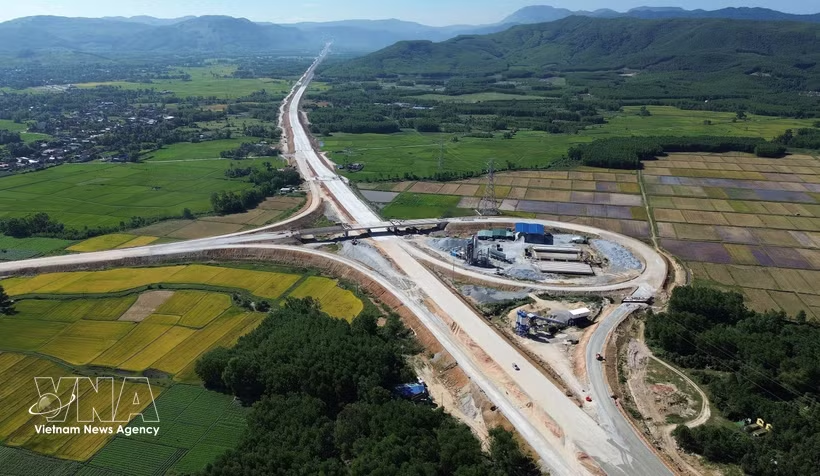
An intersection on Quang Ngai - Hoai Nhon Expressway (Photo: VNA)

Hanoi (VNS/VNA) – The World Bank has raised its forecast for Vietnam’s economic growth in 2026 by 1.1 percentage points to 7.4%, citing stronger-than-expected manufacturing and exports of high-tech and artificial intelligence (AI)-related goods.

The latest East Asia and Pacific Economic Update, released on October 6, said Vietnam’s growth was expected to remain robust at 7.4% this year, before moderating slightly to 7.3% in both 2027 and 2028.

The upgrade reflects the stronger performance of the manufacturing and export sectors, particularly the production and shipment of high-tech and AI-related products. The World Bank expects this trend to continue, supported by increased domestic stimulus from structural reforms and expanded public investment.

However, inflationary pressures are expected to remain a concern. Consumer price inflation in Vietnam is projected to average 4.2% in 2026, driven mainly by higher fuel, housing and utility costs, according to the report.

The World Bank’s upgrade puts Vietnam among the region’s stronger performers. The East Asia and Pacific region as a whole is projected to grow 4.5% in 2026, while Malaysia and Thailand are forecast to expand by 5.1% and 2%, respectively.

AI adoption gathers pace

The report also highlighted Vietnam’s growing adoption of AI, although it noted that the pace and scale of adoption remain uneven across developing economies in East Asia and the Pacific.

Among emerging-market and developing economies in the region, Malaysia and Vietnam recorded the highest levels of individual generative AI use in early 2026.

In Vietnam, AI applications are already being used in a range of practical areas. An AI coach tailored to Vietnamese speakers has become one of the country’s popular language-learning tools, while AI-powered medical imaging is helping under-resourced hospitals improve diagnoses.

Small hotels and tour operators are also using AI to generate promotional visuals and apply dynamic pricing at lower cost.

The World Bank said these examples illustrate the potential of what it calls “Small AI” – the adoption or adaptation of existing AI tools for specific local needs – rather than developing costly frontier AI models.

For most developing economies, adopting and adapting existing technologies is likely to deliver greater benefits in the near term, particularly when tools are tailored to local languages and economic conditions.

The report warned that AI adoption alone would not be enough to deliver broad-based productivity gains. Businesses face constraints including skills shortages, high adoption costs and concerns over security and data privacy.

It also noted that demand for AI-related skills in emerging and developing economies in the region remains relatively low compared with other emerging markets, pointing to the need for stronger investment in skills and education.

Reliable electricity and sound governance are also important for attracting investment in data centres. Southeast Asian economies could benefit from opportunities in semiconductor manufacturing and other parts of the AI value chain.

The World Bank said governments should create an enabling environment for AI adoption by improving digital and energy infrastructure, access to capital and skills, while also using AI themselves to improve public services./.

VNA
See more

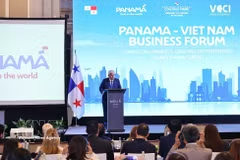
Panamanian President José Raúl Mulino speaks at the Panama-Vietnam Business Forum on October 7 in Hanoi. (Photo: VNA)

Vietnam, Panama seek to expand economic cooperation

In the presence of President Mulino, VCCI and the Chamber of Commerce, Industries and Agriculture of Panama signed a memorandum of understanding (MoU) to strengthen cooperation, enhance trade and investment promotion programmes, and support bilateral investment and trade.

Ministry updates on Vietnam-US reciprocal trade agreement talks

Ministry updates on Vietnam-US reciprocal trade agreement talks

The US is one of Vietnam’s major trading partners and holds paramount importance to the country’s exports. The conclusion of the bilateral trade agreement will help establish a stable and balanced trade framework toward sustainable development and open up greater opportunities for cooperation between the two countries.

MICE visitors enjoy services at Song Be Golf Resort in Ho Chi Minh City. (Photo: VNA)

Ho Chi Minh City shifts MICE tourism from venues to experiences

Ho Chi Minh City boasts significant advantages for MICE tourism, with the central area offering strengths in finance, trade and services; Binh Duong in industry, exhibitions and business connectivity; and Ba Ria-Vung Tau and Con Dao in marine tourism, resorts, ecology and distinctive experiences.

National Brand products are on display at the Vietnam National Brand International Forum. (Photo: VNA)

Vietnam's national brand value jumps 45% to over 462 bln USD

Deputy Minister of Industry and Trade Luong Hoang Thai outlined Vietnam's National Brand Programme 's achievements, the role of business community and plans for brand development in a press interview ahead of the 10th Vietnam National Brand Product recognition ceremony on October 16.

Khanh Hoa province possesses significant advantages for renewable energy projects and new energy sectors. (Photo: VNA)

New value chains from two industrial – renewable energy centres

To implement the revised Power Development Plan VIII, the Ministry of Industry and Trade has proposed establishing two inter-regional renewable energy industrial and service centres in the northern and southern regions to develop the renewable energy sector and a complete value chain.

WB Senior Environmental Specialist and Task Team Leader Stephen Ling speaks at the working session (Photo; VNA)

Ca Mau, WB cooperate in sustainable fisheries development

Scheduled to run from 2026 to 2029, the project aims to develop the local fisheries sector and deepen global integration, while adapting to climate change and protecting the environment through infrastructure upgrades, technological innovation, and better management and production capacity.

Vice President of the Vietnamese National Assembly Nguyen Hong Dien speaks at the forum. (Photo: Vietnam Trade Promotion Agency)

Tanzanian businesses seek greater cooperation, investment opportunities with Vietnam

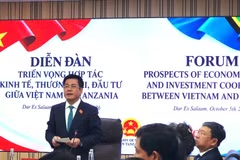
Attending the forum during his working visit to Tanzania, Vice President of the National Assembly Nguyen Hong Dien said the two economies were highly complementary. Tanzania has strengths in natural resources, agriculture, energy, its domestic market and its strategic position in East Africa, while Vietnam has advantages in manufacturing and processing, high-tech agriculture, electronics, telecommunications and international trade.

The automatic ticketing system that uses electronic identification, authentication, biometric recognition and cashless payment for passengers on the Cat Linh-Ha Dong railway line in Hanoi. (Photo: VNA)

Cashless payments open gateway to financial inclusion

Cashless payments continued to grow rapidly in the first eight months of 2026. The number and value of cashless transactions rose 34.56% and 13.26% year-on-year, respectively, while online transactions increased 46.57% in number and 21.77% in value.