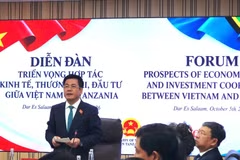
Ho Chi Minh City (VNA) – Experts discussed mechanisms for Ho Chi Minh City to access long-term capital from international markets at a consultation on international bond issuance through the Vietnam International Financial Centre in Ho Chi Minh City (VIFC-HCMC) on October 7.
The consultation was organised by VIFC-HCMC in coordination with the International Finance Corporation (IFC) as the city and relevant agencies work on a draft resolution of the Ho Chi Minh City People’s Council on issuing municipal and project bonds through the VIFC.
According to the municipal Department of Construction, Ho Chi Minh City will need more than 3.17 quadrillion VND (122.01 billion USD) for infrastructure investment in 2026-2030, while the city’s budget is expected to provide about 975 trillion VND, covering only around 31% of the total demand.
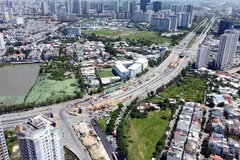
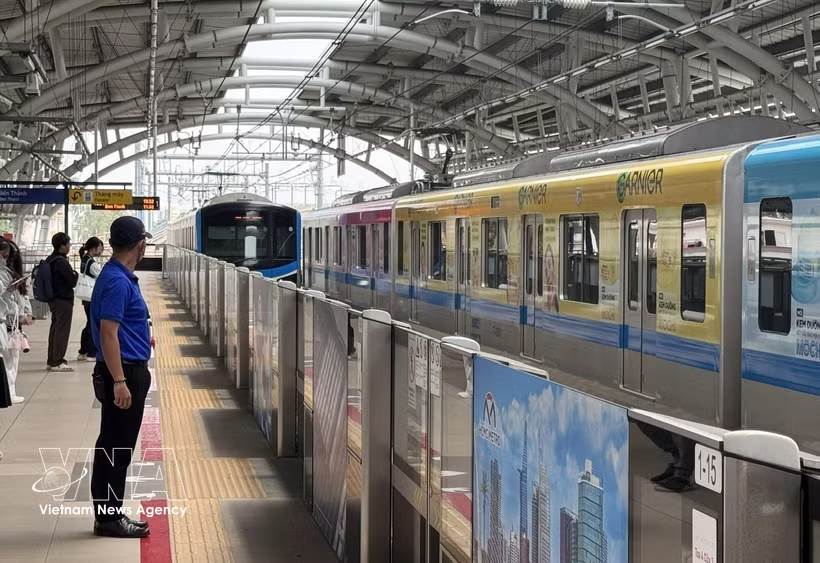
The funding gap comes as the city needs to accelerate investment in public transport, regional connectivity, flood control, water supply and drainage, and wastewater treatment.
Under the draft proposal, municipal and project bonds are expected to become among the first core products of the financial centre. They are expected to provide additional medium- and long-term funding for key projects while supporting the development of advisory, credit rating, capital arrangement and other financial services at VIFC-HCMC.
Assoc. Prof. Dr. Nguyen Huu Huan, Vice Chairman of the Executive Board of VIFC-HCMC, said one notable proposal is to conduct multiple bond issuances under a medium-term programme. Common documentation and preparatory work would be completed upfront, while each issuance would be updated based on disbursement needs, debt-servicing capacity and market conditions.
The Ho Chi Minh City People’s Committee would decide the timing, size, currency, maturity and target market for each issue within the framework of the approved programme and limits set by the municipal People’s Council.
The approach would allow capital mobilisation to match project implementation schedules, reducing the risk of borrowing too early and avoiding a concentration of debt obligations at the same time.
The draft proposal also suggests using domestic or international registration, custody, settlement and trading systems that meet market requirements and are accepted by the target market if the financial centre’s own infrastructure is not yet ready.
These mechanisms remain at the proposal stage and depend on the completion of relevant regulations and required approvals.
Pavel Kochanov, IFC Senior Municipal Finance Specialist, said Ho Chi Minh City’s borrowing capacity would depend on factors including its economic base, revenue and expenditure structure, liquidity, debt obligations and financial management.
The assessment should be based on a financial model covering the full loan term and include adverse scenarios, he said.
A key requirement is the city’s ability to service debt from its own resources while maintaining an appropriate safety margin. Financial statements, budget data and information on contingent liabilities must be sufficiently clear to allow investors to assess risks.
Borrowing plans should also take into account interest rate, foreign exchange and refinancing risks, Kochanov said.
On project selection, Neeraj Gupta, Principal Investment Officer at IFC, recommended that the city prioritise projects that have completed feasibility studies and secured land, permits and necessary contract documents, allowing them to begin disbursement and deliver results soon.
This is particularly important for international bonds because undisbursed funds still incur costs, reducing the financial efficiency of an issuance.
For metro projects, financial structures should allocate risks related to passenger numbers, site clearance and payment obligations among the parties. For water supply and drainage and other public infrastructure projects, financial plans should consider project revenues, possible budget support and wider socio-economic benefits.
Therefore, there is no single financial structure suitable for all projects. Funding instruments should be tailored to each project’s cash flow and risk profile.
According to advice from A&O Shearman, before entering international markets, Ho Chi Minh City needs to complete a range of preparations, including legal documentation, professional advisory work, credit rating, investor outreach, pricing and foreign-currency issuance./.