Capital Economic Forum: Human resources at heart of new growth drivers

Discussions focused on improving the quality of human resources to meet the changing demands of the economy, with people placed at the centre of innovation, productivity growth and competitiveness enhancement.

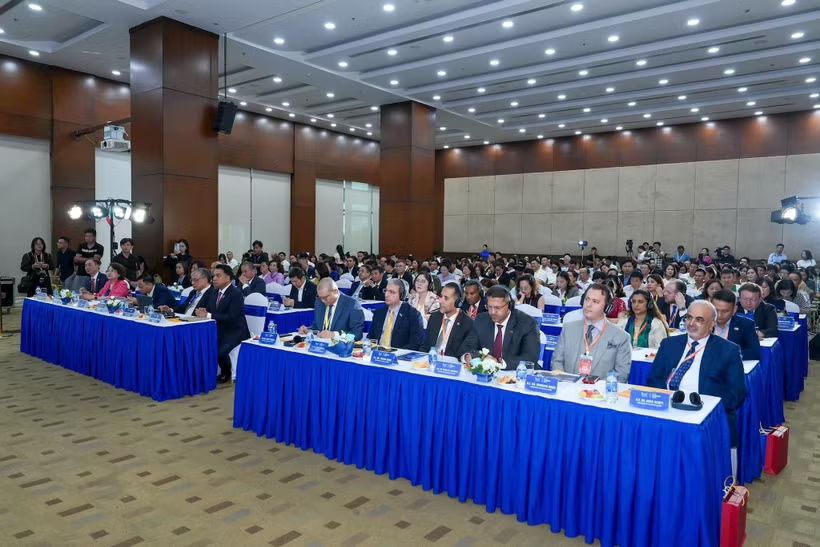
The third Capital Economic Forum (CEF III 2026) is held in Hanoi on October 8. (Photo: hanoimoi.vn)

Hanoi (VNA) – The third Capital Economic Forum (CEF III 2026) was held in Hanoi on October 8 under the theme “Growth Drivers from High-Quality Human Resources,” focusing on how to develop a workforce capable of driving productivity, innovation and competitiveness in the new economy.

The forum was organised under the direction of the Hanoi People’s Committee and the Vietnam Chamber of Commerce and Industry (VCCI), with the Hanoi Association of Small and Medium Enterprises (HANOISME) serving as the coordinating organiser alongside a network of 18 co-hosting units.

It was attended by ambassadors and diplomatic representatives from 15 countries, including Mozambique, Thailand, Iraq, Belarus, Azerbaijan, Sri Lanka, Kazakhstan, Egypt, Türkiye, Haiti, Pakistan, the Netherlands, Mongolia, Palestine and the United Arab Emirates.

Discussions focused on improving the quality of human resources to meet the changing demands of the economy, with people placed at the centre of innovation, productivity growth and competitiveness enhancement.

Rather than viewing human resources simply in terms of recruitment and training, CEF III examined how a high-quality workforce can enable businesses to master technology, mobilise capital, develop markets and participate more deeply in global value chains.

The forum assessed the strengths and weaknesses of Hanoi’s business community. Key issues included developing human resources to increase productivity and added value; improving corporate governance, financial capacity and mergers and acquisitions (M&A) capabilities to help businesses absorb capital and restructure; and strengthening links between enterprises and training institutions to develop engineers, technicians and skilled workers for manufacturing, retail and global supply chains.

Speaking at the event, Azerbaijani Ambassador to Vietnam Shovgi Kamal Oglu Mehdizade highlighted the important role of small- and medium-sized enterprises in the economy, particularly amid rapid technological development and digital transformation, noting that stronger competition and a modern legal framework are prerequisites for development.

New challenges require new knowledge and skills, as well as new and more flexible approaches to education, he said, adding that from this perspective, Hanoi authorities are doing a very good job.

A key difference between CEF III and the previous two editions was its focus on human resources capable of translating technology, capital and market opportunities into business results. While CEF I focused more on digital tools and CEF II on supply-chain and investor connections, this year's event placed human resources at the centre of economic growth.

The forum also saw the launch of the CEF High-Level Expert Council, comprising nine experts in economics, science – technology, management, education, communications and business. The council will provide consultancy, independent assessment and professional guidance for the forum’s activities.

CEF III aimed to turn discussions into concrete action, with five to seven priority issues to be selected for pilot implementation and responsibilities assigned among State agencies, business associations, enterprises and training institutions.

Mac Quoc Anh, Vice Chairman and Secretary General of HANOISME and head of the forum’s organising board, said high-quality human resources should not merely be an input for the economy but a direct force driving productivity, innovation, competitiveness and new growth.

The ultimate goal of the forum is to develop a “Post-CEF III Action Framework” to expand exchanges among authorities, businesses, training institutions and international partners, linking human resources development with higher productivity, technological innovation and stronger corporate competitiveness./.

VNA

See more

Members of the RoK delegation visit booths showcasing signature agricultural products of Da Lat – Lam Dong. (Photo: VNA)

Lam Dong seeks stronger economic, tourism links with RoK

Lam Dong is particularly interested in sectors in which Korean businesses have strengths, including agriculture, green energy, the circular economy, high-quality tourism, healthcare, education, human resources training and digital transformation, an official said.

Illustrative image (Photo: EVNNPT)

EVNNPT seeks over 224 mln USD in bank loans for grid expansion

Three projects account for part of the financing need, including 13.3 million EUR for the 220kV Ung Hoa substation and connection lines, 18.6 million EUR for the 220kV Tan Viet substation and the 220kV Tan Viet–Gia Loc–Pho Noi line, and 35.3 million EUR for the 220kV substation connecting the Dong Anh–Van Tri transmission line.

At a farm produce supermarket in Hue city (Photo: VNA)

Inflation control key to maintaining growth momentum

Average consumer price index (CPI) rose 4.52% in the first nine months, roughly in line with the National Assembly (NA)'s full-year target, while core inflation climbed 4.26%, the National Statistics Office (NSO) reported. CPI in some localities ran above the national average, including economic hubs Hanoi and Ho Chi Minh City.

According to experts, Vietnam’s relatively attractive valuation could help draw active investors. (Photo: VNA)

Capital-market channels widened after FTSE upgrade: expert

Vietnam officially entered FTSE Russell’s Secondary Emerging Market category on September 21 after reforms to trading, settlement and foreign-investor access. The reclassification gives Vietnamese equities access to a much larger pool of international capital, but also puts them in direct competition with other emerging markets.

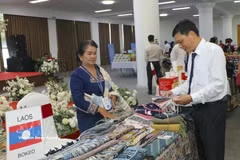
Lao products are promoted at a trade fair in Dien Bien province in September 2026. (Photo: VNA)

Vietnam, Laos seek to expand room for trade, investment cooperation

Vietnam and Laos aim to boost bilateral trade in 2026 towards the milestone of 10 billion USD by 2030, a target said to be challenging but feasible as both Governments work to remove trade barriers, improve border-trade mechanisms, and strengthen transport and logistics connectivity.

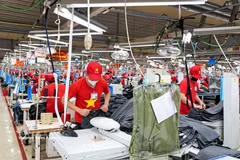
At a garment company in Bac Ninh city. (Photo: VNA)

Bac Ninh maintains its lead nationwide in import-export scale

Exports totaled almost 87.5 billion USD while imports hit 90.3 billion USD. The figures show output at the electronics manufacturing hub is still expanding. They also underscore the need for local companies to build capacity and capture more value in supply chains.

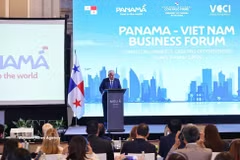
Panamanian President José Raúl Mulino speaks at the Panama-Vietnam Business Forum on October 7 in Hanoi. (Photo: VNA)

Vietnam, Panama seek to expand economic cooperation

In the presence of President Mulino, VCCI and the Chamber of Commerce, Industries and Agriculture of Panama signed a memorandum of understanding (MoU) to strengthen cooperation, enhance trade and investment promotion programmes, and support bilateral investment and trade.

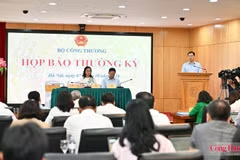
Ministry updates on Vietnam-US reciprocal trade agreement talks

Ministry updates on Vietnam-US reciprocal trade agreement talks

The US is one of Vietnam’s major trading partners and holds paramount importance to the country’s exports. The conclusion of the bilateral trade agreement will help establish a stable and balanced trade framework toward sustainable development and open up greater opportunities for cooperation between the two countries.

MICE visitors enjoy services at Song Be Golf Resort in Ho Chi Minh City. (Photo: VNA)

Ho Chi Minh City shifts MICE tourism from venues to experiences

Ho Chi Minh City boasts significant advantages for MICE tourism, with the central area offering strengths in finance, trade and services; Binh Duong in industry, exhibitions and business connectivity; and Ba Ria-Vung Tau and Con Dao in marine tourism, resorts, ecology and distinctive experiences.