Hanoi (VNA) - Vietnam's inflation stayed elevated in the first nine months of 2026 even as the economy grew strongly, making price stability a core part of efforts to preserve macroeconomic stability and protect social welfare.
Limited room for further price control
Average consumer price index (CPI) rose 4.52% in the first nine months, roughly in line with the National Assembly (NA)'s full-year target, while core inflation climbed 4.26%, the National Statistics Office (NSO) reported. CPI in some localities ran above the national average, including economic hubs Hanoi and Ho Chi Minh City.
Economist Ngo Tri Long from the Vietnam Association of Financial Consultants said with the gap between headline CPI and core inflation narrowing, price pressures are showing signs of spreading more broadly across the economy.
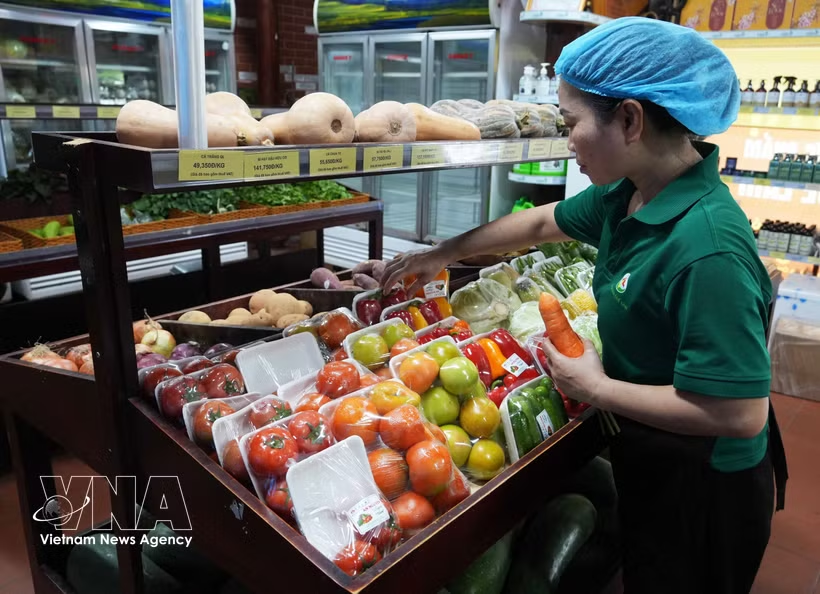
Long noted that food and catering services made the biggest contribution, rising 4.72% and adding 1.69 percentage points to overall CPI growth. Housing, electricity, water, fuel and construction materials rose 6.68%, contributing 1.52 points, while transport prices gained 6.06%, adding 0.6 point. Fuel alone within the transport group jumped 10.89%, contributing 0.52 point. All three groups have ample scope to pass higher costs through to production, transportation and consumer prices.
Rising input costs added to the pressure, with prices of raw materials, fuels, production materials and imports staying high for an extended period. Holding full-year inflation at 4.5% will not be easy. The target remains within reach, but room for policy maneuver has clearly narrowed.
Nguyen Thu Oanh, head of the NSO’s Price and Services Statistics Department, said beyond those three groups, higher prices for healthcare, education and other goods and services also fed CPI growth. The effect was most visible in September 2026, when CPI went up 0.62% from August and 5.08% from a year earlier.
Domestic fuel price adjustments tracking global levels drove the September gain, lifting transport prices 3.97% and pushing overall CPI up about 0.4 percentage point. Education prices moved up 1.41%, adding 0.08 point. Both nine-month average inflation and September inflation marked the highest annual hikes since 2016, reflecting a mix of demand-pull and cost-push pressures.
Pressure is set to build in the final months of the year. Risks of higher global energy, raw material and fuel prices are rising as geopolitical tensions intensify and international transport routes stay disrupted. Stronger year-end consumer spending and seasonal factors in production and trade will add to the strain. As Vietnam pushes for double-digit growth, credit expansion and public investment in 2026 have both run high compared with previous years and are expected to weigh more heavily on prices in the fourth quarter and into 2027 because of policy lags.
Challenges in year-end price management
Prime Minister Le Minh Hung told ministries, agencies and localities at the Government's regular September meeting to keep pursuing high growth while maintaining macroeconomic stability, tightly controlling prices and striving to hold average CPI growth in 2026 at the NA's target.
To ease mounting inflationary pressure, the PM instructed agencies not to raise electricity prices and continue appropriate measures to regulate fuel prices. He also called for smooth supplies of essentials such as construction materials, food and medicines, and stepped-up inspections and strict punishment of speculation, hoarding and profiteering.
Minister of Finance Ngo Van Tuan, responding to voters' questions in Quang Ninh ahead of the 16th NA's second session, stressed that the Government, ministries, agencies and localities will keep up coordinated measures to boost growth while controlling inflation, maintaining macroeconomic stability and tackling difficulties facing firms and citizens. The ultimate aim is to safeguard major economic balances, create a favourable environment for production and trade, ensure livelihoods and strive for the highest possible level of the 2026 socio-economic targets.
ong urged authorities to keep driving growth without putting excessive pressure on aggregate demand, expand credit while steering capital toward production, accelerate investment while clearing supply-side bottlenecks, and adjust prices in line with market mechanisms on an appropriate roadmap, with careful timing./.