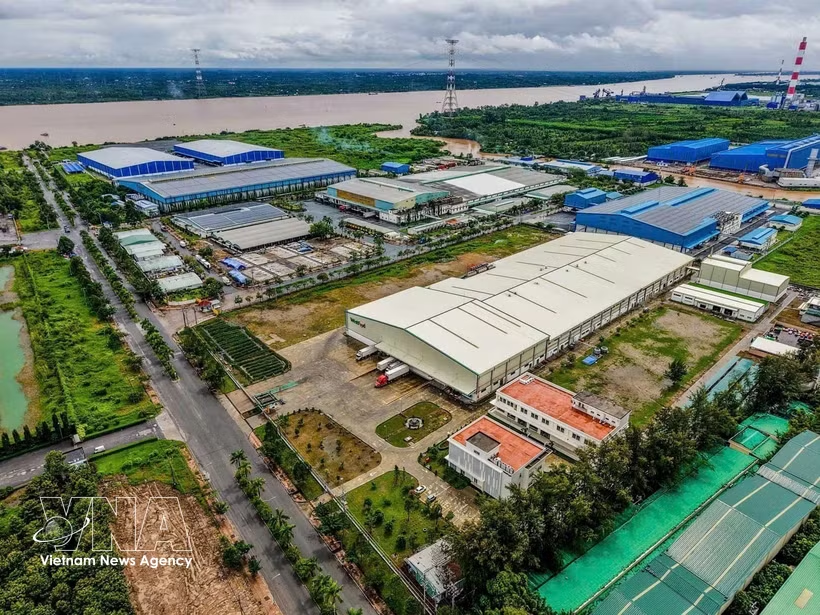
Hanoi (VNA) – The industrial property market in the southern region is entering a new phase of competition as manufacturers’ requirements increasingly extend beyond land availability and location.
As foreign direct investment (FDI) continues to flow into higher value-added manufacturing, infrastructure, technical standards, sustainability, deployment speed and expansion potential are becoming increasingly important in site selection.
Adapting to manufacturers’ changing needs
Industrial site selection was previously driven largely by land prices, location and access to markets. However, as supply chains become more complex and manufacturing projects face higher technical requirements, businesses are increasingly assessing sites based on their long-term operational capabilities.
John Campbell, Head of Industrial Services at Savills Vietnam, said infrastructure can put a location on an investor’s shortlist, but the industrial property itself must also perform effectively.
Power supply, sustainability, factory specifications, labour availability, licensing and expansion potential are increasingly considered alongside connectivity, he said.
These requirements are particularly important for electronics, high technology, medical equipment and precision manufacturing, where companies need facilities that meet operational standards, can become operational quickly and support future expansion.
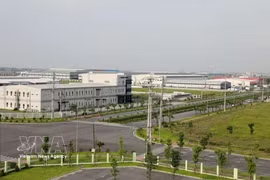
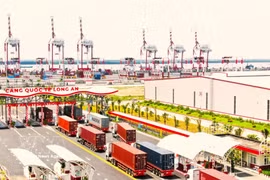
Against this backdrop, the former Long An province (now part of Tay Ninh) has developed a diverse industrial base, ranging from industrial land to ready-built factories and warehouses.
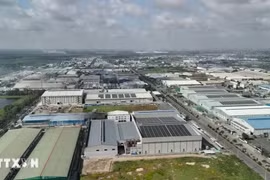
According to Savills data, the area has about 4,000ha of industrial land, of which around 3,000ha has been leased, giving an occupancy rate of about 82%. It also has around 3.2 million sq.m of ready-built factories and warehouses, with an occupancy rate of about 80%.
The diverse supply allows businesses to choose deployment models according to project scale and operational timelines. Industrial land offers greater flexibility for designing and expanding production facilities, while ready-built factories and warehouses can shorten market-entry times.
New development models are also emerging in Ben Luc, Can Giuoc and Duc Hoa.
The 400ha Prodezi Eco-Industrial Park in Ben Luc is being developed with integrated green infrastructure and renewable energy, targeting industries including electronics, medical equipment, pharmaceuticals, logistics and data centres.
Meanwhile, the 13.4ha Phu An Thanh project in Ben Luc offers ready-built factory and hybrid solutions for businesses seeking rapid deployment.
High-tech FDI raises market standards
The changing quality of industrial property is occurring alongside shifts in FDI flows. In the first half of 2026, registered FDI in processing and manufacturing reached 10.71 billion USD, while investment in electronics surged from about 985 million USD to 7.03 billion USD.
Projects in these sectors typically require higher standards for infrastructure stability, power supply, logistics, factory specifications and expansion capacity. This is prompting industrial property developers to compete not only on land availability but also on product quality and suitability for specific tenant groups.
For businesses seeking locations in southern Vietnam, connectivity with manufacturing centres, labour sources and logistics infrastructure remains fundamental. However, connectivity is increasingly becoming part of a broader package in which product quality and operational capacity determine a location’s suitability.
According to Campbell, as businesses expand their supply chains, they are seeking both well-connected locations and industrial properties that match their operational requirements. The market is therefore shifting from competition based on land availability to competition based on comprehensive operational solutions.
In the long term, the combination of land availability, ready-built products, operational standards and connectivity will increasingly determine the competitiveness of southern industrial markets.
With its diverse supply base and development potential, the former Long An, now part of Tay Ninh province following the administrative merger, is well positioned to attract businesses ranging from manufacturing and logistics to high-tech industries./.