Deputy PM calls for tighter price management of essential goods

Deputy PM Thang, who is also head of the committee, urged ministries and agencies to coordinate closely to deliver effective fiscal and macroeconomic policies. The aim is to control inflation, stabilise the macroeconomy, ensure major economic balances, create room to support growth and bolster the economy’s resilience to external shocks.

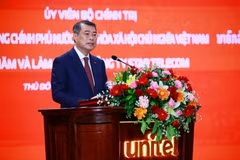
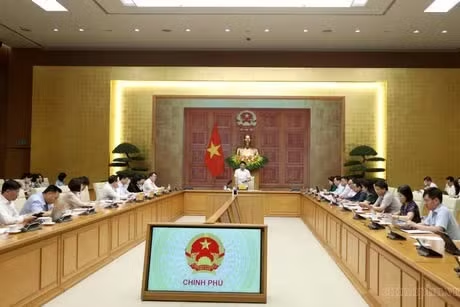
An overview of the meeting (Photo: chinhphu.vn)

​Hanoi (VNA) - Deputy Prime Minister Nguyen Van Thang chaired a meeting of the Steering Committee for Price Management in Hanoi on October 9 to review third-quarter price management and discuss forecasts and scenarios for the rest of 2026.

​Deputy PM Thang, who is also head of the committee, urged ministries and agencies to coordinate closely to deliver effective fiscal and macroeconomic policies. The aim is to control inflation, stabilise the macroeconomy, ensure major economic balances, create room to support growth and bolster the economy’s resilience to external shocks.

​He also called for close monitoring of domestic and international developments and prompt, effective steps to bring down the Consumer Price Index, which will leave more room to support growth.

​They were told to adjust prices of State-regulated goods and services on appropriate roadmaps and carefully assess the impact on CPI. They must balance market-based pricing, inflation control and support for the recovery of production and trade.

​Inspections of price declarations and listings, particularly for essential goods, are to be tightened. Authorities must crack down on speculation, hoarding and price manipulation for illicit gain, as well as arbitrary price hikes that exploit natural disasters such as storms, floods, and peak holiday periods.

​Companies must cut selling prices promptly when input costs fall to protect consumers. Authorities must also strictly enforce rules requiring transparent disclosure of school fees and other charges at the start of the academic year and prevent unauthorised collections.

​Thang urged ministries and agencies to strengthen monitoring in their areas. They should step up communications with timely, transparent information on price management policies and swings in essential goods prices, to guide public opinion, steady consumer and business sentiment and contain inflation.

He also called for wider dissemination of new pricing rules, along with procedures for receiving price declarations, to ensure timely data for market analysis, assessment and forecasting.

​The State Bank of Vietnam (SBV) was tasked with running monetary policy in close coordination with fiscal policy. The SBV is to monitor exchange and lending rates, money supply, and international capital flows to find ways to curb inflation. Credit growth should be maintained at a reasonable pace, with funds directed toward production, trade, and key priority sectors.

​The Ministry of Finance was asked to keep using tax, fee, and charge exemptions, reductions, and extensions to lower business input costs and support livelihoods.

​Deputy Minister of Finance Tran Quoc Phuong said the ministry has updated two inflation scenarios for 2026, projecting rates of about 4.5% and 4.8%.

​The central bank forecasts average 2026 inflation at 4.5-5%, while international organisations project Vietnam’s average inflation at about 4.2-5.5%./.
​

VNA

See more

 Khanh Binh International Land Border Gate in An Giang province.( Photo: VNA)

Vietnam-Cambodia trade gathers pace towards 20 billion USD target

After setting a record of more than 11.3 billion USD in 2025, bilateral trade reached about 8.7 billion USD in the first eight months of 2026, up 8.3% year on year. Vietnam is currently Cambodia’s third-largest trading partner, its second-largest source of imports and second-largest export market.

Vietnamese Ambassador to India Trinh Minh Manh discusses potential areas and strengths for cooperation between Vietnam and India’s Gujarat state. (Photo: VNA)

Vietnam, India’s Gujarat state seek to unlock cooperation potential

Vietnam attaches importance to strengthening cooperation with Indian states boasting strong economic potential, including Gujarat, to further advance the two countries’ Enhanced Comprehensive Strategic Partnership, particularly in the economy, trade and investment, said Ambassador Trinh Minh Manh.

At Nestlé Vietnam factory in Hung Yen province (Photo: VNA)

Vietnam seeks to build stronger ecosystem for FDI

The World Bank has stressed the need to connect global companies with domestic suppliers, improve the business climate and develop supply-chain finance solutions. Those steps will let domestic firms gradually meet requirements on quality, technology, costs and delivery times, and position them to become suppliers to multinational corporations.

Construction of technical infrastructure facilities serving APEC 2027 in Phu Quoc Special Zone, An Giang province. (Illustrative photo: VNA)

Vietnam enters investment grade credit rating category for first time

Vietnam has maintained robust growth, outperforming other Southeast Asian economies. Its ongoing government reforms aimed at streamlining the state apparatus, promoting the private sector, improving the institutional framework and developing capital markets will strengthen the country’s growth potential and economic resilience.

Vietnamese Prime Minister Le Minh Hung and Lao Prime Minister Saleumxay Kommasith witness the presentation of investment certificates and investment cooperation agreements between businesses of the two countries. (Photo: VNA)

Vietnam, Laos strengthen “strategic cohesion” in economic sector

The great friendship, special solidarity, comprehensive cooperation and strategic cohesion between Vietnam and Laos, and between Laos and Vietnam, are an invaluable asset of the Vietnamese and Lao Parties, States and people. It is the responsibility of today's generation to transform this invaluable political asset into new resources for the development of the two countries’ people.

West Food Hau Giang JSC’s factory at the Nam Song Hau Industrial Park – Phase 1, Can Tho city (Photo: VNA)

Southern industrial property market enters new phase of competition

Industrial site selection was previously driven largely by land prices, location and access to markets. However, as supply chains become more complex and manufacturing projects face higher technical requirements, businesses are increasingly assessing sites based on their long-term operational capabilities.

Members of the RoK delegation visit booths showcasing signature agricultural products of Da Lat – Lam Dong. (Photo: VNA)

Lam Dong seeks stronger economic, tourism links with RoK

Lam Dong is particularly interested in sectors in which Korean businesses have strengths, including agriculture, green energy, the circular economy, high-quality tourism, healthcare, education, human resources training and digital transformation, an official said.

Illustrative image (Photo: EVNNPT)

EVNNPT seeks over 224 mln USD in bank loans for grid expansion

Three projects account for part of the financing need, including 13.3 million EUR for the 220kV Ung Hoa substation and connection lines, 18.6 million EUR for the 220kV Tan Viet substation and the 220kV Tan Viet–Gia Loc–Pho Noi line, and 35.3 million EUR for the 220kV substation connecting the Dong Anh–Van Tri transmission line.

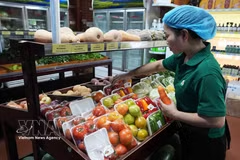
At a farm produce supermarket in Hue city (Photo: VNA)

Inflation control key to maintaining growth momentum

Average consumer price index (CPI) rose 4.52% in the first nine months, roughly in line with the National Assembly (NA)'s full-year target, while core inflation climbed 4.26%, the National Statistics Office (NSO) reported. CPI in some localities ran above the national average, including economic hubs Hanoi and Ho Chi Minh City.

According to experts, Vietnam’s relatively attractive valuation could help draw active investors. (Photo: VNA)

Capital-market channels widened after FTSE upgrade: expert

Vietnam officially entered FTSE Russell’s Secondary Emerging Market category on September 21 after reforms to trading, settlement and foreign-investor access. The reclassification gives Vietnamese equities access to a much larger pool of international capital, but also puts them in direct competition with other emerging markets.