Vietnam’s wood industry eyes higher growth from domestic market

Vietnam’s domestic wood market could grow from around 5 billion USD in 2025 to 7-7.7 billion USD by 2030, representing annual growth of 7-9%.

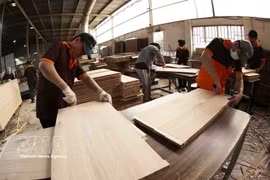
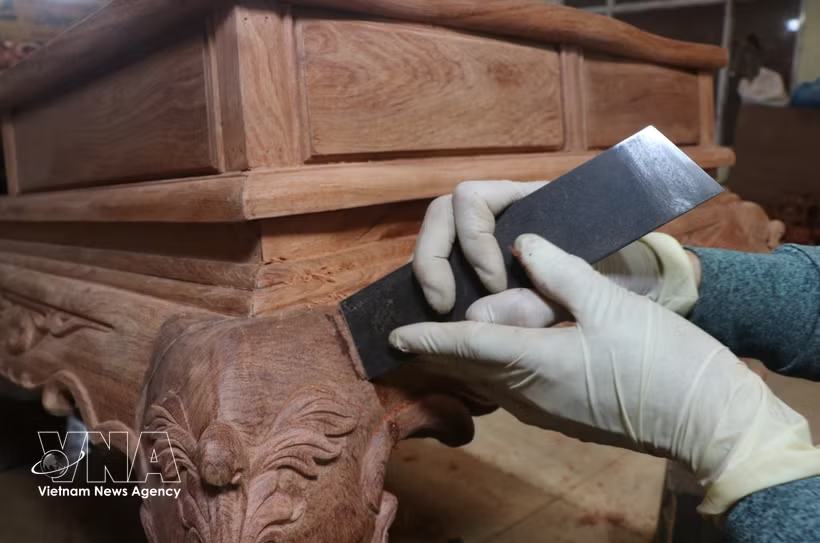
Businesses are developing furniture that reflects Vietnamese lifestyles, culture and family traditions, as well as the identity of individual households. (Illustrative photo: VNA)

Hanoi (VNA) – Vietnam’s wood industry is seeking to better tap the domestic market to diversify sales channels, boost product value, and drive growth amid continued volatility in global markets.

Domestic wood market predicted to reach 7-7.7 billion USD by 2030

The Vietnam Timber and Forest Products Association (VIFOREST) said the domestic market could complement exports, helping businesses sustain production, employment and cash flow amid global market volatility.

According to VIFOREST Secretary General Ngo Sy Hoai, annual per capita spending on wood products and furniture is estimated at around 50 USD. If Vietnam achieves double-digit GDP growth, such spending could increase by 7-9% annually, exceeding the global demand growth rate of around 6%.

​Vietnam’s domestic wood market could grow from around 5 billion USD in 2025 to 7-7.7 billion USD by 2030, representing annual growth of 7-9%. While this is a hypothetical scenario rather than an official forecast, the market’s potential is significant given the country’s population of more than 100 million.

Some businesses have already begun tapping this potential, seeing the domestic market as an opportunity to build their brands and expand operations.

Nguyen Minh Cuong, General Director of Minh Long Wood Company, said the company shifted its focus to the domestic market after around 13 years of studying markets in Europe, India, China and the US. Currently, around 95% of its business is focusing on the domestic market, while exports account for only 3-5%.

The company aims to develop furniture that reflects Vietnamese lifestyles, culture and family traditions, as well as the identity of individual households, Cuong said.

He said Vietnam’s furniture industry should leverage its cultural identity, knowledge and people to build competitive advantages. A strong understanding of domestic consumers would help businesses develop higher-value products and expand into international markets.

Raising standards for domestic market

Despite strong demand, the domestic market faces shortcomings in product quality, origin verification, and traceability. Competition is also intensifying as a wide range of Chinese goods reaches Vietnamese consumers through e-commerce and domestic distribution networks, underscoring the need for businesses to take a more proactive role in developing the home market.

Experts stress the need to build a transparent, high-quality and sustainable market, supported by clear standards for raw materials and finished products.

According to To Xuan Phuc, Director of the Forest Policy, Trade and Finance Programme at Forest Trends, domestic market development should combine policy and standard setting with practical models. Pilot projects would provide data and experience to help ensure policies reflect market realities.

​Vietnam’s wood industry has proven its international competitiveness, Phuc said. The key challenge is to apply at home the quality, origin and sustainability standards that have enabled Vietnamese wood products to enter global markets. This would turn the domestic market into not just a sales outlet but also a driver of consumer understanding, higher product value and more sustainable business growth.

Public procurement could also help stimulate demand. Experts have proposed prioritising school desks and chairs made from domestically grown plantation timber that meet legal, quality and safety requirements.

VIFOREST said that alongside exports, businesses would proactively supply wooden furniture, wood materials and interior products for social housing, schools, hospitals, government offices, hotels, tourist areas and infrastructure projects being fast-tracked.

The industry also aims to move up the value chain by developing better-designed, branded and more deeply processed products; increasing the use of domestic plantation timber, certified wood and legally sourced imports; digitising traceability records; and strengthening links with forest owners, cooperatives, tree-growing households, and traditional craft villages.

Businesses need to shift from price-based competition to a focus on design, quality, services, branding and transparent sourcing to raise product value and strengthen competitiveness in the domestic market and across the wood industry’s value chain, experts said./.

VNA

See more

At Nestlé Vietnam factory in Hung Yen province (Photo: VNA)

Vietnam seeks to build stronger ecosystem for FDI

The World Bank has stressed the need to connect global companies with domestic suppliers, improve the business climate and develop supply-chain finance solutions. Those steps will let domestic firms gradually meet requirements on quality, technology, costs and delivery times, and position them to become suppliers to multinational corporations.

Construction of technical infrastructure facilities serving APEC 2027 in Phu Quoc Special Zone, An Giang province. (Illustrative photo: VNA)

Vietnam enters investment grade credit rating category for first time

Vietnam has maintained robust growth, outperforming other Southeast Asian economies. Its ongoing government reforms aimed at streamlining the state apparatus, promoting the private sector, improving the institutional framework and developing capital markets will strengthen the country’s growth potential and economic resilience.

Vietnamese Prime Minister Le Minh Hung and Lao Prime Minister Saleumxay Kommasith witness the presentation of investment certificates and investment cooperation agreements between businesses of the two countries. (Photo: VNA)

Vietnam, Laos strengthen “strategic cohesion” in economic sector

The great friendship, special solidarity, comprehensive cooperation and strategic cohesion between Vietnam and Laos, and between Laos and Vietnam, are an invaluable asset of the Vietnamese and Lao Parties, States and people. It is the responsibility of today's generation to transform this invaluable political asset into new resources for the development of the two countries’ people.

West Food Hau Giang JSC’s factory at the Nam Song Hau Industrial Park – Phase 1, Can Tho city (Photo: VNA)

Southern industrial property market enters new phase of competition

Industrial site selection was previously driven largely by land prices, location and access to markets. However, as supply chains become more complex and manufacturing projects face higher technical requirements, businesses are increasingly assessing sites based on their long-term operational capabilities.

Members of the RoK delegation visit booths showcasing signature agricultural products of Da Lat – Lam Dong. (Photo: VNA)

Lam Dong seeks stronger economic, tourism links with RoK

Lam Dong is particularly interested in sectors in which Korean businesses have strengths, including agriculture, green energy, the circular economy, high-quality tourism, healthcare, education, human resources training and digital transformation, an official said.

Illustrative image (Photo: EVNNPT)

EVNNPT seeks over 224 mln USD in bank loans for grid expansion

Three projects account for part of the financing need, including 13.3 million EUR for the 220kV Ung Hoa substation and connection lines, 18.6 million EUR for the 220kV Tan Viet substation and the 220kV Tan Viet–Gia Loc–Pho Noi line, and 35.3 million EUR for the 220kV substation connecting the Dong Anh–Van Tri transmission line.

At a farm produce supermarket in Hue city (Photo: VNA)

Inflation control key to maintaining growth momentum

Average consumer price index (CPI) rose 4.52% in the first nine months, roughly in line with the National Assembly (NA)'s full-year target, while core inflation climbed 4.26%, the National Statistics Office (NSO) reported. CPI in some localities ran above the national average, including economic hubs Hanoi and Ho Chi Minh City.

According to experts, Vietnam’s relatively attractive valuation could help draw active investors. (Photo: VNA)

Capital-market channels widened after FTSE upgrade: expert

Vietnam officially entered FTSE Russell’s Secondary Emerging Market category on September 21 after reforms to trading, settlement and foreign-investor access. The reclassification gives Vietnamese equities access to a much larger pool of international capital, but also puts them in direct competition with other emerging markets.

Lao products are promoted at a trade fair in Dien Bien province in September 2026. (Photo: VNA)

Vietnam, Laos seek to expand room for trade, investment cooperation

Vietnam and Laos aim to boost bilateral trade in 2026 towards the milestone of 10 billion USD by 2030, a target said to be challenging but feasible as both Governments work to remove trade barriers, improve border-trade mechanisms, and strengthen transport and logistics connectivity.

At a garment company in Bac Ninh city. (Photo: VNA)

Bac Ninh maintains its lead nationwide in import-export scale

Exports totaled almost 87.5 billion USD while imports hit 90.3 billion USD. The figures show output at the electronics manufacturing hub is still expanding. They also underscore the need for local companies to build capacity and capture more value in supply chains.

Panamanian President José Raúl Mulino speaks at the Panama-Vietnam Business Forum on October 7 in Hanoi. (Photo: VNA)

Vietnam, Panama seek to expand economic cooperation

In the presence of President Mulino, VCCI and the Chamber of Commerce, Industries and Agriculture of Panama signed a memorandum of understanding (MoU) to strengthen cooperation, enhance trade and investment promotion programmes, and support bilateral investment and trade.