Vietnam-Cambodia trade gathers pace towards 20 billion USD target

After setting a record of more than 11.3 billion USD in 2025, bilateral trade reached about 8.7 billion USD in the first eight months of 2026, up 8.3% year on year. Vietnam is currently Cambodia’s third-largest trading partner, its second-largest source of imports and second-largest export market.

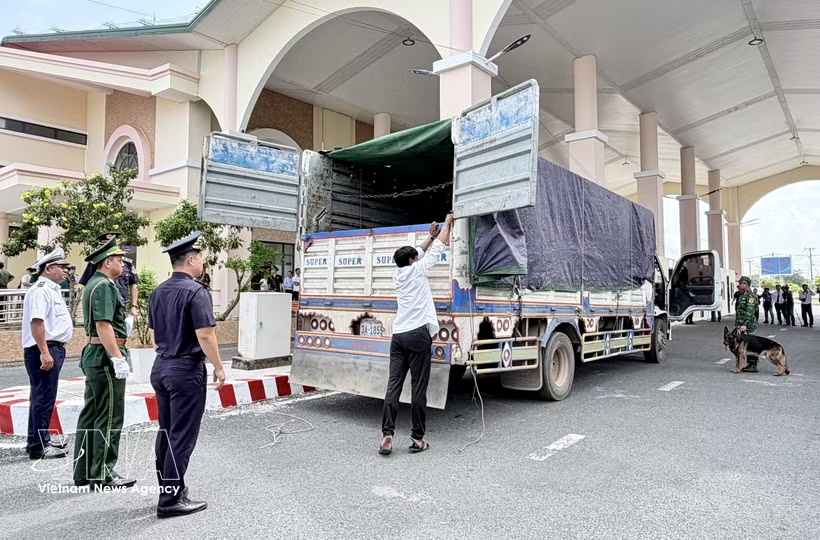
 Khanh Binh International Land Border Gate in An Giang province.( Photo: VNA)
Khanh Binh International Land Border Gate in An Giang province.( Photo: VNA)

Hanoi (VNA) – Trade between Vietnam and Cambodia continues to grow, remaining a bright spot and a key pillar of bilateral cooperation as the two countries aim to raise two-way trade to 20 billion USD in the coming years.

After setting a record of more than 11.3 billion USD in 2025, bilateral trade reached about 8.7 billion USD in the first eight months of 2026, up 8.3% year on year. Vietnam is currently Cambodia’s third-largest trading partner, its second-largest source of imports and second-largest export market.

Vietnam has 223 investment projects in Cambodia, with total registered capital of nearly 3.4 billion USD. These projects have generated jobs for tens of thousands of workers, contributed to the Cambodian budget and supported local social welfare programmes.

Vietnamese Customs data shows that Vietnam exported 4.3 billion USD worth of goods to Cambodia during the period, up 13.8%, while imports from the neighbouring country totalled 4.4 billion USD, an increase of 3.4%.

Vietnam’s major exports include textiles and garments, steel, textile and footwear materials, fertilisers, animal feed and ingredients, paper and paper products, plastics, chemicals, and machinery and equipment. Imports from Cambodia are concentrated in 14 major product groups, notably cashew nuts, rubber and textile and footwear materials.

The two economies have complementary strengths. Cambodia has advantages in agricultural production, raw materials and certain industrial products, while Vietnam supplies goods for both production and consumption. Cambodia’s exports to Vietnam include rice, rubber, cassava, cashew nuts, timber, fruit and vegetables. This complementarity provides a foundation for moving beyond cross-border trade towards deeper processing, higher value addition and participation in shared supply chains.

However, achieving the 20-billion-USD target will require both countries to address policy and institutional barriers, improve the business environment and establish new mechanisms to promote economic, trade and investment cooperation.

Experts point to several potential growth drivers, including deeper processing of agricultural products, expanded industrial and supporting-industry cooperation, and more effective use of ASEAN markets and trade agreements. Combining Cambodia’s agricultural resources with Vietnam’s processing capacity, technology, capital, and distribution networks could generate greater value than exports of raw materials alone.

Logistics and transport connectivity will also be crucial. The opening of the Meun Chey–Tan Nam international border gate in late 2025 and the Khanh Binh–Chrey Thom international border gate on October 3, 2026, is expected to facilitate trade and strengthen links between Cambodia’s Prey Veng and Vietnam’s Tay Ninh province, as well as between Vietnam’s An Giang province and Cambodia’s Kandal province.

In the long run, linking the Ho Chi Minh City–Moc Bai–Bavet–Phnom Penh routes to mutual expressway networks will cut transport times, lower logistics costs, and boost the growth of logistics hubs, industrial parks, and services along the economic corridors.

With their geographic proximity, complementary production structures and established bilateral ties, Vietnam and Cambodia have an opportunity to build a more closely integrated Mekong economic space. Reaching 20 billion USD in trade would represent not only higher turnover but also more substantive cooperation, greater value addition and stronger cross-border supply chains./.

VNA
See more

Vietnamese Ambassador to India Trinh Minh Manh discusses potential areas and strengths for cooperation between Vietnam and India’s Gujarat state. (Photo: VNA)

Vietnam, India’s Gujarat state seek to unlock cooperation potential

Vietnam attaches importance to strengthening cooperation with Indian states boasting strong economic potential, including Gujarat, to further advance the two countries’ Enhanced Comprehensive Strategic Partnership, particularly in the economy, trade and investment, said Ambassador Trinh Minh Manh.

At Nestlé Vietnam factory in Hung Yen province (Photo: VNA)

Vietnam seeks to build stronger ecosystem for FDI

The World Bank has stressed the need to connect global companies with domestic suppliers, improve the business climate and develop supply-chain finance solutions. Those steps will let domestic firms gradually meet requirements on quality, technology, costs and delivery times, and position them to become suppliers to multinational corporations.

Construction of technical infrastructure facilities serving APEC 2027 in Phu Quoc Special Zone, An Giang province. (Illustrative photo: VNA)

Vietnam enters investment grade credit rating category for first time

Vietnam has maintained robust growth, outperforming other Southeast Asian economies. Its ongoing government reforms aimed at streamlining the state apparatus, promoting the private sector, improving the institutional framework and developing capital markets will strengthen the country’s growth potential and economic resilience.

Vietnamese Prime Minister Le Minh Hung and Lao Prime Minister Saleumxay Kommasith witness the presentation of investment certificates and investment cooperation agreements between businesses of the two countries. (Photo: VNA)

Vietnam, Laos strengthen “strategic cohesion” in economic sector

The great friendship, special solidarity, comprehensive cooperation and strategic cohesion between Vietnam and Laos, and between Laos and Vietnam, are an invaluable asset of the Vietnamese and Lao Parties, States and people. It is the responsibility of today's generation to transform this invaluable political asset into new resources for the development of the two countries’ people.

West Food Hau Giang JSC’s factory at the Nam Song Hau Industrial Park – Phase 1, Can Tho city (Photo: VNA)

Southern industrial property market enters new phase of competition

Industrial site selection was previously driven largely by land prices, location and access to markets. However, as supply chains become more complex and manufacturing projects face higher technical requirements, businesses are increasingly assessing sites based on their long-term operational capabilities.

Members of the RoK delegation visit booths showcasing signature agricultural products of Da Lat – Lam Dong. (Photo: VNA)

Lam Dong seeks stronger economic, tourism links with RoK

Lam Dong is particularly interested in sectors in which Korean businesses have strengths, including agriculture, green energy, the circular economy, high-quality tourism, healthcare, education, human resources training and digital transformation, an official said.

Illustrative image (Photo: EVNNPT)

EVNNPT seeks over 224 mln USD in bank loans for grid expansion

Three projects account for part of the financing need, including 13.3 million EUR for the 220kV Ung Hoa substation and connection lines, 18.6 million EUR for the 220kV Tan Viet substation and the 220kV Tan Viet–Gia Loc–Pho Noi line, and 35.3 million EUR for the 220kV substation connecting the Dong Anh–Van Tri transmission line.

At a farm produce supermarket in Hue city (Photo: VNA)

Inflation control key to maintaining growth momentum

Average consumer price index (CPI) rose 4.52% in the first nine months, roughly in line with the National Assembly (NA)'s full-year target, while core inflation climbed 4.26%, the National Statistics Office (NSO) reported. CPI in some localities ran above the national average, including economic hubs Hanoi and Ho Chi Minh City.

According to experts, Vietnam’s relatively attractive valuation could help draw active investors. (Photo: VNA)

Capital-market channels widened after FTSE upgrade: expert

Vietnam officially entered FTSE Russell’s Secondary Emerging Market category on September 21 after reforms to trading, settlement and foreign-investor access. The reclassification gives Vietnamese equities access to a much larger pool of international capital, but also puts them in direct competition with other emerging markets.

Lao products are promoted at a trade fair in Dien Bien province in September 2026. (Photo: VNA)

Vietnam, Laos seek to expand room for trade, investment cooperation

Vietnam and Laos aim to boost bilateral trade in 2026 towards the milestone of 10 billion USD by 2030, a target said to be challenging but feasible as both Governments work to remove trade barriers, improve border-trade mechanisms, and strengthen transport and logistics connectivity.

At a garment company in Bac Ninh city. (Photo: VNA)

Bac Ninh maintains its lead nationwide in import-export scale

Exports totaled almost 87.5 billion USD while imports hit 90.3 billion USD. The figures show output at the electronics manufacturing hub is still expanding. They also underscore the need for local companies to build capacity and capture more value in supply chains.