Vietnam-China trade growing rapidly, substantive: Commercial Counsellor

According to the Vietnam Customs data, bilateral trade hit 253.1 billion USD in the first nine months of this year, up 37.6% annually. Vietnam’s exports to China rose 32.9% to 65.8 billion USD while imports climbed 39.3% to 187.3 billion USD. China accounted for around 41.3% of Vietnam’s imports and 15.2% of its total exports.

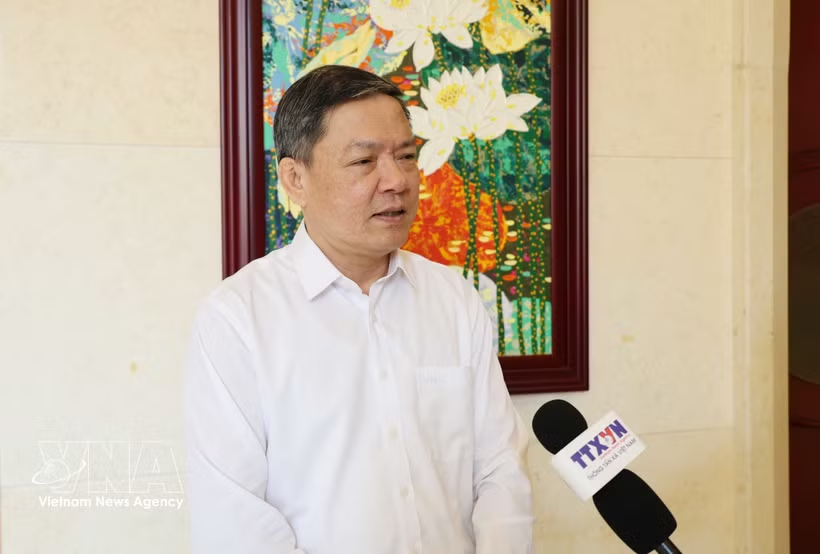
Commercial Counsellor at the Vietnamese Embassy in China Nong Duc Lai (Photo: VNA)

Beijing (VNA) – Vietnam-China trade is expanding rapidly and has become a bright spot in bilateral ties, particularly since General Secretary of the Communist Party of Vietnam Central Committee and President To Lam’s state visit to China in April, said Commercial Counsellor at the Vietnamese Embassy in China Nong Duc Lai.

In an interview recently granted to Vietnam News Agency (VNA) reporters in Beijing, ahead of National Assembly President Tran Thanh Man’s official visit to China, Lai said this momentum has been driven not only by market demand and the complementary nature of the two economies, but also by the close alignment between the strategic orientations of the two Parties’ and countries’ high-ranking leaders and efforts to turn those orientations into concrete mechanisms, schemes and practical cooperation activities. That gives trade a base to keep growing in scale, improve in quality and adapt to a shifting global landscape.

First, strategic orientations from the high-ranking leaders offer political impetus and a favourable framework to trade. Through high-level visits and contacts in recent years, the two sides have consistently named economic and trade ties as a pillar of their comprehensive strategic cooperative partnership. High-level shared understandings and agreements, particularly since 2023, have clearly outlined directions for balanced and sustainable trade, wider market access; stronger infrastructure, logistics and supply chain connectivity; and joint work in such emerging areas as digital economy, e-commerce and green transition.

The orientations have grown more specific and more closely tied to practical needs and direct benefits for companies. Trade is no longer treated in isolation but as part of a broader framework spanning development, investment, production, transport infrastructure and regional supply chains. That lets ministries, agencies, localities and firms launch interconnected, complementary, long-term cooperation schemes.

Second, trade has kept growing strongly, driven by high-level direction and demand for substantive cooperation. China remains Vietnam’s largest trade partner and import source, and one of its top export markets. Vietnam is China’s largest trade partner in ASEAN and its third largest worldwide.

According to the Vietnam Customs data, bilateral trade hit 253.1 billion USD in the first nine months of this year, up 37.6% annually. Vietnam’s exports to China rose 32.9% to 65.8 billion USD while imports climbed 39.3% to 187.3 billion USD. China accounted for around 41.3% of Vietnam’s imports and 15.2% of its total exports. Electronics, machinery and equipment, materials and components, and agricultural and food products were among the main product groups.

The trade structure is increasingly tied to supply chains, particularly in electronics, machinery and equipment, materials and components, and processing and manufacturing. Export growth to China points to room for further expansion, not only in farm produce but also in processed and manufactured goods.
vnanet-s.jpg
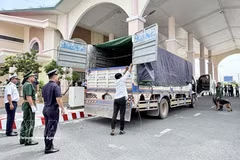
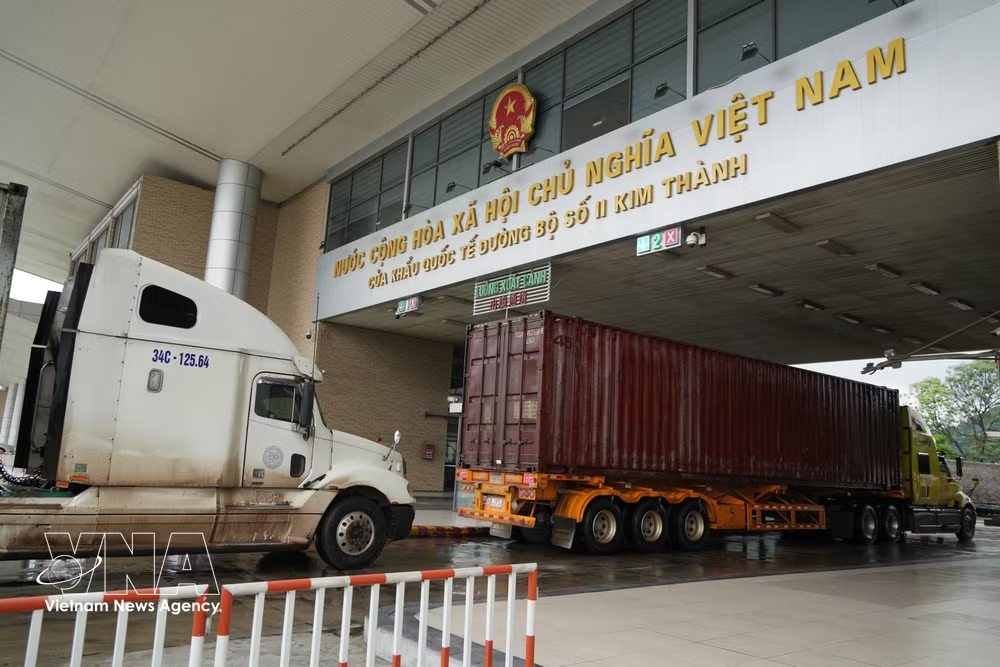
Kim Thanh international border gate in Lao Cai province (Photo: VNA)

Third, high-level common understandings are gradually turning into tangible results. Vietnamese ministries and agencies have staged numerous trade and investment promotion events in China, raising the presence of Vietnamese goods and spreading Vietnamese brands among Chinese consumers.

Notably, the two sides are coordinating more closely to clear trade barriers and widen market access for farm produce, food and other key exports. The negotiation, signing and delivery of protocols on quarantine and food safety give many Vietnamese farm producce a legal basis for official export to China. That is steadily shifting toward more standards-based, stable and sustainable commerce.

Work on smart border gates, customs, quarantine, logistics and rail connectivity continues to advance. It eases immediate bottlenecks in moving goods while fostering long-term links between the two economies, cutting trade costs and smoothing business operations.

Efforts to advance mechanisms for cross-border economic cooperation zones and production and supply chains signal a move beyond traditional trade. The aim is deeper economic integration that ties trade to investment, production and infrastructure.

Fourth, trade cooperation is moving into new areas in line with development trends and both countries’ long-term interests. Alongside traditional sectors, cross-border e-commerce, digital economy, smart logistics and green transition are opening opportunities. Chinese e-commerce platforms give Vietnamese firms more direct access to China’s distribution networks and consumers, particularly for farm produce, processed food and branded consumer goods.

The Regional Comprehensive Economic Partnership and existing frameworks, notably the ASEAN-China Free Trade Area, are also easing trade and investment. They support rules of origin and production links among Vietnam, China and other regional partners. Such help both countries make better use of complementary strengths and adapt to changes in global supply chains.

Fifth, prospects remain promising, but the focus needs to shift decisively from scale to quality and efficiency. Vietnam-China trade is poised to keep growing, backed by stable political ties, regular attention from the high-ranking leaders, complementary economies, geographic proximity and an increasingly comprehensive cooperation framework. Agreed orientations on market opening, infrastructure connectivity, trade facilitation, supply chain development and digital economy should add momentum.

Realising that potential, however, depends largely on effective delivery of signed agreements, clearing technical barriers, improving logistics connectivity and business competitiveness. Priority should be given to expanding Vietnamese exports to China, developing higher value-added products, building business-to-business ties and propelling more balanced, sustainable trade, Lai added./.
VNA

See more

Vietjet Air leaders and flight crew pose for a photo with guests at the launch ceremony. (Photo: VNA)

Vietjet launches Prague–Hanoi route

Vietjet Air operates the Prague–Hanoi route twice a week using Airbus A330-300 aircraft with a capacity of 377 passengers. Flights depart Prague at 8:55 p.m. every Tuesday and Saturday and arrive in Hanoi at 4:20 p.m. the following day, local time. In the opposite direction, flights leave Hanoi at 8:25 a.m. and arrive in Prague at 6:55 p.m. The route includes a stop in Almaty, Kazakhstan.

At Yen Phong II-C Industrial Park in Bac Ninh province (Photo: VNA)

Tax policy stability now key to keeping foreign investors: Officials

Companies must ensure records and data truthfully reflect the substance of transactions and engage in dialogue early when complex issues arise. Tax authorities, in turn, need to publish policies, give clear guidance, enforce rules consistently and deliver information in a timely manner.

The MoU signing ceremony between the gency for Domestic Market Surveillance and Development and Procter & Gamble (P&G). (Photo: Ministry of Industry and Trade)

Vietnam steps up fight against counterfeits, IP violations

The renewed memorandum between Vietnam's domestic market surveillance force and Procter & Gamble (P&G) is expected to build on the results achieved since 2023, strengthen IP enforcement, safeguard the legitimate rights and interests of businesses and consumers, and contribute to a more transparent and fair business environment.

A Jatropha cultivation area of Star Japan Co., Ltd in My Son commune, Khanh Hoa province (Photo of Star Japan Co., Ltd)

Vietnam – a potential regional supply hub for Jatropha seed oil

Japan’s research on non-edible oil feedstocks showed that Jatropha is highly drought-tolerant and could grow well on wasteland, eroded sandy land and infertile soil. Given this, areas in central Vietnam, including Ninh Thuan, Binh Thuan and the Central Highlands, have climatic, sunlight and soil conditions suitable for achieving high seed yields and oil content.

Officials launch the Expo Platform on September 29. It will be officially put into use on October 20, two days before the opening of HCMC Export 2026. (Photo: VNA)

Technology opens new routes for Vietnamese exports

As global markets impose increasingly stringent requirements on standards, traceability, sustainability and green transformation, digitalising product data and bringing buyers closer to production sites can help Vietnamese businesses demonstrate their capabilities and meet market-specific requirements.

Phuong Dinh Anh, Deputy Chief of the Office of the Central Coordination Office for the National Target Programme, speaks at the event.( VNA)

Turning OCOP products into rural tourism experiences

Experts stressed that rural tourism can develop sustainably only when local communities actively participate and benefit from it. Investment in transport, accommodation and attractions must go hand in hand with clean water, waste treatment, hygiene, traditional craft preservation and environmental protection.

Prime Minister Le Minh Hung and his Cambodian counterpart Hun Manet witness the exchange of cooperation agreements between businesses of the two countries (Photo: VNA)

Vietnam, Cambodia look to elevate economic links

Prime Minister Le Minh Hung said that economic, trade and investment cooperation constitutes an important pillar of bilateral ties, which has achieved positive results. However, considerable room remains for further expansion to match the strong political ties and the potential of both countries.

An overview of the meeting (Photo: chinhphu.vn)

Deputy PM calls for tighter price management of essential goods

Deputy PM Thang, who is also head of the committee, urged ministries and agencies to coordinate closely to deliver effective fiscal and macroeconomic policies. The aim is to control inflation, stabilise the macroeconomy, ensure major economic balances, create room to support growth and bolster the economy’s resilience to external shocks.

 Khanh Binh International Land Border Gate in An Giang province.( Photo: VNA)

Vietnam-Cambodia trade gathers pace towards 20 billion USD target

After setting a record of more than 11.3 billion USD in 2025, bilateral trade reached about 8.7 billion USD in the first eight months of 2026, up 8.3% year on year. Vietnam is currently Cambodia’s third-largest trading partner, its second-largest source of imports and second-largest export market.

Vietnamese Ambassador to India Trinh Minh Manh discusses potential areas and strengths for cooperation between Vietnam and India’s Gujarat state. (Photo: VNA)

Vietnam, India’s Gujarat state seek to unlock cooperation potential

Vietnam attaches importance to strengthening cooperation with Indian states boasting strong economic potential, including Gujarat, to further advance the two countries’ Enhanced Comprehensive Strategic Partnership, particularly in the economy, trade and investment, said Ambassador Trinh Minh Manh.

At Nestlé Vietnam factory in Hung Yen province (Photo: VNA)

Vietnam seeks to build stronger ecosystem for FDI

The World Bank has stressed the need to connect global companies with domestic suppliers, improve the business climate and develop supply-chain finance solutions. Those steps will let domestic firms gradually meet requirements on quality, technology, costs and delivery times, and position them to become suppliers to multinational corporations.