Saigontel licensed to distribute satellite Internet, bolster connectivity for production

Under the licence, Saigontel can resell telecommunications services on public networks, including leased-line services for mobile base stations, Internet access via fixed satellite public telecommunications networks nationwide, and Internet access via mobile satellite public telecommunications networks for maritime connectivity.

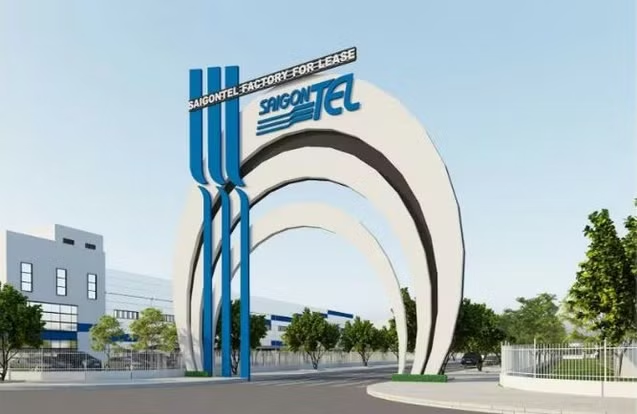
The Saigon Telecommunication & Technologies Corporation (Saigontel) is licensed to provide telecommunications services without network infrastructure. (Illustrative photo: cafef.vn)

Ho Chi Minh (VNA) – The Saigon Telecommunication & Technologies Corporation (Saigontel) has been licensed to provide telecommunications services without network infrastructure and become an authorised distributor of Starlink in Vietnam, adding satellite connectivity to solutions serving businesses and industrial production.

According to Saigontel, the Ho Chi Minh City Department of Science and Technology issued Licence No. 11042/GP-SKHCN to the company on October 8, 2026, valid through December 31, 2030.

Under the licence, Saigontel can resell telecommunications services on public networks, including leased-line services for mobile base stations, Internet access via fixed satellite public telecommunications networks nationwide, and Internet access via mobile satellite public telecommunications networks for maritime connectivity. The services cover both domestic and international communications.

Earlier, Saigontel signed a cooperation agreement with Starlink Vietnam to distribute services within the licensed scope. Developed by SpaceX, Starlink uses a low Earth orbit (LEO) satellite constellation to provide Internet connectivity in areas where terrestrial telecommunications infrastructure is difficult to deploy. It can also provide backup connections for systems requiring uninterrupted communications.

The service can support industrial parks, manufacturing, logistics, construction, energy and maritime transport, as well as factories, mobile base stations, vessels and offshore facilities. Depending on infrastructure conditions and operational requirements, satellite Internet can serve as either a primary or backup connection.

Saigontel is also participating in a pilot programme to eliminate mobile coverage black spots, in coordination with the Authority of Telecommunications under the Ministry of Science and Technology, Starlink Vietnam and departments of science and technology in 13 provinces and cities. The programme plans to install 254 Starlink equipment sets to assess the technology’s applicability in areas with limited connectivity.

Saigontel Chairman Dang Thanh Tam said the partnership with Starlink aims to help businesses address connectivity infrastructure constraints while strengthening investor confidence in building, manufacturing and innovation in Vietnam.

The expansion into satellite telecommunications forms part of Saigontel’s strategy to develop integrated infrastructure spanning four pillars: physical infrastructure, digital infrastructure, energy and social infrastructure. The approach aims to support a sustainable industrial ecosystem, with satellite technology complementing existing connectivity solutions to meet the diverse operational needs of businesses and investors.

By 2030, Saigontel plans to study expanding its platform to include network management, monitoring and information security services, working with telecommunications operators, system integrators and management service providers. The initiative aims to develop integrated enterprise connectivity solutions in compliance with licensing and data protection regulations./.


VNA

See more

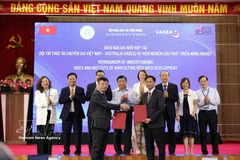
The signing of an MoU between the Department of Digital Technology and Artificial Intelligence and the Institute for Agricultural Research and Development at the forum. (Photo: VNA)

Vietnam, Australia step up digital technology, AI cooperation

An Australian diplomat said Australian businesses are keen to engage in Vietnam’s digital development, particularly in semiconductors, AI and cybersecurity. They also hope to share expertise and support Vietnamese companies in technology and investment.

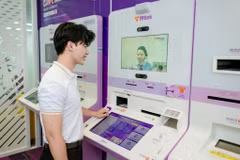
A customer uses the LiveBank 24/7 service of Tien Phong Commercial Joint Stock Bank (TPBank). (Photo: TPBank)

AI adoption in banking requires strict supervision

Banks are increasingly applying AI in data analysis, personalised services, fraud detection and risk management. In August, the Joint Stock Commercial Bank for Foreign Trade of Vietnam (Vietcombank) launched its One Data Platform (ODP) project to support advanced analytics and lay the groundwork for AI and machine learning applications.

Delegates launch the commune-level digital transformation application on October 9 (Photo: VNA)

Commune-level digital transformation app launched

The app is designed to help grassroots officials, businesses, household businesses and citizens find suitable solutions, acquire relevant skills and access consultancy during their digital transformation journey.

Project to build big data database on law approved

Project to build big data database on law approved

The project is expected to help reform lawmaking and law enforcement, advance smart legal governance, promote a culture of legal compliance and make the law a national competitive advantage in the new era.

Vietnam targets modern pharmaceutical chemical industry by 2045. (Illustrative photo: baochinhphu.vn)

Vietnam targets modern pharmaceutical chemical industry by 2045

By 2030, Vietnam aims to master, acquire and transfer advanced technologies and produce selected essential and strategic pharmaceutical ingredients, prioritising active pharmaceutical ingredients (APIs), starting materials, chemical intermediates and excipients.

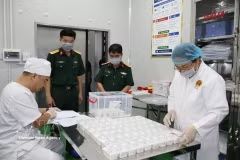
Martyr remains samples from the northern province of Cao Bang are handed over to the Military Institute of Forensic Medicine for DNA analysis. (Photo: VNA)

DNA testing capacity expanded to identify over 207,000 martyrs’ remains

By September 2026, Steering Committee 515 had collected samples from the remains of 207,656 martyrs, achieving 98.15% of the goal. Nearly 120,000 samples have been received and preserved. Additionally, authorities gathered 265,761 DNA samples from martyrs’ relatives, with about 100,000 analysed and around 80,000 results entered into the database.

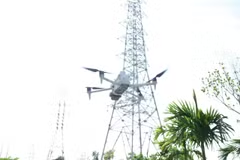
Unmanned aerial vehicle used to inspect power lines. (Photo: VNA)

Hanoi’s power grid modernised through science, technology and data

As the national political and administrative centre and a major hub for economic, scientific, technological and innovation activities, Hanoi is seeing growing demand for energy infrastructure. Rapid urbanisation and the development of industry, services, modern transport, data centres and the digital economy require the capital’s power system to ensure not only daily consumption but also reliable electricity for production and business activities, operations of central agencies, and major political and diplomatic events.​

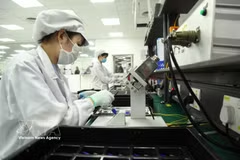
Electronic component production at Star Engineers Vietnam Co., Ltd. in Binh Xuyen Industrial Park, Phu Tho province. (Photo: VNA)

Vietnam turns AI ambitions into tangible business results

AI has become a high or top priority for 69% of surveyed Vietnamese businesses, while 84% expect their use of AI to increase over the next year. Although 61% of adopters remain at the experimentation stage, 71% said their AI investments have already broken even or generated returns.

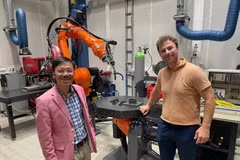
Assoc. Prof. Vu Viet Hung (left) visits a robotic 3D printing facility. (Photo published by VNA)

Vietnam, Canada look to turn strategic partnership into tech projects

Canada's research strength paired with Vietnam's manpower, market size and speed of adoption could address national-level challenges and help small- and medium-sized enterprises modernise production and tap into the international innovation ecosystem, said Assoc. Prof. Vu Viet Hung.

Associate Professor Dang Duc Huy (left) poses for a photo with Canadian Governor General Louise Arbour. (Photo: VNA)

Overseas Vietnamese intellectuals drive innovation

Overseas Vietnamese scientists do not have to return to Vietnam for long-term work to make an impact. They can contribute by joining collaborative research teams, sharing analytical techniques, facilitating access to modern equipment, and linking Vietnam with international labs and universities.

The Better Choice Awards 2026 Gala is a key activity in response to the National Innovation Day 2026 (Photo: qdnd.vn)

Better Choice Awards 2026 honours innovative Vietnamese businesses, tech products

The fourth edition of the awards featured a complete restructuring into four award tracks: Innovative Choice Awards, Smart Choice Awards, Car Choice Awards and the newly introduced Nation Builders Awards. The latter honours businesses contributing to national development by building infrastructure, energy systems and technological capacity for the national economy.

A resident scans a QR code to get a queue number at the public administrative service centre in Hoa Xuan ward, Da Nang city (Photo: VNA)

Localities apply AI, data to drive practical digital transformation

In the central province of Quang Tri, an AI-powered “People’s Assistant” is being piloted from October 1 to 31 at the provincial Public Administration Service Centre and the centres of this kind in Dong Thuan and Dong Ha wards. The system provides information on procedures, required documents, forms and fees, while also supporting declaration and preliminary checks.