Efforts stepped up to harness overseas Vietnamese expertise for national development

The main challenge is how to match overseas Vietnamese experts with domestic needs and utilise their expertise to generate practical results in support of the nation.

More than 60 overseas Vietnamese from 24 countries and territories worldwide join a delegation visiting soldiers and residents on the Truong Sa (Spratly) and DK1 offshore platforms from April 18 to 26, 2025. (Photo: VNA)

Hanoi (VNA) – The Political Bureau's Resolution No. 23-NQ/TW on overseas Vietnamese affairs calls for shifting from mobilising and supporting the community to establishing mechanisms to harness its resources for national development, including in science, technology and innovation.

The main challenge is how to match overseas Vietnamese experts with domestic needs and utilise their expertise to generate practical results in support of the nation.

Matching talented people with right challenges

The resolution identifies the more than 6.5 million Vietnamese people in over 130 countries and territories as an important strategic resource for enhancing national strength, while acknowledging that their potential has yet to be fully tapped. It asked for better and breakthrough policies to connect, attract, and optimise their resources and expertise, including shaping a sustainable ecosystem linking Vietnamese experts, scientists, intellectuals, entrepreneurs, and young people worldwide.

At the 33rd Diplomatic Conference in August 2026, Prime Minister Le Minh Hung stressed that development diplomacy must deliver tangible results within specific timeframes and for clearly identified beneficiaries. He called for a shift “from attracting resources to translating resources into results”, including by engaging overseas Vietnamese talent in national innovation programmes.

He also urged a results-oriented approach and stronger efforts to encourage overseas Vietnamese to transfer knowledge, skills, technology and other resources to support the development of new productive forces at home.

Vietnam has established expert networks in numerous countries and strategic technology fields, but effective cooperation requires clear tasks, appropriate expertise, sufficient resources and transparent arrangements on responsibilities, benefits and expected outcomes. Administrative procedures, financial mechanisms and intellectual property policies also need to be improved.

From inviting experts home to jointly solving problems
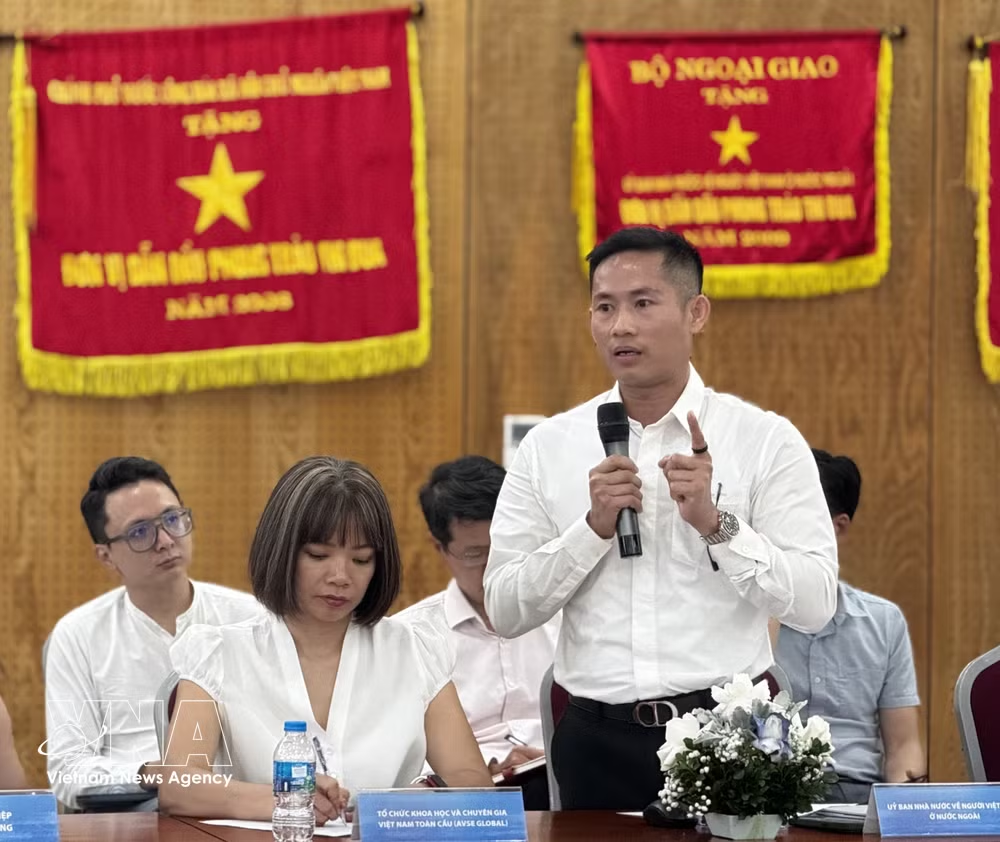
vnanet-phuc-binh.jpg
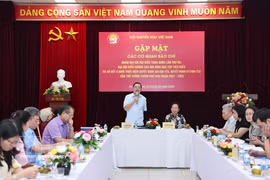
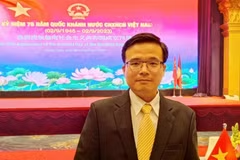
Nguyen Phuc Binh, Chairman of the Vietnam–Australia Innovation Network (NIC-AU), speaks at a conference. (Photo: VNA)

Nguyen Phuc Binh, Chairman of the Vietnam–Australia Innovation Network (NIC-AU), said the main challenge is matching talented people with problems requiring solutions, rather than a lack of expertise or willingness to contribute.

Many young Vietnamese intellectuals in Australia wish to support their homeland, but administrative barriers and unclear arrangements regarding tasks, responsibilities and benefits can hinder their participation.

NIC-AU therefore prioritises finding suitable experts for specific assignments based on practical experience, availability and willingness to contribute, Binh noted.

He proposed developing a “problem bank” to connect domestic needs with overseas expertise, expanding joint research and involving expert networks earlier in policymaking and policy review. Network effectiveness, he said, should be measured by actual partnerships rather than membership numbers.

Meanwhile, ministries, localities, research institutes, universities and businesses need to translate their demand for expertise into specific tasks with clear objectives, expected deliverables, resources and coordination mechanisms.

As many overseas Vietnamese scientists have established careers and research facilities abroad, flexible cooperation arrangements can enable them to contribute without relocating permanently to Vietnam, Binh suggested.

Hanoi University of Science and Technology (HUST) is testing this approach through its HUST Talent scheme.

Dr Ta Anh Son, deputy head of the university’s personnel organisation department, said the scheme offers leading experts working abroad opportunities to participate as invited lecturers, advisers or senior experts, alongside full-time positions. The university aims to connect with around 100 leading overseas experts and scientists by 2030.

Since its launch in October 2025, the scheme had received around 50 applications by June 2026. Son said turning initial interest into concrete cooperation remains challenging as identifying specific problems suited to individual experts often requires further consultation.

HUST is developing a task-based mechanism under which it identifies problems, selects suitable experts and establishes cooperation arrangements with defined timelines, key performance indicators (KPIs), expected deliverables and remuneration.

“Experts’ contributions are expected to be assessed based on the value they create rather than primarily on the time they spend at the university,” Son said.

In 2026–2027, the university plans to pilot the approach in some priority areas such as artificial intelligence, semiconductors and new energy, selecting three to five problems in each field with designated lead units, budgets and specific KPIs.

These efforts reflect the need to move beyond attracting overseas experts towards enabling them to address concrete domestic challenges regardless of where they are.

By clarifying needs, connecting the right people with the right tasks and assessing contributions through results, Vietnam can better turn the intellectual resources of its global Vietnamese community into research, technologies, products, and solutions for national development./.
VNA

See more

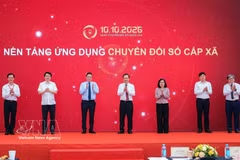
Delegates launch the commune-level digital transformation application on October 9 (Photo: VNA)

Commune-level digital transformation app launched

The app is designed to help grassroots officials, businesses, household businesses and citizens find suitable solutions, acquire relevant skills and access consultancy during their digital transformation journey.

Project to build big data database on law approved

Project to build big data database on law approved

The project is expected to help reform lawmaking and law enforcement, advance smart legal governance, promote a culture of legal compliance and make the law a national competitive advantage in the new era.

Vietnam targets modern pharmaceutical chemical industry by 2045. (Illustrative photo: baochinhphu.vn)

Vietnam targets modern pharmaceutical chemical industry by 2045

By 2030, Vietnam aims to master, acquire and transfer advanced technologies and produce selected essential and strategic pharmaceutical ingredients, prioritising active pharmaceutical ingredients (APIs), starting materials, chemical intermediates and excipients.

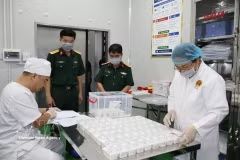
Martyr remains samples from the northern province of Cao Bang are handed over to the Military Institute of Forensic Medicine for DNA analysis. (Photo: VNA)

DNA testing capacity expanded to identify over 207,000 martyrs’ remains

By September 2026, Steering Committee 515 had collected samples from the remains of 207,656 martyrs, achieving 98.15% of the goal. Nearly 120,000 samples have been received and preserved. Additionally, authorities gathered 265,761 DNA samples from martyrs’ relatives, with about 100,000 analysed and around 80,000 results entered into the database.

Unmanned aerial vehicle used to inspect power lines. (Photo: VNA)

Hanoi’s power grid modernised through science, technology and data

As the national political and administrative centre and a major hub for economic, scientific, technological and innovation activities, Hanoi is seeing growing demand for energy infrastructure. Rapid urbanisation and the development of industry, services, modern transport, data centres and the digital economy require the capital’s power system to ensure not only daily consumption but also reliable electricity for production and business activities, operations of central agencies, and major political and diplomatic events.​

Electronic component production at Star Engineers Vietnam Co., Ltd. in Binh Xuyen Industrial Park, Phu Tho province. (Photo: VNA)

Vietnam turns AI ambitions into tangible business results

AI has become a high or top priority for 69% of surveyed Vietnamese businesses, while 84% expect their use of AI to increase over the next year. Although 61% of adopters remain at the experimentation stage, 71% said their AI investments have already broken even or generated returns.

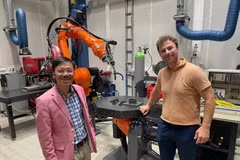
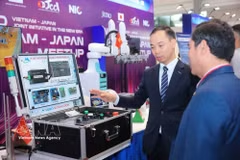
Assoc. Prof. Vu Viet Hung (left) visits a robotic 3D printing facility. (Photo published by VNA)

Vietnam, Canada look to turn strategic partnership into tech projects

Canada's research strength paired with Vietnam's manpower, market size and speed of adoption could address national-level challenges and help small- and medium-sized enterprises modernise production and tap into the international innovation ecosystem, said Assoc. Prof. Vu Viet Hung.

The Better Choice Awards 2026 Gala is a key activity in response to the National Innovation Day 2026 (Photo: qdnd.vn)

Better Choice Awards 2026 honours innovative Vietnamese businesses, tech products

The fourth edition of the awards featured a complete restructuring into four award tracks: Innovative Choice Awards, Smart Choice Awards, Car Choice Awards and the newly introduced Nation Builders Awards. The latter honours businesses contributing to national development by building infrastructure, energy systems and technological capacity for the national economy.

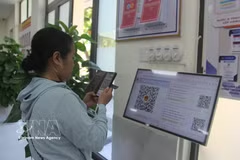
A resident scans a QR code to get a queue number at the public administrative service centre in Hoa Xuan ward, Da Nang city (Photo: VNA)

Localities apply AI, data to drive practical digital transformation

In the central province of Quang Tri, an AI-powered “People’s Assistant” is being piloted from October 1 to 31 at the provincial Public Administration Service Centre and the centres of this kind in Dong Thuan and Dong Ha wards. The system provides information on procedures, required documents, forms and fees, while also supporting declaration and preliminary checks.

Science, technology and innovation products on display. (Photo: VNA)

Businesses must be at heart of innovation: Deputy PM

“Businesses must be placed at the centre of this process,” he said, noting that enterprises understand market demand, formulate practical requirements, invest resources, adopt and master technologies, organise production and bring products to consumers.

The Vietnamese Ministry of Public Security's delegation holds a discussion with representatives of the WIPO's Advisory Committee on Enforcement. (Photo: VNA)

WIPO innovation report viewed through Resolution 57 perspective

He said the GII 2026 results should be viewed in the broader context of Vietnam’s implementation of Resolution No. 57-NQ/TW, which identifies science and technology, innovation and national digital transformation as key breakthroughs and major drivers for developing modern productive forces and enhancing economic competitiveness.

Minister of Science and Technology Vu Hai Quan (left) meets with Japanese Minister of Internal Affairs and Communications Fujii Hisayuki (Photo: VNA)

Vietnam, Japan expand cooperation in strategic technology fields

Meeting with Japanese Minister of Education, Culture, Sports, Science and Technology Seki Yoshihiro on October 2, Minister of Science and Technology Vu Hai Quan proposed the Japanese side continue providing postgraduate scholarships, particularly at master's and doctoral levels in strategic technological sectors, facilitate exchanges among students and researchers, and maintain support for the Vietnam Japan University (VJU).