DNA testing capacity expanded to identify over 207,000 martyrs’ remains

By September 2026, Steering Committee 515 had collected samples from the remains of 207,656 martyrs, achieving 98.15% of the goal. Nearly 120,000 samples have been received and preserved. Additionally, authorities gathered 265,761 DNA samples from martyrs’ relatives, with about 100,000 analysed and around 80,000 results entered into the database.

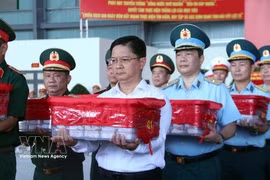
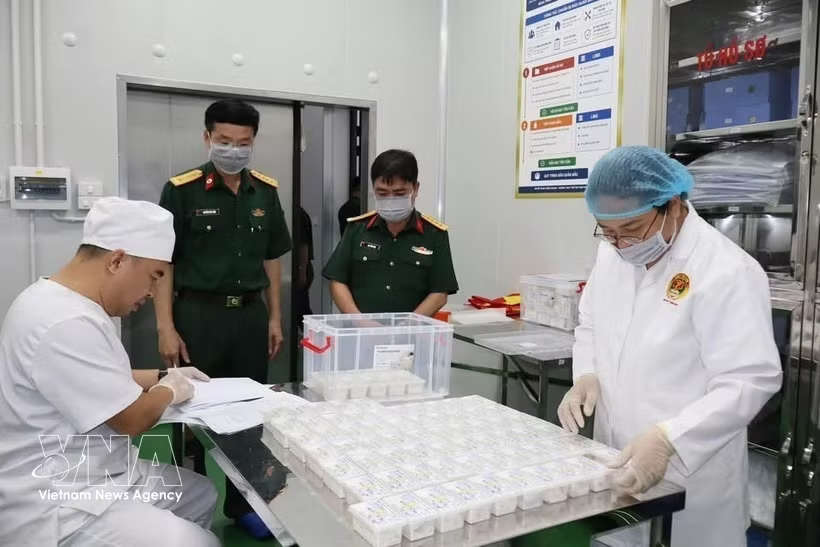
Martyr remains samples from the northern province of Cao Bang are handed over to the Military Institute of Forensic Medicine for DNA analysis. (Photo: VNA)

Hanoi (VNA) – Efforts are being stepped up to expand DNA testing capacity and apply next-generation sequencing technology to improve the identification of more than 207,000 fallen soldiers' remains whose DNA samples have been collected.

The identification of martyr remains is being carried out through both physical evidence and DNA testing, with greater use of next-generation sequencing (NGS) technology to increase chances for identifying remains that have undergone extensive decomposition. The Prime Minister's Decision No. 150/QD-TTg, dated January 14, 2013, provides the foundation for DNA testing to identify the remains of martyrs.

Under the National Steering Committee for the Search for, Collection and Identification of Martyrs’ Remains (Steering Committee 515), units involved in the 500-day campaign have been tasked with testing 18,000 samples of remains, including more than 17,000 samples collected before Government Resolution No. 26/2026/NQ-CP took effect. The 2026 target is 9,000 samples collected before July 1, 2025.

Four units are responsible for DNA testing, including the Military Institute of Forensic Medicine under the Ministry of National Defence, the Institute of Criminal Sciences under the Ministry of Public Security, the National Institute of Forensic Medicine under the Ministry of Public Health, and the Institute of Biology under the Vietnam Academy of Science and Technology.

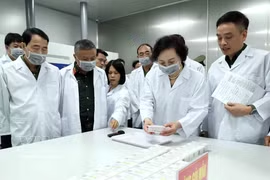
The Military Institute of Forensic Medicine currently uses the Sanger method for mitochondrial DNA testing, with a capacity of about 800 samples a year. From 2021 to 2025, it received nearly 15,000 samples, tested nearly 4,000, and identified 558 martyrs through DNA matching. The institute is also coordinating with the Vietnam Academy of Science and Technology (VAST) to apply next-generation sequencing and single nucleotide polymorphism (NGS-SNP) technology, with Vingroup’s Thien Tam Foundation supporting technology transfer and equipment.

The National Institute of Forensic Medicine is also using the traditional Sanger sequencing method while successfully piloting NGS and researching single-nucleotide polymorphism (SNP) technology, but faces shortages in specialised equipment and personnel. Meanwhile, the Institute of Biology is coordinating in the transfer of NGS-SNP technology with five testing units. The first batch of equipment is expected to be handed over in October 2026 and the second in March 2027, along with chemicals for testing 3,000 samples of remains and 3,000 relatives’ samples.

The initial trials showed promising results. In 2025, the NGS-SNP technology was used on 58 samples from Tra Linh Martyrs Cemetery in Cao Bang province, with 54 producing SNP data fit for matching. Matches were successfully made with 14 families, leading to the identification of five martyrs. In 2026, the pilot extended to Giong Rieng Martyrs Cemetery in An Giang province, where 965 graves were excavated and 535 samples gathered.

By September 2026, Steering Committee 515 had collected samples from the remains of 207,656 martyrs, achieving 98.15% of the goal. Nearly 120,000 samples have been received and preserved. Additionally, authorities gathered 265,761 DNA samples from martyrs’ relatives, with about 100,000 analysed and around 80,000 results entered into the database.

However, testing capacity remains limited due to shortages in personnel, equipment, and chemicals, while funding was only allocated from August 2026. Storage infrastructure is also under pressure. The Ministry of National Defence has upgraded Warehouse 708 to store about 110,000 samples and begun building a facility capable of storing about 300,000 samples, targeted for completion before April 30, 2027.

At a recent conference between the Government and localities, Deputy Prime Minister Pham Thi Thanh Tra, head of Steering Committee 515, asked localities to complete remains sampling in 2026, while urging the Ministry of Public Security and localities to collect additional biological samples from martyrs’ relatives to support the application of next-generation DNA technology./.

VNA
See more

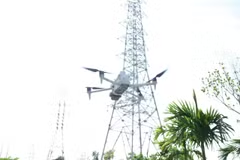
Unmanned aerial vehicle used to inspect power lines. (Photo: VNA)

Hanoi’s power grid modernised through science, technology and data

As the national political and administrative centre and a major hub for economic, scientific, technological and innovation activities, Hanoi is seeing growing demand for energy infrastructure. Rapid urbanisation and the development of industry, services, modern transport, data centres and the digital economy require the capital’s power system to ensure not only daily consumption but also reliable electricity for production and business activities, operations of central agencies, and major political and diplomatic events.​

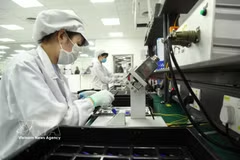
Electronic component production at Star Engineers Vietnam Co., Ltd. in Binh Xuyen Industrial Park, Phu Tho province. (Photo: VNA)

Vietnam turns AI ambitions into tangible business results

AI has become a high or top priority for 69% of surveyed Vietnamese businesses, while 84% expect their use of AI to increase over the next year. Although 61% of adopters remain at the experimentation stage, 71% said their AI investments have already broken even or generated returns.

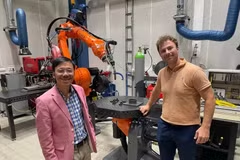
Assoc. Prof. Vu Viet Hung (left) visits a robotic 3D printing facility. (Photo published by VNA)

Vietnam, Canada look to turn strategic partnership into tech projects

Canada's research strength paired with Vietnam's manpower, market size and speed of adoption could address national-level challenges and help small- and medium-sized enterprises modernise production and tap into the international innovation ecosystem, said Assoc. Prof. Vu Viet Hung.

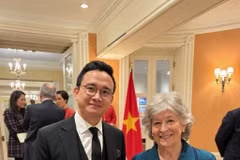
Associate Professor Dang Duc Huy (left) poses for a photo with Canadian Governor General Louise Arbour. (Photo: VNA)

Overseas Vietnamese intellectuals drive innovation

Overseas Vietnamese scientists do not have to return to Vietnam for long-term work to make an impact. They can contribute by joining collaborative research teams, sharing analytical techniques, facilitating access to modern equipment, and linking Vietnam with international labs and universities.

The Better Choice Awards 2026 Gala is a key activity in response to the National Innovation Day 2026 (Photo: qdnd.vn)

Better Choice Awards 2026 honours innovative Vietnamese businesses, tech products

The fourth edition of the awards featured a complete restructuring into four award tracks: Innovative Choice Awards, Smart Choice Awards, Car Choice Awards and the newly introduced Nation Builders Awards. The latter honours businesses contributing to national development by building infrastructure, energy systems and technological capacity for the national economy.

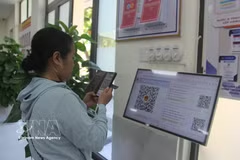
A resident scans a QR code to get a queue number at the public administrative service centre in Hoa Xuan ward, Da Nang city (Photo: VNA)

Localities apply AI, data to drive practical digital transformation

In the central province of Quang Tri, an AI-powered “People’s Assistant” is being piloted from October 1 to 31 at the provincial Public Administration Service Centre and the centres of this kind in Dong Thuan and Dong Ha wards. The system provides information on procedures, required documents, forms and fees, while also supporting declaration and preliminary checks.

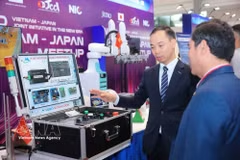
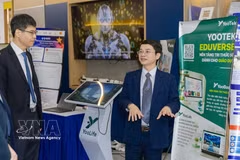
Science, technology and innovation products on display. (Photo: VNA)

Businesses must be at heart of innovation: Deputy PM

“Businesses must be placed at the centre of this process,” he said, noting that enterprises understand market demand, formulate practical requirements, invest resources, adopt and master technologies, organise production and bring products to consumers.

The Vietnamese Ministry of Public Security's delegation holds a discussion with representatives of the WIPO's Advisory Committee on Enforcement. (Photo: VNA)

WIPO innovation report viewed through Resolution 57 perspective

He said the GII 2026 results should be viewed in the broader context of Vietnam’s implementation of Resolution No. 57-NQ/TW, which identifies science and technology, innovation and national digital transformation as key breakthroughs and major drivers for developing modern productive forces and enhancing economic competitiveness.

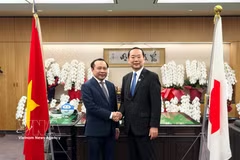
Minister of Science and Technology Vu Hai Quan (left) meets with Japanese Minister of Internal Affairs and Communications Fujii Hisayuki (Photo: VNA)

Vietnam, Japan expand cooperation in strategic technology fields

Meeting with Japanese Minister of Education, Culture, Sports, Science and Technology Seki Yoshihiro on October 2, Minister of Science and Technology Vu Hai Quan proposed the Japanese side continue providing postgraduate scholarships, particularly at master's and doctoral levels in strategic technological sectors, facilitate exchanges among students and researchers, and maintain support for the Vietnam Japan University (VJU).

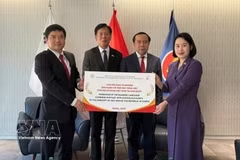
Minister of Science and Technology Vu Hai Quan (second, right) witnesses Director of the Posts and Telecommunications Institute of Technology Dang Hoai Bac presenting the Vietnamese-learning app to representatives of the Vietnamese Embassy in the Republic of Korea. (Photo: VNA)

Vietnamese-learning app presented to community in RoK

The initiative aims to support language learning among children growing up in more than 100,000 Vietnamese-Korean multicultural families, while helping preserve Vietnamese cultural identity and strengthen their ties with their homeland.

Prof. Dr. Nguyen Ngoc Diep (R), Director of the Australia-Vietnam Strategic Technologies Centre, introduces strategic technology products to delegates at the forum. (Photo: VNA)

Strategic technologies expand space for Vietnam - Australia cooperation

Vietnamese Deputy Minister of Science and Technology Tran Trung Tinh said that amid global uncertainties, strategic technologies are becoming a decisive driver of national competitiveness and sustainable development. Vietnam has identified science, technology, innovation and digital transformation as key strategic breakthroughs.