Science, technology seen as lever for medicinal plant industry

Vietnam is one of the world’s biodiversity-rich countries, with more than 5,100 medicinal plant and fungal species, along with hundreds of animal and mineral species used in traditional medicine.

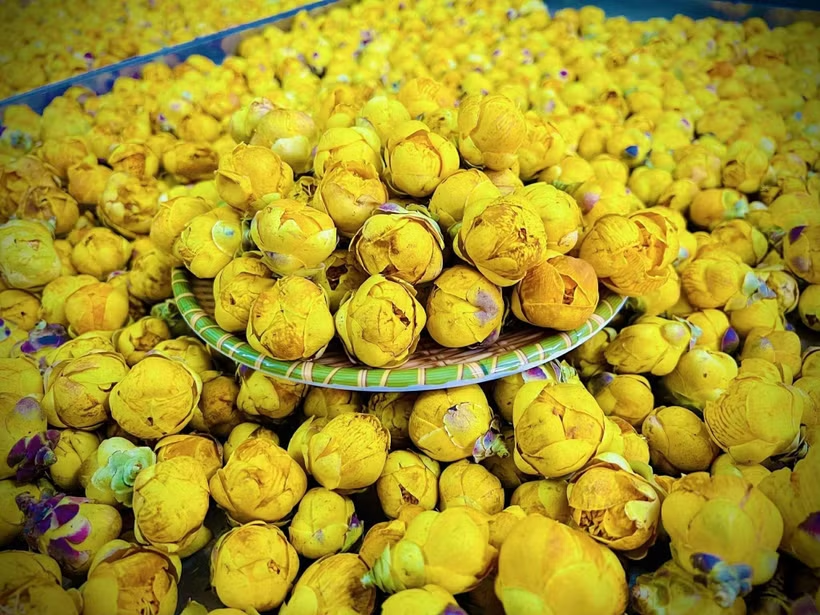
The golden camellia, a valuable medicinal plant, is widely cultivated in Thai Nguyen province. (Photo published by VNA)

Hanoi (VNA) – With rich medicinal resources and a long history of traditional medicine, Vietnam has the potential to develop an internationally competitive medicinal plant industry. However, turning this potential into reality requires stronger policies and greater use of science and technology.

Vietnam is one of the world’s biodiversity-rich countries, with more than 5,100 medicinal plant and fungal species, along with hundreds of animal and mineral species used in traditional medicine. From physician Tue Tinh’s principle of using local herbs to treat local people to the contributions of Hai Thuong Lan Ong Le Huu Tracn, one of the most prominent physicians in the history of Vietnamese traditional medicine, Vietnam has built a rich body of traditional medical knowledge.

Over the years, gene conservation networks in different ecological regions have preserved 964 genetic resources belonging to 642 medicinal plant species, including valuable species such as Ngoc Linh ginseng, Lai Chau ginseng, red fleeceflower root and golden camellia.
​

vnanet_potal-da-nang-vung-dat-cua-loai-sam-tot-nhat-the-gioi-8885369.jpg
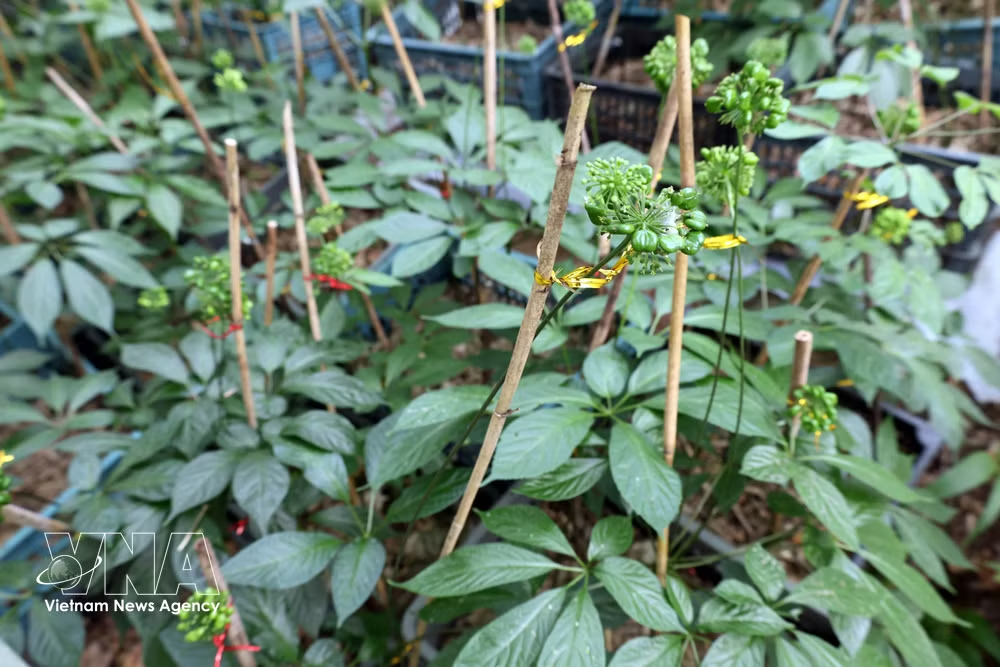
Ngoc Linh ginseng is a high-value endemic crop that Da Nang city has identified as a key medicinal plant. (Photo: VNA)

Research into restoration and propagation has also expanded. Around 70 species or groups of species have the potential for exploitation, with estimated reserves of 18,372 tonnes a year. The total area devoted to medicinal plants is estimated at 357,178ha, with about 150 species being cultivated.

However, only 58 medicinal plant species are currently cultivated under GACP-WHO standards, covering about 375ha with expected output of 1,400 tonnes a year. Most medicinal plants are still grown, harvested and preliminarily processed using traditional methods.

Dr Nguyen Minh Ngoc, Director of the National Institute of Medicinal Materials under the Ministry of Health, said medicinal raw materials for pharmaceutical production must meet strict requirements for chemical composition, active ingredients, purity and safety, in addition to being correctly identified by species and plant part.

The highest value lies in research into active ingredients and mechanisms of action, extraction, purification, standardisation and formulation, as well as scientific evidence on product efficacy and safety.

Vietnam has many medicinal plants but has yet to produce enough high-quality medicines from them, Ngoc said. High-value stages such as advanced extraction technology, modern formulation, scientific evidence, and intellectual property remain limited.

The application of GACP-WHO, Good Manufacturing Practice (GMP), Good Laboratory Practice (GLP) and Good Storage Practice (GSP) standards is also not yet consistent across the value chain. Research capacity, innovation and the commercialisation of research results remain limited, with some scientific projects stopping at publications or pilot models.

Nguyen Viet Hung, General Director of Gia Dinh Medicinal Materials Co., Ltd., said one reason was that the medicinal plant industry had not been fully recognised as part of the digital, green and circular economies. Medicinal plants are often viewed mainly as traditional remedies, while globally the sector is increasingly linked with biotechnology, pharmaceuticals, functional foods, smart agriculture, and the healthcare market.
vnanet_potal-hung-yen-phat-trien-san-xuat-cay-duoc-lieu-8893770.jpg
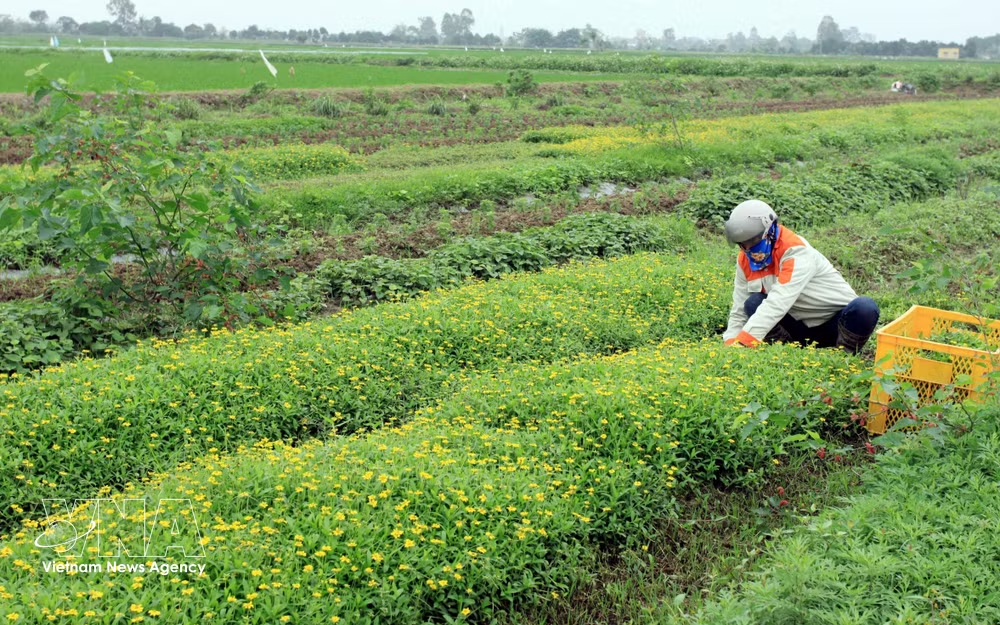
Currently, Hung Yen province has approximately 2,000 hectares of annual and perennial medicinal and aromatic plants. (Photo: VNA)

Politburo Resolution No. 57-NQ/TW identifies science, technology, innovation, and digital transformation as breakthrough drivers for sustainable national development. Together with Resolutions No. 66-NQ/TW on reforming law-building and enforcement to meet the requirements of national development in the new era and Resolution 68-NQ/TW on the development of the private economic sector, Resolution No. 57-NQ/TW provides an important institutional foundation for knowledge-intensive sectors, including the medicinal plant industry, to shift from resources-based to technology- and innovation-driven development.

Ngoc said science and technology should be applied throughout the value chain, from genetic resources, varieties and cultivation areas to extraction, formulation, testing and pharmaceutical production.

He also called for the development of a national programme on medicinal plants and herbal medicines, linked with national strategies on science, technology, innovation and digital transformation./.


VNA

See more

An overview of the meeting between Deputy Prime Minister Pham Thi Thanh Tra and César Louis-Philip Marseille, Managing Director of VAMED Engineering GmbH of Austria and member of the Board of Directors of VAMED+WWH Group of Germany,in Hanoi on October 7. (Photo: VNA)

Deputy PM suggests studying long-term development of hospital ship model

Vietnam is one of VAMED’s important partners in Southeast Asia. The group plans to invest 1.2 billion EUR in Vietnam over the next five years, creating jobs for thousands of workers and promoting knowledge and technology transfer. It also wishes to expand cooperation through preferential credit projects, public-private partnerships (PPPs) and partnerships with private enterprises; and supply medical products from Austria and Germany for Vietnamese partners.

The Son Tra regional medical centre (Photo: benhviensontra.com.vn)

Da Nang: Satellite hospitals prove effective at grassroots level

The model is an important component of the roadmap to turn Da Nang into a specialised medical centre for the central and Central Highlands regions, with a number of key specialties, in line with the spirit of Politburo Resolution No. 72-NQ/TW dated September 9, 2025, on breakthrough solutions to strengthen the protection, care and improvement of people's health.

Illustrative image (Photo: daibieunhandan.vn)

Ho Chi Minh City digitises 99.4% of hospital records

As of July 2026, 163 of the city's 164 hospitals, or 99.4%, adopted electronic medical records, the report said. About 64% of public hospitals and 65% of private hospitals now run the technology across their entire operations

Yersin International Clinic in Ho Chi Minh City. (Photo: VNA)

Ho Chi Minh City eyes more foreign medical tourists

Director of the municipal Department of Health Tang Chi Thuong said a key prerequisite for attracting foreign patients is a strategy to develop centres of medical excellence. He proposed selecting hospitals and specialties with strong expertise for investment towards international standards, particularly in competitive fields such as cardiology, oncology, robotic surgery, assisted reproduction, paediatrics, dentistry, cosmetic medicine, specialised health check-ups, traditional medicine and rehabilitation.

A nurse from Children's Hospital No. 1, Ho Chi Minh City, collects a blood sample for HIV testing from an infant. (Illustrative photo: VNA)

Health cooperation adds fresh momentum to Vietnam-US relations

Through this MOU, the US Department of State, working with Congress, plans to provide 98.75 million USD in life-saving global health assistance over the next five years, including 21.385 million USD in dedicated Global Health Security funding, to support Vietnam’s transition to full country ownership of its HIV/AIDS and tuberculosis programmes while strengthening its capacity to detect and respond to emerging and re-emerging infectious disease threats.

Minister of Health Dao Hong Lan and US Ambassador to Vietnam Jennifer McNamara Wick sign the memorandum of understanding on health cooperation. (Photo: US Embassy in Vietnam)

Vietnam, US launch five-year health cooperation

The cooperation will also support Vietnam in strengthening its healthcare capacity and gradually enhancing self-reliance in HIV/AIDS and tuberculosis prevention and control programmes, as well as in responding to emerging and re-emerging infectious diseases.

Director of the Ho Chi Minh City Department of Health Tang Chi Thuong (third, right) presents flowers to congratulate six young doctors who have volunteered to work at grassroots-level health stations (Photo: VNA)

Ho Chi Minh City strengthens grassroots healthcare workforce

Ho Chi Minh City's Department of Health on September 10 reviewed a pilot programme combining hospital-based practice with work at grassroots health stations and organised the fourth healthcare job fair, attracting nearly 1,000 candidates and 94 recruiters offering 806 positions.

Children undergo health screening. (Photo: Dong Da General Hospital in Hanoi)

Vietnam to screen students nationwide for five health risks from 2028

Vietnam will launch nationwide screening for five groups of school-related diseases and health conditions among students from preschool through high school from 2028, including overweight and obesity, refractive errors, spinal curvature, oral diseases and mental health disorders.