Vietnam reaches out to WHO after death of Russian lab worker

Vietnam reaches out to WHO after death of Russian lab worker

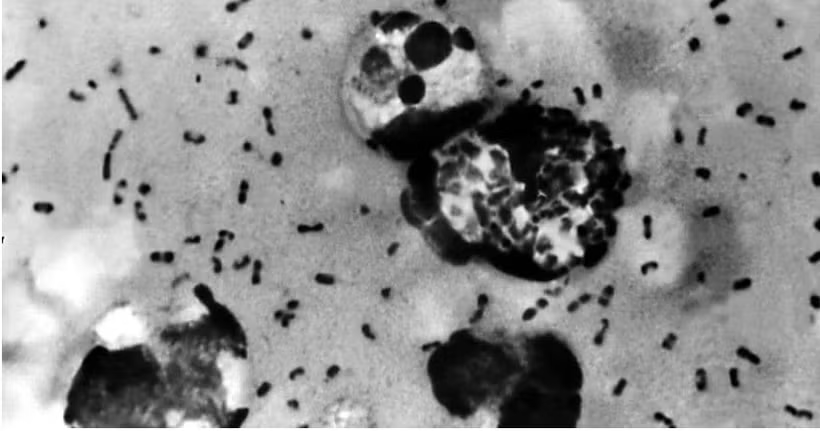
The bacterium Yersinia pestis causes plague, with bubonic plague being the most common form. Photo: US Centres for Disease Control and Prevention (CDC)

Hanoi (VNA) - The Ministry of Health’s Department of Disease Control, which serves as Vietnam’s national focal point under the International Health Regulations (IHR), has contacted the World Health Organisation (WHO) Office in the country to verify reports that a lab worker in Russia's Irkutsk region died of pneumonia of unknown cause.

The WHO said on October 7 that it is closely monitoring the situation and engaging with the relevant authorities.

The worker, employed at the Irkutsk Anti-Plague Research Institute, died on October 2 after being hospitalised with severe pneumonia.

Russian health authorities told the WHO that no recent plague cases have been recorded in Irkutsk.

Russia has conducted an epidemiological investigation and put prevention and control measures in place, authorities said. Contacts of the deceased have been identified for medical monitoring and testing.

No high-risk pathogens were found among the contacts, and medical monitoring of all of them has finished, the WHO said.

The WHO is continuing to work with Russian authorities to verify media reports and gather more information to assess any implications for international public health.

The department said it will keep working with the WHO to monitor the situation, assess risks and promptly take disease prevention and control measures as needed.

It urged residents to stay calm and follow updates from the ministry and official health authorities, and not to panic over, or share unverified information about the disease.

The ministry also advised keeping the environment clean and controlling rodents and fleas. Residents should avoid touching, catching or handling sick or unusually dead rodents without proper protection.

Those who may have been exposed to suspected sources of infection, or have travelled to outbreak areas, should seek immediate medical care if they develop sudden high fever, painful swollen lymph nodes, cough, chest pain or difficulty breathing. They should not take antibiotics without medical advice.

The department said it will keep updating the situation, assessing risks and providing timely, transparent information to help residents protect themselves and their communities./.

​

VNA

See more

An overview of the meeting between Deputy Prime Minister Pham Thi Thanh Tra and César Louis-Philip Marseille, Managing Director of VAMED Engineering GmbH of Austria and member of the Board of Directors of VAMED+WWH Group of Germany,in Hanoi on October 7. (Photo: VNA)

Deputy PM suggests studying long-term development of hospital ship model

Vietnam is one of VAMED’s important partners in Southeast Asia. The group plans to invest 1.2 billion EUR in Vietnam over the next five years, creating jobs for thousands of workers and promoting knowledge and technology transfer. It also wishes to expand cooperation through preferential credit projects, public-private partnerships (PPPs) and partnerships with private enterprises; and supply medical products from Austria and Germany for Vietnamese partners.

The Son Tra regional medical centre (Photo: benhviensontra.com.vn)

Da Nang: Satellite hospitals prove effective at grassroots level

The model is an important component of the roadmap to turn Da Nang into a specialised medical centre for the central and Central Highlands regions, with a number of key specialties, in line with the spirit of Politburo Resolution No. 72-NQ/TW dated September 9, 2025, on breakthrough solutions to strengthen the protection, care and improvement of people's health.

Illustrative image (Photo: daibieunhandan.vn)

Ho Chi Minh City digitises 99.4% of hospital records

As of July 2026, 163 of the city's 164 hospitals, or 99.4%, adopted electronic medical records, the report said. About 64% of public hospitals and 65% of private hospitals now run the technology across their entire operations

Yersin International Clinic in Ho Chi Minh City. (Photo: VNA)

Ho Chi Minh City eyes more foreign medical tourists

Director of the municipal Department of Health Tang Chi Thuong said a key prerequisite for attracting foreign patients is a strategy to develop centres of medical excellence. He proposed selecting hospitals and specialties with strong expertise for investment towards international standards, particularly in competitive fields such as cardiology, oncology, robotic surgery, assisted reproduction, paediatrics, dentistry, cosmetic medicine, specialised health check-ups, traditional medicine and rehabilitation.

A nurse from Children's Hospital No. 1, Ho Chi Minh City, collects a blood sample for HIV testing from an infant. (Illustrative photo: VNA)

Health cooperation adds fresh momentum to Vietnam-US relations

Through this MOU, the US Department of State, working with Congress, plans to provide 98.75 million USD in life-saving global health assistance over the next five years, including 21.385 million USD in dedicated Global Health Security funding, to support Vietnam’s transition to full country ownership of its HIV/AIDS and tuberculosis programmes while strengthening its capacity to detect and respond to emerging and re-emerging infectious disease threats.

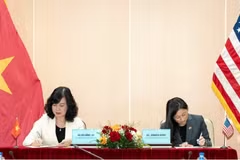
Minister of Health Dao Hong Lan and US Ambassador to Vietnam Jennifer McNamara Wick sign the memorandum of understanding on health cooperation. (Photo: US Embassy in Vietnam)

Vietnam, US launch five-year health cooperation

The cooperation will also support Vietnam in strengthening its healthcare capacity and gradually enhancing self-reliance in HIV/AIDS and tuberculosis prevention and control programmes, as well as in responding to emerging and re-emerging infectious diseases.

Director of the Ho Chi Minh City Department of Health Tang Chi Thuong (third, right) presents flowers to congratulate six young doctors who have volunteered to work at grassroots-level health stations (Photo: VNA)

Ho Chi Minh City strengthens grassroots healthcare workforce

Ho Chi Minh City's Department of Health on September 10 reviewed a pilot programme combining hospital-based practice with work at grassroots health stations and organised the fourth healthcare job fair, attracting nearly 1,000 candidates and 94 recruiters offering 806 positions.

Children undergo health screening. (Photo: Dong Da General Hospital in Hanoi)

Vietnam to screen students nationwide for five health risks from 2028

Vietnam will launch nationwide screening for five groups of school-related diseases and health conditions among students from preschool through high school from 2028, including overweight and obesity, refractive errors, spinal curvature, oral diseases and mental health disorders.

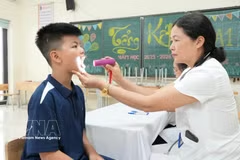
A doctor provides dental checkup for a student. (Photo: VNA)

Free health checkups for children ahead of new school year

According to the Hanoi Department of Health, the city has 4,776 educational institutions with more than 2.2 million preschool and school students. The health campaign will run from August 18 to September 4, targeting 100% coverage before the new school year begins.