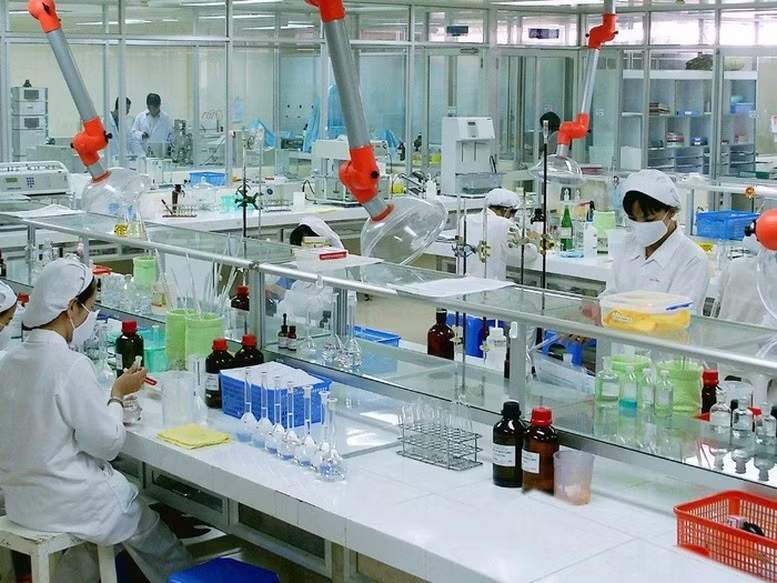
Hanoi (VNA) – The Government has approved a programme on developing Vietnam’s pharmaceutical chemical industry into a modern and high-tech sector with high added value and competitiveness by 2045, aiming to strengthen domestic production capacity, reduce reliance on imported pharmaceutical ingredients and ensure national medicine security.
Under Decision No. 1954/QD-TTg dated October 8, 2026, the programme seeks to strengthen research, innovation, technology acquisition and transfer, and domestic capacity to manufacture pharmaceutical ingredients. It also aims to establish industrial-scale production of essential and strategic ingredients and build an integrated ecosystem linking research, training, technology transfer, manufacturing and commercialisation.
By 2030, Vietnam aims to master, acquire and transfer advanced technologies and produce selected essential and strategic pharmaceutical ingredients, prioritising active pharmaceutical ingredients (APIs), starting materials, chemical intermediates and excipients.
The programme targets at least two advanced pharmaceutical chemical research and development centres meeting international standards, with capabilities in process development, testing, scale-up, technology transfer and commercialisation.
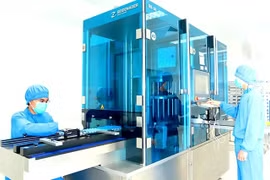
All domestic facilities producing pharmaceutical ingredients are expected to meet applicable quality, Good Manufacturing Practice (GMP) and chemical safety requirements. At least 50% of them are to apply digital solutions in production, quality management, and traceability.
The programme also seeks to commercialise high-value-added technologies and products, particularly those that can replace imports, meet domestic manufacturing needs and offer export potential. Exports of high-value-added pharmaceutical chemical products are targeted to grow by at least 10% annually.
By 2045, Vietnam aims to establish a modern, competitive pharmaceutical chemical industry with high added value and a relatively comprehensive ecosystem spanning research, innovation, technology development, manufacturing and commercialisation.
The country also seeks to master selected technologies, develop competitive advantages in essential and strategic pharmaceutical ingredients, improve self-reliance in supplies and strengthen its capacity to respond to supply chain disruptions. It aims to expand the production of high-value-added products that are capable of engaging deeply into regional and global value chains.
To achieve these goals, the programme outlines measures covering institutions and legislation, science and technology, human resources, international cooperation, trade promotion, communications, finance and investment.
Priority will be given to advanced technologies in synthesis, extraction, purification, biotechnology, peptides and other processes for producing high-value-added pharmaceutical chemicals. Businesses will be supported in acquiring, mastering, refining, scaling up and transferring technologies, particularly for high-demand APIs, essential medicines and import-substituting products.
The programme also emphasises specialised training in synthetic and process chemistry, biotechnology, analytical techniques, GMP, quality assurance and control, technology transfer, smart manufacturing, digital transformation and chemical safety. Cooperation among businesses, universities and research institutions will be strengthened to align training with businesses’ demands.
International cooperation will focus on technology acquisition, personnel training, selective investment attraction, market expansion and deeper integration into regional and global pharmaceutical and chemical value chains.
Priority will be given to countries with strengths in pharmaceutical ingredients, chemical intermediates, active pharmaceutical ingredients, excipients, biotechnology and advanced pharmaceutical technologies, as well as research institutions, universities and multinational pharmaceutical and chemical corporations with expertise in research, development, manufacturing and technology transfer.
The programme also underlined the need to enhance international cooperation on standards, quality, testing, GMP and conformity assessment to improve Vietnam’s capacity to manufacture and export pharmaceutical ingredients. Partnerships will prioritise projects delivering concrete results in technology, products, investment, human resources and market access./.