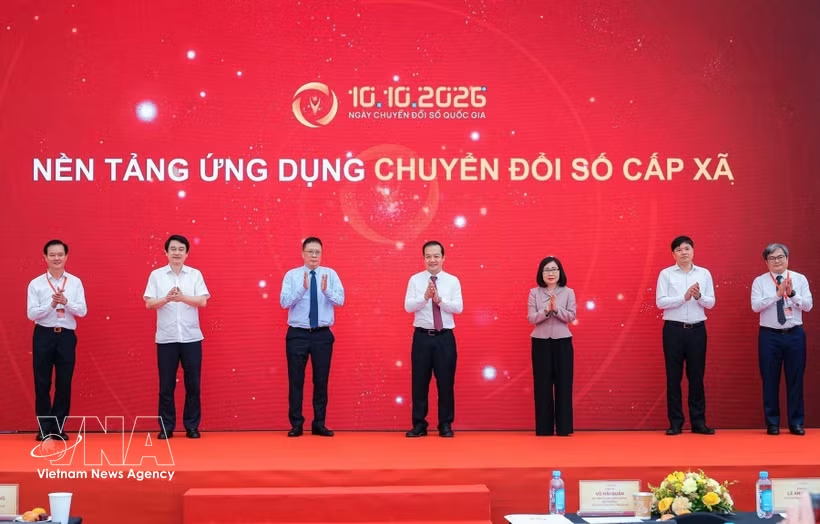
Hanoi (VNA) - The Ministry of Science and Technology launched a commune-level digital transformation application on October 9 as part of activities marking National Digital Transformation Day 2026.
The app is designed to help grassroots officials, businesses, household businesses and citizens find suitable solutions, acquire relevant skills and access consultancy during their digital transformation journey.
The ministry, tasked with coordinating with other ministries and sectors to review, standardise and publish a list of products and solutions to promote the digital transformation market, has announced a list of 1,591 products and solutions developed or supplied by 360 entities.
The list is organised around three pillars: digital government, digital economy and digital society, providing a centralised source of information on available market offerings.
However, the large number of options makes it challenging for commune-level officials, small businesses, household businesses and citizens to identify suitable solutions. Needs at the grassroots level often arise from specific practical issues, such as work management, online sales and digital payments, rather than from the selection of technology itself.
The commune-level digital transformation app was developed to help users identify solutions suited to their needs and determine how to begin implementation. It seeks to answer a practical question: given a particular problem, which solution is appropriate and where should implementation start?
The app does not replace operational software already in use by local authorities or introduce new administrative procedures at commune level. Instead, it serves as a tool for guidance and connection, helping grassroots users approach digital transformation from their actual needs.
It provides a support process covering needs identification, reference models, solution searches, skills development, consultancy requests and feedback on practical results.
User interactions and feedback will also give the Ministry of Science and Technology a clearer picture of grassroots needs, helping it refine policies and guide the development of the market for digital transformation products and solutions. The app is intended to foster a shared space where organisations can seek solutions, learn from effective models and share practical experience.
The app has been officially available since September 22, 2026, at https://ungdungcdscapxa.dx.gov.vn/.
During implementation, provincial and municipal Departments of Science and Technology will serve as local focal points, while commune-level People's Committees will direct efforts to introduce the app to officials, citizens and businesses. Community digital technology teams will play a key role in guiding users on how to access and use it in practice.
The app has recorded 6,544 registered accounts, 13,025 instances of interest in digital transformation products and solutions, 178 requests for specific consultancy, 528 course registrations, and 28 contact or feedback submissions.
These initial figures indicate user interest in exploring solutions, seeking advice and undertaking training to support digital transformation./.
#Nghị quyết 57 #NQ 57 #National Digital Transformation Day #digital transformation #commune-level digital transformation application #Resolution 57
Related News

Hanoi’s power grid modernised through science, technology and data
As the national political and administrative centre and a major hub for economic, scientific, technological and innovation activities, Hanoi is seeing growing demand for energy infrastructure. Rapid urbanisation and the development of industry, services, modern transport, data centres and the digital economy require the capital’s power system to ensure not only daily consumption but also reliable electricity for production and business activities, operations of central agencies, and major political and diplomatic events.
Localities apply AI, data to drive practical digital transformation
In the central province of Quang Tri, an AI-powered “People’s Assistant” is being piloted from October 1 to 31 at the provincial Public Administration Service Centre and the centres of this kind in Dong Thuan and Dong Ha wards. The system provides information on procedures, required documents, forms and fees, while also supporting declaration and preliminary checks.
Vietnam accelerates innovation to boost growth, competitiveness
By 2030, Vietnam aims to rank among the world’s top 40 in the GII; raise total social investment in R&D to at least 2% of GDP, with non-State funding accounting for over 60%; increase international scientific publications by an average of 10% annually; and raise the number of patent applications and granted patents by an average of 16-18% annually.
See more

Project to build big data database on law approved
The project is expected to help reform lawmaking and law enforcement, advance smart legal governance, promote a culture of legal compliance and make the law a national competitive advantage in the new era.
Vietnam targets modern pharmaceutical chemical industry by 2045
By 2030, Vietnam aims to master, acquire and transfer advanced technologies and produce selected essential and strategic pharmaceutical ingredients, prioritising active pharmaceutical ingredients (APIs), starting materials, chemical intermediates and excipients.
Vietnamese intellectuals in China pin high hopes on NA President’s visit
Vietnam could learn from China’s experience in developing research universities, attracting talent, ensuring long-term research funding and connecting universities and research institutes with businesses.
DNA testing capacity expanded to identify over 207,000 martyrs’ remains
By September 2026, Steering Committee 515 had collected samples from the remains of 207,656 martyrs, achieving 98.15% of the goal. Nearly 120,000 samples have been received and preserved. Additionally, authorities gathered 265,761 DNA samples from martyrs’ relatives, with about 100,000 analysed and around 80,000 results entered into the database.
Over 50 international scientists attend 45th symposium on physics in collision
Participants are discussing the latest experimental and theoretical findings in particle physics, covering Higgs and electroweak physics, quantum chromodynamics (QCD), physics beyond the Standard Model, neutrinos and heavy ions, as well as dark matter, gravitational waves and cosmology.

Digital technology gives Vietnamese businesses an edge in market access
When data is standardised, transparent and updated, digital platforms can help businesses more effectively reach buyers, investors and international partners. Data thus becomes not merely a promotional tool but part of a business’s competitive capacity.
Vietnam turns AI ambitions into tangible business results
AI has become a high or top priority for 69% of surveyed Vietnamese businesses, while 84% expect their use of AI to increase over the next year. Although 61% of adopters remain at the experimentation stage, 71% said their AI investments have already broken even or generated returns.
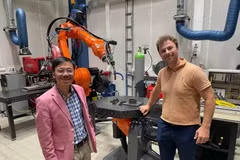
Vietnam, Canada look to turn strategic partnership into tech projects
Canada's research strength paired with Vietnam's manpower, market size and speed of adoption could address national-level challenges and help small- and medium-sized enterprises modernise production and tap into the international innovation ecosystem, said Assoc. Prof. Vu Viet Hung.

Public security ministry eyes AI, cyber training ties with Canada's Concordia University
Concordia is ready to step up exchanges with the Vietnamese Ministry of Public Security's training and research facilities to identify areas that fit both sides' strengths and needs and gradually turn training and research opportunities into concrete initiatives, said Prof. Graham Carr, Concordia University's President and Vice-Chancellor.
Vietnam’s approach to innovation inspires countries worldwide: WIPO
Vietnam's approach to adopting the GII and coordinating with government agencies at both central and local levels is an invaluable lesson many other countries are studying and trying to replicate.

Overseas Vietnamese intellectuals drive innovation
Overseas Vietnamese scientists do not have to return to Vietnam for long-term work to make an impact. They can contribute by joining collaborative research teams, sharing analytical techniques, facilitating access to modern equipment, and linking Vietnam with international labs and universities.

Better Choice Awards 2026 honours innovative Vietnamese businesses, tech products
The fourth edition of the awards featured a complete restructuring into four award tracks: Innovative Choice Awards, Smart Choice Awards, Car Choice Awards and the newly introduced Nation Builders Awards. The latter honours businesses contributing to national development by building infrastructure, energy systems and technological capacity for the national economy.
Businesses must be at heart of innovation: Deputy PM
“Businesses must be placed at the centre of this process,” he said, noting that enterprises understand market demand, formulate practical requirements, invest resources, adopt and master technologies, organise production and bring products to consumers.

Hanoi tops 2026 Provincial Innovation Index
Hanoi led in 18 of the 52 component indicators – the highest number among the 34 localities assessed.

WIPO innovation report viewed through Resolution 57 perspective
He said the GII 2026 results should be viewed in the broader context of Vietnam’s implementation of Resolution No. 57-NQ/TW, which identifies science and technology, innovation and national digital transformation as key breakthroughs and major drivers for developing modern productive forces and enhancing economic competitiveness.

Vietnam, Japan expand cooperation in strategic technology fields
Meeting with Japanese Minister of Education, Culture, Sports, Science and Technology Seki Yoshihiro on October 2, Minister of Science and Technology Vu Hai Quan proposed the Japanese side continue providing postgraduate scholarships, particularly at master's and doctoral levels in strategic technological sectors, facilitate exchanges among students and researchers, and maintain support for the Vietnam Japan University (VJU).
Vietnamese intellectuals in China: AI offers chance to narrow development gap
The resolution offers a broader approach, with contributions possible through knowledge, experience or by connecting businesses, universities and research institutes in Vietnam and abroad. Individual contributions may be small, but when multiplied, they can create significant strength.

Vietnam, WIPO seek stronger cooperation in intellectual property enforcement
After three months of intensive enforcement, Vietnamese police had identified and verified 600 cases, initiated legal proceedings in 205 cases involving 293 suspects, and seized goods worth more than 300 million VND (11,400 USD).
Vietnamese-learning app presented to community in RoK
The initiative aims to support language learning among children growing up in more than 100,000 Vietnamese-Korean multicultural families, while helping preserve Vietnamese cultural identity and strengthen their ties with their homeland.
Strategic technologies expand space for Vietnam - Australia cooperation
Vietnamese Deputy Minister of Science and Technology Tran Trung Tinh said that amid global uncertainties, strategic technologies are becoming a decisive driver of national competitiveness and sustainable development. Vietnam has identified science, technology, innovation and digital transformation as key strategic breakthroughs.