šŸ“OP-ED: Party Central Committee’s 4th plenum offers new thinking encouraging Party members to engage in business

Accordingly, the plenum reached a consensus on several key principles, including shifting from a mindset of ā€œpermissionā€ to one of ā€œencouragement and facilitationā€ for Party members engaging in the private sector; protecting their lawful economic activities; and maintaining strict oversight of those exercising control and benefiting from such activities.

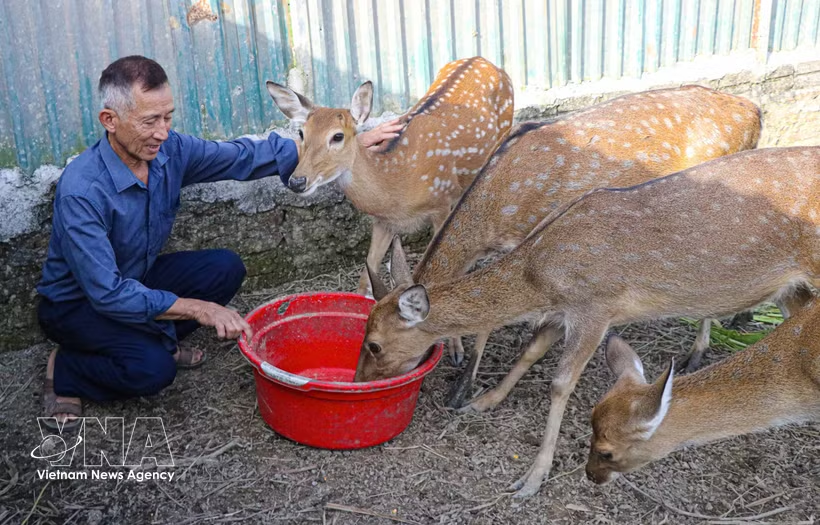
Nguyen Dinh Kien, Secretary of the Sam Mun commune Party cell in Dien Bien province, builds wealth through spotted deer farming. (Photo: VNA)

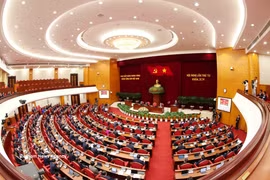
Hanoi (VNA) – Party members are now encouraged to pursue legitimate wealth creation and contribute to national development, according to the new regulation, adopted at the fourth plenum of the 14th Party Central Committee, held in Hanoi from October 5 to 8.

The new regulation on Party members’ participation in investment and business activities replaces Regulation No. 15-QD/TW dated August 28, 2006, on Party members’ engagement in the private economy.

Accordingly, the plenum reached a consensus on several key principles, including shifting from a mindset of ā€œpermissionā€ to one of ā€œencouragement and facilitationā€ for Party members engaging in the private sector; protecting their lawful economic activities; and maintaining strict oversight of those exercising control and benefiting from such activities.

The regulation stipulates that Party members’ rights and eligibility to engage in investment and business activities must be consistent with their legal status and official responsibilities. At the same time, safeguards must be put in place to control potential conflicts of interest and prevent public power, information or assets from being used to secure private advantages.

All support policies must be based on public, transparent and equitable criteria, ensuring non-discriminatory treatment of businesses regardless of whether their owners are Party members.

The shift in thinking from ā€œpermissionā€ to ā€œencouragement and facilitationā€ for Party members to build legitimate wealth marks a highly significant turning point.

This shift will help unlock resources and link Party members’ pioneering spirit with economic development, contributing to the growth of the non-State economic sector. Encouraging Party members to engage in business will create fresh momentum for achieving and surpassing the set socio-economic development targets.

The approaches of ā€œpermittingā€ and ā€œencouragingā€ Party members to engage in economic activities differ in several important respects.

The ā€œpermission-basedā€ approach is essentially passive, viewing business as a citizen’s right while allowing Party members to exercise it only under certain conditions. By contrast, the ā€œencouragement-basedā€ approach is proactive and enabling, recognising business activities and legitimate wealth creation as patriotic acts and part of Party members’ pioneering responsibility.

Under the ā€œpermission-basedā€ approach, those concerned tend to be hesitant and cautious, with Party members engaging in business while worrying that their integrity and motives may be questioned. The ā€œencouragement-basedā€ approach, meanwhile, gives them greater confidence to mobilise resources, think big, act bold, and take pride in creating economic value for the country.

vnanet-party-member2.jpg
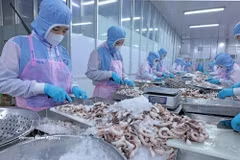
Nguyen Thanh Phong (left), Chairman of the Board of Directors of Song Cau Ha Bac Joint Stock Company and Vice Chairman of the Bac Ninh Business Association, oversees production activities. (Photo: VNA)

The ā€œpermission-basedā€ approach restricts the scope of activities largely to small-scale private businesses, subject to numerous criteria and limitations on scale. In contrast, the ā€œencouragement-basedā€ approach opens the door to all forms of lawful investment and business activities.

Under the former approach, assessments tend to focus on formalities, such as asset size or administrative records and reports. Under the latter, evaluation focuses on substantive contributions, including productivity, technological innovation, tax compliance, social welfare and occupational safety.

The ā€œpermission-basedā€ approach also tends to make management overly bureaucratic, focusing on reviewing what Party members are or are not allowed to do. The ā€œencouragement-basedā€ approach, by contrast, emphasises substantive oversight to prevent conflicts between public and private interests.

The new regulation removes invisible barriers to attracting talent. Every Party member engaged in business is a ā€œsoldier on the economic frontā€. This approach will help the Party attract outstanding entrepreneurs, talented intellectuals and highly skilled technical workers.

Party members engaged in economic activities are expected to take the lead in technological innovation, productivity improvement, Vietnamese brand development and sustainable growth. Their role goes beyond earning a living for their families; they are expected to shoulder the mission of strengthening the national economy from within.

However, the term ā€œencouragementā€ must be properly understood. Encouragement does not mean lax oversight. It must go hand in hand with transparent and integrity-based control mechanisms. The new regulation clearly distinguishes lawful investment and business activities from the abuse of positions, information or public assets for personal gain.

For incumbent officials and civil servants, as well as senior leaders, economic activities will continue to be subject to extremely strict controls to prevent conflicts between public and private interests. Meanwhile, Party members outside the public sector will enjoy maximum flexibility in starting and running businesses.

The shift in wording from ā€œpermissionā€ to ā€œencouragementā€ is not merely an administrative amendment, but a significant breakthrough in thinking.

Legitimate wealth creation is a positive value, as Party members with business acumen not only generate wealth for themselves but also create jobs, produce material wealth and make direct contributions to the country’s prosperity.

This is a requirement of the new era: to unlock, mobilise and harness all social resources for economic development. If the approach stops at merely ā€œpermittingā€ Party members to engage in business, a vast source of intellectual and economic potential within the Party membership could inadvertently be held back.

Today, clearer risk-control mechanisms are in place, with governance shifting towards proactive risk management. Boundaries and powers have also been clarified to reflect Party members’ legal status and prevent potential conflicts of interest.

To ensure that they do not lose sight of their ideals under profit pressures, suffer moral degradation in a complex business environment or undergo political degeneration under the influence of capital flows and external circumstances, the Party consistently emphasises the need for Party members to strictly comply with State laws and the Party’s regulations and Charter, and not engage in activities prohibited to Party members.

They are required to uphold their pioneering role, especially in creating jobs, improving workers’ livelihoods and actively participating in social welfare activities.

Meanwhile, Party organisations must closely monitor and manage Party members’ activities to promptly correct and address deviations in their perceptions and conduct.

As in every sphere of social life, Party members engaged in business must remain committed to self-cultivation and discipline, and maintain firm political mettle as a core value so as not to be swept up in the negative aspects of the market economy./.
VNA

See more

AVAC ASF LIVE vaccine developed and manufactured by AVAC Vietnam Joint Stock Company. (Photo: avac.com.vn)

Vietnam ships first commercial ASF vaccine order to Philippines

Nguyen Van Diep, General Director of AVAC Vietnam, said this was the company’s first commercial export order following the Philippines’ approval of the vaccine for unrestricted circulation. The Philippine Department of Agriculture is expected to issue usage guidelines next week, paving the way for wider distribution and application.

Workers process octopus for export to the Japanese market at Huy Nam Company in An Giang province. (Photo: VNA)

Fisheries sector strives for 12 billion USD in exports amid rising costs

The 12-billion-USD export target remains achievable given solid output growth and generally favourable market conditions. However, any fourth-quarter slowdown would not necessarily reflect raw material shortages but also impacts on economic efficiency amid rising material and fuel costs.

Commercial Counsellor at the Vietnamese Embassy in China Nong Duc Lai (Photo: VNA)

Vietnam-China trade growing rapidly, substantive: Commercial Counsellor

According to the Vietnam Customs data, bilateral trade hit 253.1 billion USD in the first nine months of this year, up 37.6% annually. Vietnam’s exports to China rose 32.9% to 65.8 billion USD while imports climbed 39.3% to 187.3 billion USD. China accounted for around 41.3% of Vietnam’s imports and 15.2% of its total exports.

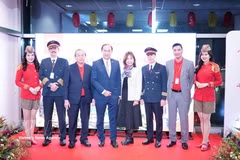
Vietjet Air leaders and flight crew pose for a photo with guests at the launch ceremony. (Photo: VNA)

Vietjet launches Prague–Hanoi route

Vietjet Air operates the Prague–Hanoi route twice a week using Airbus A330-300 aircraft with a capacity of 377 passengers. Flights depart Prague at 8:55 p.m. every Tuesday and Saturday and arrive in Hanoi at 4:20 p.m. the following day, local time. In the opposite direction, flights leave Hanoi at 8:25 a.m. and arrive in Prague at 6:55 p.m. The route includes a stop in Almaty, Kazakhstan.

At Yen Phong II-C Industrial Park in Bac Ninh province (Photo: VNA)

Tax policy stability now key to keeping foreign investors: Officials

Companies must ensure records and data truthfully reflect the substance of transactions and engage in dialogue early when complex issues arise. Tax authorities, in turn, need to publish policies, give clear guidance, enforce rules consistently and deliver information in a timely manner.

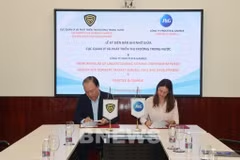
The MoU signing ceremony between the gency for Domestic Market Surveillance and Development and Procter & Gamble (P&G). (Photo: Ministry of Industry and Trade)

Vietnam steps up fight against counterfeits, IP violations

The renewed memorandum between Vietnam's domestic market surveillance force and Procter & Gamble (P&G) is expected to build on the results achieved since 2023, strengthen IP enforcement, safeguard the legitimate rights and interests of businesses and consumers, and contribute to a more transparent and fair business environment.

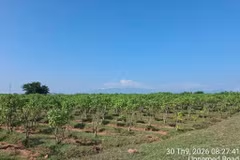
A Jatropha cultivation area of Star Japan Co., Ltd in My Son commune, Khanh Hoa province (Photo of Star Japan Co., Ltd)

Vietnam – a potential regional supply hub for Jatropha seed oil

Japan’s research on non-edible oil feedstocks showed that Jatropha is highly drought-tolerant and could grow well on wasteland, eroded sandy land and infertile soil. Given this, areas in central Vietnam, including Ninh Thuan, Binh Thuan and the Central Highlands, have climatic, sunlight and soil conditions suitable for achieving high seed yields and oil content.

Officials launch the Expo Platform on September 29. It will be officially put into use on October 20, two days before the opening of HCMC Export 2026. (Photo: VNA)

Technology opens new routes for Vietnamese exports

As global markets impose increasingly stringent requirements on standards, traceability, sustainability and green transformation, digitalising product data and bringing buyers closer to production sites can help Vietnamese businesses demonstrate their capabilities and meet market-specific requirements.

Phuong Dinh Anh, Deputy Chief of the Office of the Central Coordination Office for the National Target Programme, speaks at the event.( VNA)

Turning OCOP products into rural tourism experiences

Experts stressed that rural tourism can develop sustainably only when local communities actively participate and benefit from it. Investment in transport, accommodation and attractions must go hand in hand with clean water, waste treatment, hygiene, traditional craft preservation and environmental protection.

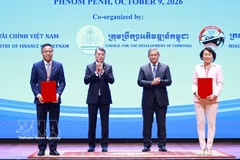
Prime Minister Le Minh Hung and his Cambodian counterpart Hun Manet witness the exchange of cooperation agreements between businesses of the two countries (Photo: VNA)

Vietnam, Cambodia look to elevate economic links

Prime Minister Le Minh Hung said that economic, trade and investment cooperation constitutes an important pillar of bilateral ties, which has achieved positive results. However, considerable room remains for further expansion to match the strong political ties and the potential of both countries.

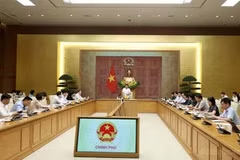
An overview of the meeting (Photo: chinhphu.vn)

Deputy PM calls for tighter price management of essential goods

Deputy PM Thang, who is also head of the committee, urged ministries and agencies to coordinate closely to deliver effective fiscal and macroeconomic policies. The aim is to control inflation, stabilise the macroeconomy, ensure major economic balances, create room to support growth and bolster the economy’s resilience to external shocks.

 Khanh Binh International Land Border Gate in An Giang province.( Photo: VNA)

Vietnam-Cambodia trade gathers pace towards 20 billion USD target

After setting a record of more than 11.3 billion USD in 2025, bilateral trade reached about 8.7 billion USD in the first eight months of 2026, up 8.3% year on year. Vietnam is currently Cambodia’s third-largest trading partner, its second-largest source of imports and second-largest export market.