📝OP-ED: CPV Central Committee’s fourth plenum seeks to unlock resources for rapid, sustainable growth

If resources are not fully utilised, Vietnam risks falling into the middle-income trap, with slower growth and large investment volumes producing relatively little output. Labour productivity and the TFP contribution could fall short of expectations, making double-digit growth harder to reach.

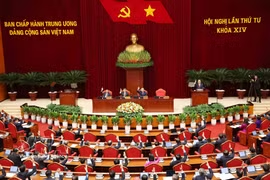
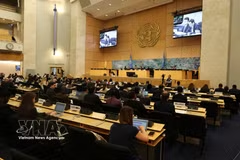
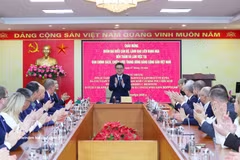
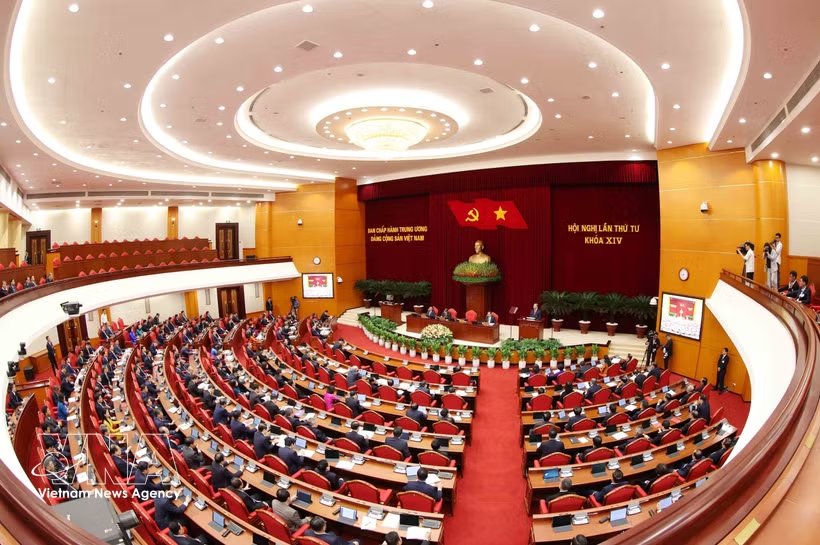
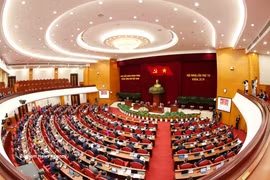
At the opening of the 14th CPV Central Committee's fourth plenum (Photo: VNA)

Hanoi (VNA) - General Secretary of the Communist Party of Vietnam (CPV) Central Committee and President To Lam opened the fourth plenum of the 14th CPV Central Committee on October 5 by setting four areas for discussion, including the right priorities for 2027 and how to use national resources to drive rapid, sustainable development.

The Party and State leader said 2027 must be a year of acceleration, breakthroughs and profound changes that builds momentum for the goals of the full term. He urged the committee to scrutinise the main targets and solutions, in particular what it will take to achieve GDP growth of 10% or higher and inflation of around 4.5%.

The committee must identify the breakthroughs needed to turn resources into productive capacity, business performance and tangible results. Institutional bottlenecks must be cleared, the economy's capacity to absorb capital improved, and infrastructure, energy and labour secured.

If 2026 is the first year of the 2026-2030 five-year plan, 2027 targets must be built to deliver sharper gains in pooling and using resources efficiently.

Growth remains the consistent priority, with the aim of double-digit expansion while maintaining macroeconomic stability, controlling inflation and preserving major economic balances.

Under this orientation, ministries, agencies and localities must fix development institutional mechanisms and push breakthroughs in lawmaking and enforcement to unlock investment, production and trade. Other key tasks include further slimming the State apparatus, raising the quality of officials and civil servants, tightening discipline and curbing corruption and wastefulness.

In science, technology and innovation, ministries and agencies must keep reviewing and upgrading policies for breakthroughs while prioritising skilled labour in strategic fields, including artificial intelligence, big data, semiconductor chips, cybersecurity and next-generation digital technologies.

On infrastructure, the focus is on speeding up key works, nationally important projects and strategic inter-regional links to create new growth drivers.

Drafting the 2027 socio-economic plan is more than an annual task for ministries, agencies and localities. It is a step toward the goals for the entire 2026-2030 period, and its quality will determine whether major policies translate into concrete results and lay the groundwork for high, sustainable growth.

Setting the right growth target for 2027 is especially important.

Vietnam's GDP grew 9.01% in the first nine months of 2026, and fourth-quarter growth must exceed 12.5% to meet the annual target. The 2027 goal must therefore be set precisely to keep the five-year plan on track and preserve momentum, without complacency or undue haste.

Breakthroughs are needed in several areas to turn resources into economic capacity in 2027:

Institutional enforcement: Laws and policies must be amended promptly and vested and sectional interests eliminated. Responsibility must be tied to implementation timelines, lead agencies and deadlines clearly named, and effectiveness gauged by tangible benefits to citizens.

Officials' ability to deliver results: Delegated authority must come with accountability, and real powers with the resources to use them. Collective and individual responsibilities must be clearly delineated and buck-passing prevented. Officials who dare to think and act in the common interest must be protected, while stagnation and fear of responsibility are dealt with strictly.
vnanet-g.jpg
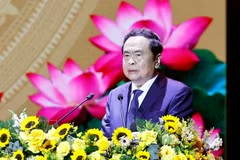
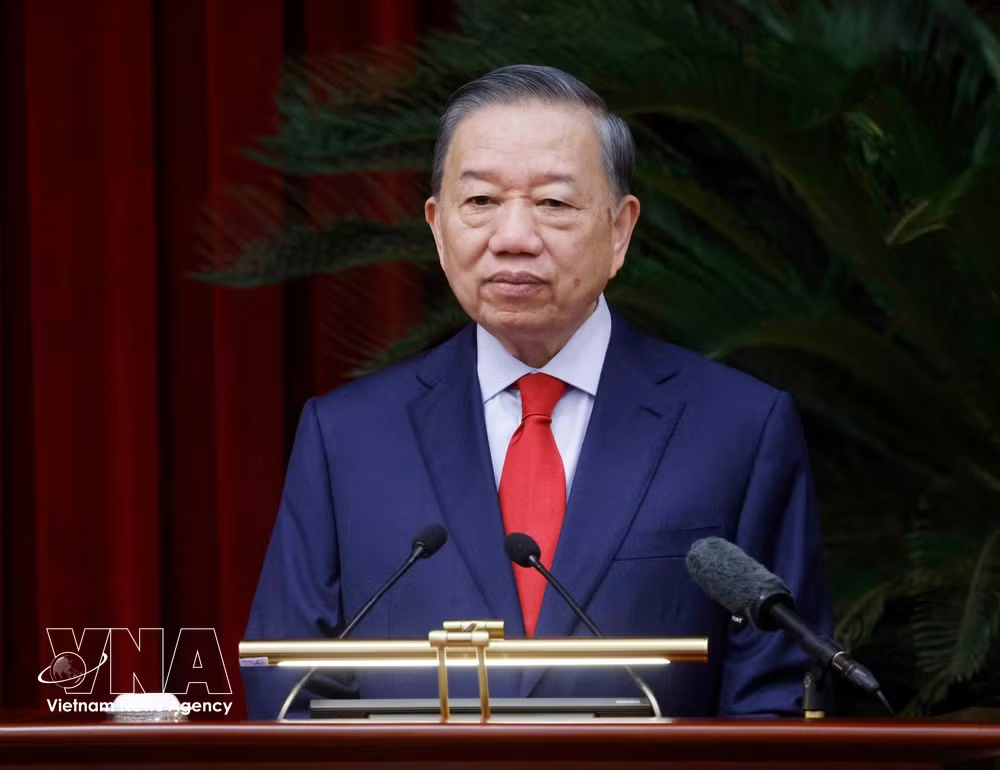
General Secretary of the CPV Central Committee and President To Lam speaks at the plenum (Photo: VNA)

Science, technology, innovation and digital transformation: Productivity must improve in substantive terms, and technology must be used to bolster enterprises' autonomy and capabilities. Digital ecosystems must be built in governance and production, links among research institutes, universities and businesses tightened, and technology experts and strategic talent attracted.

Public investment and business health: Disbursement of public investment must be accelerated and the bottlenecks behind slow spending at ministries and agencies fully cleared. Investment capital must be converted into real production capacity and output. Domestic producers must be backed by stronger technological capabilities, trade deficits minimised and domestic value added in supply chains higher.

Leveraging resources effectively, as the leader put it, means unlocking, pooling, allocating and making optimal use of the economy's inputs to create drivers of rapid, sustainable growth.

First, investment capital must be freed up. That means clearing bottlenecks holding up thousands of projects, speeding public investment disbursement and drawing capital from across society, including foreign direct investment (FDI) and public resources, into production and trade rather than leaving funds idle.

Next, the workforce must be upgraded by raising the share of trained workers, promoting digital knowledge and technological skills, and tapping overseas Vietnamese and experts to build the labour force that new forms of production require.

Innovation and digital transformation must advance through higher spending on research and development (R&D), growth of the digital and data economies, and a bigger contribution from total factor productivity (TFP) to economic growth.

Policies and mechanisms must be transparent, the business climate improved, the "ask-give" mechanism eliminated, corruption curbed and national governance capacity strengthened.

Resources must also be used more efficiently as Vietnam pursues green growth, through better use of land, water and minerals, promotion of clean energy and circular economy, and lower energy consumption per unit of GDP.

Vietnam's economic resources are generally not being used to their full potential.

Several bottlenecks undermine efficiency, including high investment needs and a high incremental capital-output ratio (ICOR), meaning large amounts of capital yield relatively low returns; a low share of trained workers and severe shortages of highly skilled personnel and technology engineers, R&D spending that is modest relative to GDP, insufficient support for the private sector, and heavy reliance on FDI.

Contributing factors include institutional bottlenecks, with overlapping legal regulations slowing capital flows and complicating access to and use of land, as well as inadequate, poorly integrated infrastructure that keeps logistics and operating costs high across the economy.

If resources are not fully utilised, Vietnam risks falling into the middle-income trap, with slower growth and large investment volumes producing relatively little output. Labour productivity and the TFP contribution could fall short of expectations, making double-digit growth harder to reach./.
​

VNA

See more

President of the National Assembly Tran Thanh Man will pay an official visit to China and co-chair the second session of the Cooperation Committee between the Vietnamese National Assembly and the National People’s Congress of China from October 11 to 15 (Photo: VNA)

National Assembly President to pay official visit to China

President of the National Assembly Tran Thanh Man will pay an official visit to China and co-chair the second session of the Cooperation Committee between the Vietnamese National Assembly and the National People’s Congress of China from October 11 to 15.

The article by Uch Leang, Acting Director of Asian, African, and Middle East Studies of the International Relations Institute of Cambodia (IRIC) and the President of the Cambodia Alumni from Vietnam Association (CAVA) on Khmer Times (Photo: VNA)

Vietnamese PM’s visit opens new phase of cooperation between Vietnam, Cambodia

The visit comes as the two countries are actively preparing to commemorate the 60th anniversary of the establishment of diplomatic relations in 2027. It therefore provides an important opportunity for both sides to review the achievements of six decades of cooperation, assess existing challenges, and reaffirm their determination to bring bilateral relations to a new level, Uch Leang, Acting Director of Asian, African, and Middle East Studies of the International Relations Institute of Cambodia (IRIC) and the President of the Cambodia Alumni from Vietnam Association (CAVA).

PM arrives in Vientiane, beginning official visit to Laos

PM arrives in Vientiane, beginning official visit to Laos

The visit provides an opportunity for the two Parties and Governments to reaffirm the special solidarity and faithful bond between Vietnam and Laos, a close relationship forged, tested and continuously nurtured throughout history. It also demonstrates the political resolve of the senior leaders of the two Parties and Governments to further develop the Vietnam–Laos special relationship in an increasingly substantive and effective manner.

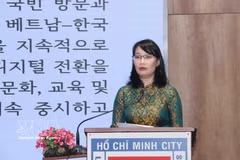
Chairwoman of the Vietnam-RoK Friendship Association in Ho Chi Minh City Tran Thi Dieu Thuy speaks at the ceremony celebrating the RoK’s National Foundation Day. (Photo: VNA)

Vietnam, RoK promote friendship, mutual understanding

Around 350,000 Vietnamese are currently living, studying and working in the RoK, while some 200,000 Koreans are residing and working in Vietnam. Together with Vietnamese-Korean multicultural families, these communities have become natural bridges connecting the two peoples.

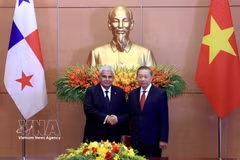
General Secretary of the Communist Party of Vietnam Central Committee and President To Lam (R) and President of Panama José Raúl Mulino pose for a photo. (Photo: VNA)

Panamanian President wraps up official visit to Vietnam

The two sides expressed their delight at the positive developments in bilateral relations in recent years, noting that there remains significant room for greater cooperation and complementarity, particularly in trade, investment and economic ties. They also held extensive discussions on strategic directions to further deepen and strengthen bilateral relations in a more substantive and practical manner.

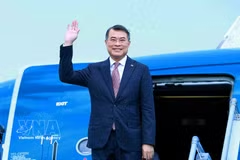
Prime Minister Le Minh Hung and a high-ranking Vietnamese delegation leaves Hanoi on October 8 for official visits to Laos and Cambodia. (Photo: VNA)

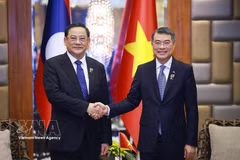
Prime Minister Le Minh Hung departs for official visits to Laos, Cambodia

This is PM Hung’s first official trip to Laos and Cambodia, reaffirming the high importance and priority that the Party, State and Government of Vietnam attach to relations with the two neighbouring countries. It also helps further deepen the “great friendship, special solidarity, comprehensive cooperation and strategic cohesion” between Vietnam and Laos and the “good neighbourliness, traditional friendship, comprehensive cooperation and long-term sustainability” between Vietnam and Cambodia.

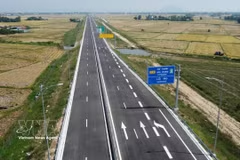
The North-South Expressway (Eastern section) project in Dak Lak province has been completed (Photo: VNA)

Deputy PM orders removal of bottlenecks in key projects

Key projects in the industry and trade and construction sectors play a particularly important role in driving growth, boosting production, strengthening infrastructure capacity, ensuring energy security, enhancing the competitiveness of the economy and creating new momentum for development in the coming period.

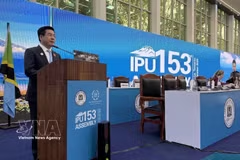
National Assembly Vice President Nguyen Hong Dien addresses the high-level General Debate of the 153rd Assembly of the Inter-Parliamentary Union (IPU-153) in Arusha, Tanzania, on October 7 (Photo: VNA)

NA Vice President proposes priorities for inter-parliamentary cooperation

Vietnam is determined to undertake strong institutional reforms to create a development-enabling environment, with science and technology, innovation, digital transformation, green transition and the circular economy serving as key drivers. The Vietnamese NA is also stepping up lawmaking, supreme oversight and making decisions on major national issues.

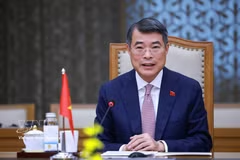
Prime Minister Le Minh Hung (Photo: VNA)

PM Le Minh Hung’s Laos visit to help deepen bilateral relations

The two countries established diplomatic relations on September 5, 1962. On July 18, 1977, they signed the Treaty of Friendship and Cooperation, providing an important political and legal foundation for strengthening bilateral ties and supporting each country’s cause of national construction and defence.

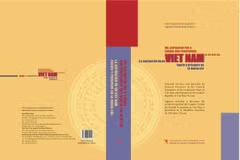
The cover of the book “The Aspiration for a Strong and Prosperous Viet Nam in the New Era,” in Mexico on October 8, 2026. (Photo: VNA Publishing House)

VNA cooperates with Mexican Labour Party to publish book on top leader's articles and addresses

The bilingual English-Spanish publication comprises 46 selected articles and speeches drawn from the political commentaries and addresses by General Secretary of the Central Committee of the Communist Party of Viet Nam (CPV) and President of the Socialist Republic of Viet Nam To Lam since August 2024, reflecting the mindset, vision and strategic decisions of the CPV to steer the country firmly into the new era.

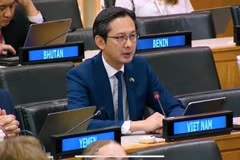
Ambassador Do Hung Viet, Permanent Representative of Vietnam to the United Nations, speaks at the general debate of the UN General Assembly’s Second Committee (Economic and Financial Committee) in New York. (Photo: VNA)

Vietnam calls for stronger int'l cooperation to drive sustainable development

Vietnam calls for stronger global partnerships tailored to the needs and conditions of countries at different levels of development, including fair access to new and emerging technologies. Such cooperation will help developing countries acquire knowledge, skills and technologies needed for innovation and competitiveness.

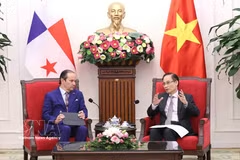
Vietnamese Minister of Foreign Affairs Le Hoai Trung (R) meets with his Panamanian counterpart Javier Eduardo Martínez-Acha Vásquez in Hanoi on October 7. (Photo: VNA)

Vietnamese, Panamanian foreign ministers discuss bilateral cooperation

The two sides encouraged businesses from both countries to expand investment and business links, making use of Panama’s strengths as a maritime transit hub and a regional centre for aviation, logistics and finance, as well as Vietnam’s strengths in manufacturing, export, economy and digital services.

On the sidelines of the 48th ASEAN Summit in Cebu, Philippines, on the afternoon of May 8, 2026, Prime Minister Le Minh Hung met with the then-Prime Minister of Laos, Sonexay Siphandone. (Photo: VNA)

Vietnam-Laos ties move from ‘special solidarity’ to ‘strategic cohesion’

As Vietnam and Laos enter a new development period, their relationship has been elevated to a new level under the framework of “great friendship, special solidarity, comprehensive cooperation and strategic cohesion.” The addition of “strategic cohesion” reflects not only the long-standing foundation of bilateral ties but also a shared vision, closely linked interests and a common path for the two nations to advance together over the long term.

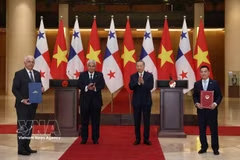
Party General Secretary and President To Lam (second from right) and President of Panama José Raúl Mulino Quintero (second from left) witness the exchange of cooperation documents between the two countries. (Photo: VNA)

Vietnam, Panama issue Joint Statement

Vietnam's Party General Secretary and President To Lam and Panamanian President José Raúl Mulino Quintero agreed to intensify high-level dialogue to provide orientations for the development of Vietnam-Panama relations through bilateral visits and meetings between high-ranking leaders of the two States, Governments, and National Assemblies, as well as ministries and sectors of the two countries.

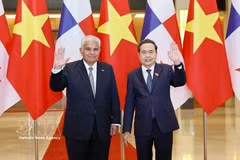
National Assembly President Tran Thanh Man meets with President of Panama José Raúl Mulino Quintero in Hanoi on October 7, 2026. Photo: VNA

Vietnam sees Panama as key partner in Latin America: Top legislator

Strengthening ties between the two legislatures is an important pillar of Vietnam-Panama relations, helping consolidate political trust, promote and oversee the implementation of high-level agreements, and support the bilateral agenda, said NA President Tran Thanh Man.

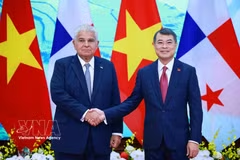
Prime Minister Le Minh Hung (R) meets with Panamanian President José Raúl Mulino in Hanoi on October 7. (Photo: VNA)

Panama regards Vietnam as leading important partner in Southeast Asia: Panamanian President

Prime Minister Le Minh Hung called on the two sides to promote exchanges of delegations at all levels, including State and parliamentary diplomacy and people-to-people exchanges; strengthen the presence and activities of diplomatic and consular missions; utilise existing cooperation mechanisms, particularly the Joint Committee on Economic, Trade and Investment Cooperation; facilitate market access for each side’s key products; and enhance transport, logistics and supply-chain connectivity.