Fisheries sector strives for 12 billion USD in exports amid rising costs

The 12-billion-USD export target remains achievable given solid output growth and generally favourable market conditions. However, any fourth-quarter slowdown would not necessarily reflect raw material shortages but also impacts on economic efficiency amid rising material and fuel costs.

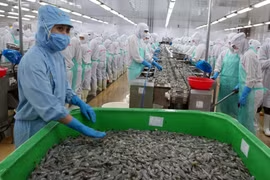
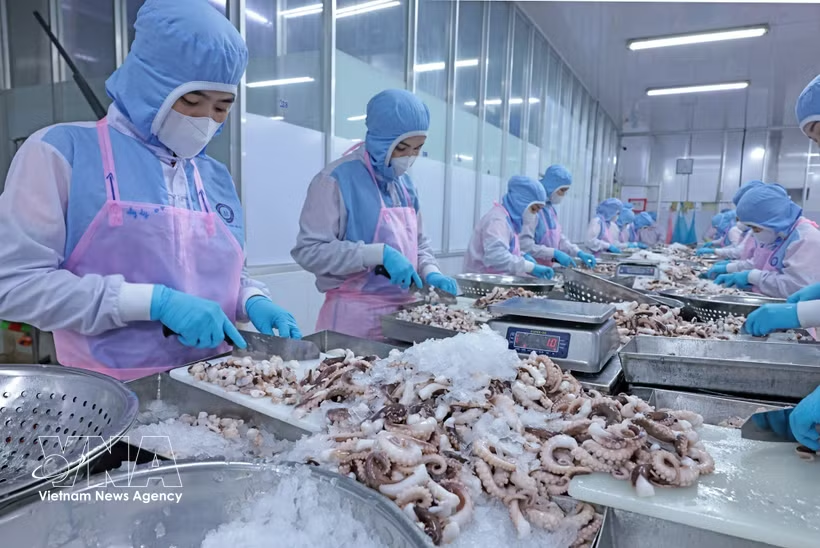
Workers process octopus for export to the Japanese market at Huy Nam Company in An Giang province. (Photo: VNA)

Hanoi (VNA) – Vietnam’s fisheries output is estimated at nearly 7.9 million tonnes in the first nine months of 2026, up 3.9% year-on-year, supporting the sector’s annual export target of 12 billion USD. However, rising input costs, supply competition and slowing demand in some major markets are putting pressure on the sector in the remaining months.

According to the Ministry of Agriculture and Environment (MAE), production continued to grow in September, with brackish-water shrimp farms entering their peak harvest season, tra fish production remaining stable and favourable marine fishing conditions helping ensure supplies for domestic consumption and export processing.

During January–September, output included 5.41 million tonnes of fish, up 2.8%; nearly 1.38 million tonnes of shrimp, up 7.1%; and 1.1 million tonnes of other aquatic products, up 5.8%. Aquaculture remained the main growth driver, supported by technological applications that improved productivity, quality and efficiency.

In the Mekong Delta, shrimp-rice and shrimp-mangrove farming models continued to deliver results, while high-tech intensive farming expanded. Stable tra fish production and growth in tilapia and marine aquaculture also helped diversify supplies.

According to the Vietnam Association of Seafood Exporters and Producers (VASEP), shrimp exports reached 3.75 billion USD in the first nine months, up 11% year-on-year and accounting for about 41% of total fisheries export revenue.

However, slower growth in September reflected intensifying supply competition and weaker market absorption. As harvesting peaked in several localities, whiteleg shrimp prices fell in parts of the Mekong Delta, highlighting the need to coordinate harvesting, purchasing and processing to protect farmers’ incomes.

Tra fish exports totalled 1.74 billion USD, up 10.7%. VASEP said tighter supplies of some wild-caught whitefish have created opportunities for Vietnamese tra fish, whose competitive prices and stable supply are attracting greater interest in several markets.

Kyokuyo’s continued introduction of the product through professional distribution channels in Japan is a notable development although the market remains relatively small, VASEP noted.

In key Mekong Delta provinces, raw tra fish prices remained favourable, supported by strong demand from processing plants preparing for the year-end export peak.

The MAE forecast that raw shrimp and tra fish prices could recover in the fourth quarter as supplies tighten and businesses step up purchases ahead of the year-end consumption season.

Phung Duc Tien, Chairman of the Vietnam Fisheries Society, said the 12-billion-USD export target remains achievable given solid output growth and generally favourable market conditions. However, he noted, any fourth-quarter slowdown would not necessarily reflect raw material shortages but also impacts on economic efficiency amid rising material and fuel costs.

VASEP forecast that exports could lose momentum in the fourth quarter after accelerating in the third as many orders for year-end consumption have been delivered early. China and the Association of Southeast Asian Nations (ASEAN) markets are expected to provide support but might not fully offset weaker demand in the US, the European Union and Japan.

To achieve the annual target, the sector needs to further stabilise raw material supplies, improve product quality and production efficiency, strengthen disease control and align farming with market demand. Closer links among farmers, fishemen and processors, alongside flexible production planning, product diversification and cost control, will be essential to maintaining competitiveness and increasing value across the supply chain./.
​

VNA

See more

AVAC ASF LIVE vaccine developed and manufactured by AVAC Vietnam Joint Stock Company. (Photo: avac.com.vn)

Vietnam ships first commercial ASF vaccine order to Philippines

Nguyen Van Diep, General Director of AVAC Vietnam, said this was the company’s first commercial export order following the Philippines’ approval of the vaccine for unrestricted circulation. The Philippine Department of Agriculture is expected to issue usage guidelines next week, paving the way for wider distribution and application.

Commercial Counsellor at the Vietnamese Embassy in China Nong Duc Lai (Photo: VNA)

Vietnam-China trade growing rapidly, substantive: Commercial Counsellor

According to the Vietnam Customs data, bilateral trade hit 253.1 billion USD in the first nine months of this year, up 37.6% annually. Vietnam’s exports to China rose 32.9% to 65.8 billion USD while imports climbed 39.3% to 187.3 billion USD. China accounted for around 41.3% of Vietnam’s imports and 15.2% of its total exports.

Vietjet Air leaders and flight crew pose for a photo with guests at the launch ceremony. (Photo: VNA)

Vietjet launches Prague–Hanoi route

Vietjet Air operates the Prague–Hanoi route twice a week using Airbus A330-300 aircraft with a capacity of 377 passengers. Flights depart Prague at 8:55 p.m. every Tuesday and Saturday and arrive in Hanoi at 4:20 p.m. the following day, local time. In the opposite direction, flights leave Hanoi at 8:25 a.m. and arrive in Prague at 6:55 p.m. The route includes a stop in Almaty, Kazakhstan.

At Yen Phong II-C Industrial Park in Bac Ninh province (Photo: VNA)

Tax policy stability now key to keeping foreign investors: Officials

Companies must ensure records and data truthfully reflect the substance of transactions and engage in dialogue early when complex issues arise. Tax authorities, in turn, need to publish policies, give clear guidance, enforce rules consistently and deliver information in a timely manner.

The MoU signing ceremony between the gency for Domestic Market Surveillance and Development and Procter & Gamble (P&G). (Photo: Ministry of Industry and Trade)

Vietnam steps up fight against counterfeits, IP violations

The renewed memorandum between Vietnam's domestic market surveillance force and Procter & Gamble (P&G) is expected to build on the results achieved since 2023, strengthen IP enforcement, safeguard the legitimate rights and interests of businesses and consumers, and contribute to a more transparent and fair business environment.

A Jatropha cultivation area of Star Japan Co., Ltd in My Son commune, Khanh Hoa province (Photo of Star Japan Co., Ltd)

Vietnam – a potential regional supply hub for Jatropha seed oil

Japan’s research on non-edible oil feedstocks showed that Jatropha is highly drought-tolerant and could grow well on wasteland, eroded sandy land and infertile soil. Given this, areas in central Vietnam, including Ninh Thuan, Binh Thuan and the Central Highlands, have climatic, sunlight and soil conditions suitable for achieving high seed yields and oil content.

Officials launch the Expo Platform on September 29. It will be officially put into use on October 20, two days before the opening of HCMC Export 2026. (Photo: VNA)

Technology opens new routes for Vietnamese exports

As global markets impose increasingly stringent requirements on standards, traceability, sustainability and green transformation, digitalising product data and bringing buyers closer to production sites can help Vietnamese businesses demonstrate their capabilities and meet market-specific requirements.

Phuong Dinh Anh, Deputy Chief of the Office of the Central Coordination Office for the National Target Programme, speaks at the event.( VNA)

Turning OCOP products into rural tourism experiences

Experts stressed that rural tourism can develop sustainably only when local communities actively participate and benefit from it. Investment in transport, accommodation and attractions must go hand in hand with clean water, waste treatment, hygiene, traditional craft preservation and environmental protection.

Prime Minister Le Minh Hung and his Cambodian counterpart Hun Manet witness the exchange of cooperation agreements between businesses of the two countries (Photo: VNA)

Vietnam, Cambodia look to elevate economic links

Prime Minister Le Minh Hung said that economic, trade and investment cooperation constitutes an important pillar of bilateral ties, which has achieved positive results. However, considerable room remains for further expansion to match the strong political ties and the potential of both countries.

An overview of the meeting (Photo: chinhphu.vn)

Deputy PM calls for tighter price management of essential goods

Deputy PM Thang, who is also head of the committee, urged ministries and agencies to coordinate closely to deliver effective fiscal and macroeconomic policies. The aim is to control inflation, stabilise the macroeconomy, ensure major economic balances, create room to support growth and bolster the economy’s resilience to external shocks.

 Khanh Binh International Land Border Gate in An Giang province.( Photo: VNA)

Vietnam-Cambodia trade gathers pace towards 20 billion USD target

After setting a record of more than 11.3 billion USD in 2025, bilateral trade reached about 8.7 billion USD in the first eight months of 2026, up 8.3% year on year. Vietnam is currently Cambodia’s third-largest trading partner, its second-largest source of imports and second-largest export market.