AI adoption in banking requires strict supervision

Banks are increasingly applying AI in data analysis, personalised services, fraud detection and risk management. In August, the Joint Stock Commercial Bank for Foreign Trade of Vietnam (Vietcombank) launched its One Data Platform (ODP) project to support advanced analytics and lay the groundwork for AI and machine learning applications.

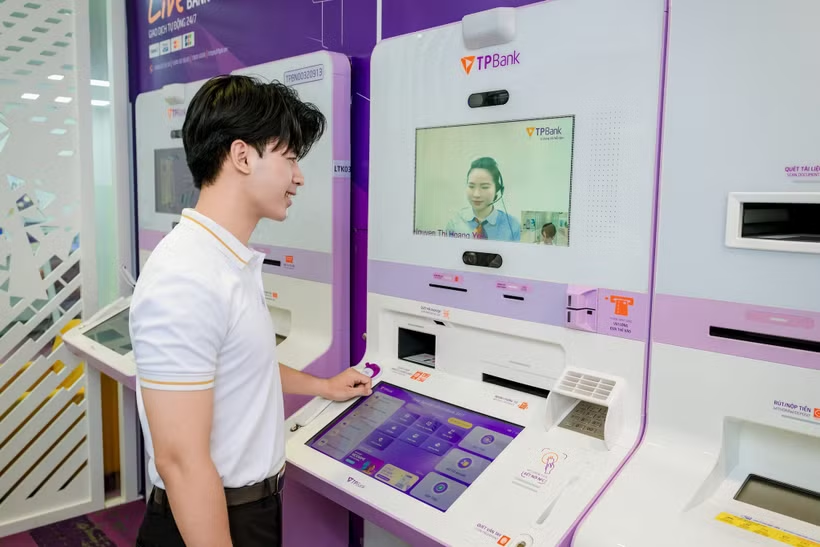
A customer uses the LiveBank 24/7 service of Tien Phong Commercial Joint Stock Bank (TPBank). (Photo: TPBank)

Hanoi (VNA) – The State Bank of Vietnam (SBV) has issued Circular No. 53/2026/TT-NHNN regulating the safety, risk management and deployment of artificial intelligence (AI) systems in the banking sector, requiring strict oversight as automation expands.

AI increasingly integrated into banking

According to the central bank, nearly 89% of people aged 15 and above had payment accounts by the end of 2025, while digital transactions accounted for over 95% of transactions at many credit institutions. In the first half of 2026, cashless payment transactions rose 34.28% in volume and 12.24% in value year on year.

Banks are increasingly applying AI in data analysis, personalised services, fraud detection and risk management. In August, the Joint Stock Commercial Bank for Foreign Trade of Vietnam (Vietcombank) launched its One Data Platform (ODP) project to support advanced analytics and lay the groundwork for AI and machine learning applications.

Meanwhile, the Tien Phong Commercial Joint Stock Bank (TPBank) combines AI, big data and real-time analytics to detect unusual transaction patterns. TPBank General Director Nguyen Hung said these tools help the bank identify potential risks before they result in losses.

Maintaining human control

At the 2026 Banking Sector Digital Transformation on August 18, SBV Governor Pham Duc An called for focused and controlled innovation amid growing challenges involving cybersecurity, digital fraud, privacy and AI governance.

The circular, which will take effect from November 15, stipulates safety, risk management and implementation requirements for the application of AI systems in the banking sector.

Notably, it classifies AI systems by risk level, including as high-risk those that automatically execute payments exceeding specified thresholds or make automated credit decisions involving 50 million VND or more. Payment risks are assessed based on individual transactions and total daily values.

AI-driven payments require prior agreements defining transaction scope, limits, duration, and conditions. Customers must be able to terminate agreements or suspend or revoke payment authorisation. Daily AI-executed transactions must not exceed internal limits or 100 million VND for individuals and 500 million VND for organisations.

Providers must continuously monitor high-risk systems and ensure authorised personnel can intervene, adjust or suspend AI decisions, or activate emergency shutdowns. All interventions must be documented.

When AI directly interacts with customers, providers must disclose this from the outset. They must also retain the rationale and key factors behind automated decisions affecting customers’ legal responsibilities, financial obligations or access to services, and explain them upon request.

Data used to train, test and operate AI must have clear and lawful origins. Providers must address inaccurate, manipulated or “poisoned” data and prevent data leaks.

The circular underscores the need to combine automation with accountability, data protection and effective human oversight./.

VNA

See more

Delegates launch the commune-level digital transformation application on October 9 (Photo: VNA)

Commune-level digital transformation app launched

The app is designed to help grassroots officials, businesses, household businesses and citizens find suitable solutions, acquire relevant skills and access consultancy during their digital transformation journey.

Project to build big data database on law approved

Project to build big data database on law approved

The project is expected to help reform lawmaking and law enforcement, advance smart legal governance, promote a culture of legal compliance and make the law a national competitive advantage in the new era.

Vietnam targets modern pharmaceutical chemical industry by 2045. (Illustrative photo: baochinhphu.vn)

Vietnam targets modern pharmaceutical chemical industry by 2045

By 2030, Vietnam aims to master, acquire and transfer advanced technologies and produce selected essential and strategic pharmaceutical ingredients, prioritising active pharmaceutical ingredients (APIs), starting materials, chemical intermediates and excipients.

Martyr remains samples from the northern province of Cao Bang are handed over to the Military Institute of Forensic Medicine for DNA analysis. (Photo: VNA)

DNA testing capacity expanded to identify over 207,000 martyrs’ remains

By September 2026, Steering Committee 515 had collected samples from the remains of 207,656 martyrs, achieving 98.15% of the goal. Nearly 120,000 samples have been received and preserved. Additionally, authorities gathered 265,761 DNA samples from martyrs’ relatives, with about 100,000 analysed and around 80,000 results entered into the database.

Unmanned aerial vehicle used to inspect power lines. (Photo: VNA)

Hanoi’s power grid modernised through science, technology and data

As the national political and administrative centre and a major hub for economic, scientific, technological and innovation activities, Hanoi is seeing growing demand for energy infrastructure. Rapid urbanisation and the development of industry, services, modern transport, data centres and the digital economy require the capital’s power system to ensure not only daily consumption but also reliable electricity for production and business activities, operations of central agencies, and major political and diplomatic events.​

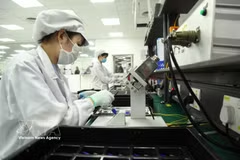
Electronic component production at Star Engineers Vietnam Co., Ltd. in Binh Xuyen Industrial Park, Phu Tho province. (Photo: VNA)

Vietnam turns AI ambitions into tangible business results

AI has become a high or top priority for 69% of surveyed Vietnamese businesses, while 84% expect their use of AI to increase over the next year. Although 61% of adopters remain at the experimentation stage, 71% said their AI investments have already broken even or generated returns.

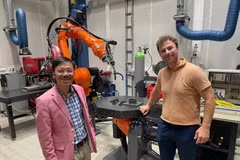
Assoc. Prof. Vu Viet Hung (left) visits a robotic 3D printing facility. (Photo published by VNA)

Vietnam, Canada look to turn strategic partnership into tech projects

Canada's research strength paired with Vietnam's manpower, market size and speed of adoption could address national-level challenges and help small- and medium-sized enterprises modernise production and tap into the international innovation ecosystem, said Assoc. Prof. Vu Viet Hung.

Associate Professor Dang Duc Huy (left) poses for a photo with Canadian Governor General Louise Arbour. (Photo: VNA)

Overseas Vietnamese intellectuals drive innovation

Overseas Vietnamese scientists do not have to return to Vietnam for long-term work to make an impact. They can contribute by joining collaborative research teams, sharing analytical techniques, facilitating access to modern equipment, and linking Vietnam with international labs and universities.

The Better Choice Awards 2026 Gala is a key activity in response to the National Innovation Day 2026 (Photo: qdnd.vn)

Better Choice Awards 2026 honours innovative Vietnamese businesses, tech products

The fourth edition of the awards featured a complete restructuring into four award tracks: Innovative Choice Awards, Smart Choice Awards, Car Choice Awards and the newly introduced Nation Builders Awards. The latter honours businesses contributing to national development by building infrastructure, energy systems and technological capacity for the national economy.

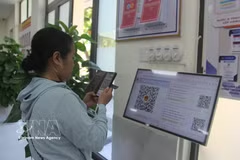
A resident scans a QR code to get a queue number at the public administrative service centre in Hoa Xuan ward, Da Nang city (Photo: VNA)

Localities apply AI, data to drive practical digital transformation

In the central province of Quang Tri, an AI-powered “People’s Assistant” is being piloted from October 1 to 31 at the provincial Public Administration Service Centre and the centres of this kind in Dong Thuan and Dong Ha wards. The system provides information on procedures, required documents, forms and fees, while also supporting declaration and preliminary checks.

Science, technology and innovation products on display. (Photo: VNA)

Businesses must be at heart of innovation: Deputy PM

“Businesses must be placed at the centre of this process,” he said, noting that enterprises understand market demand, formulate practical requirements, invest resources, adopt and master technologies, organise production and bring products to consumers.