Connecting global Vietnamese expertise to seek solutions for green agriculture

The contributions of overseas Vietnamese intellectuals should be assessed not only by the number of research publications they produce but also by their ability to develop solutions that meet the country's development needs, said a Vietnamese scientist in Canada.

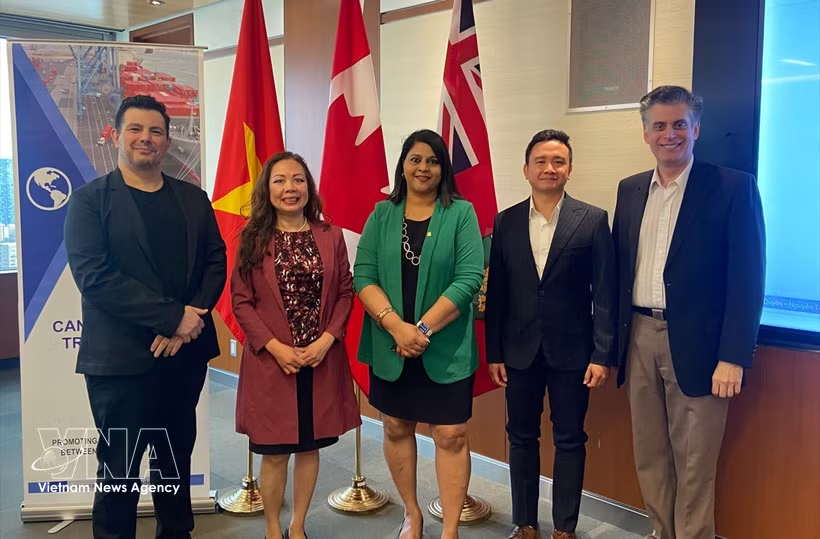
Associate Professor Dang Duc Huy (second from right) with other speakers at a Vietnam-Canada agricultural trade and investment cooperation forum (Photo: VNA)

Ottawa (VNA) – Vietnamese-origin scientists in Canada are seeking practical avenues for cooperation to translate research findings into real-world applications, helping promote green and sustainable agriculture as Vietnam faces an urgent need to cut emissions, conserve resources and improve production efficiency.

Speaking to Vietnam News Agency correspondents in Canada, Associate Professor Dang Duc Huy at Trent University's School of the Environment and Chemistry Department said advances in environmental chemistry, fertiliser technology and modern farming methods could offer solutions suited to Vietnam’s agricultural development needs.

However, the key lies not only in adopting advanced technologies but also in establishing long-term cooperation mechanisms to ensure that research findings reach businesses, cooperatives and farmers.

According to Huy, agriculture, the environment and climate change are closely interconnected through soil, water and air systems, as well as natural cycles. Sustainable agricultural development must therefore go beyond increasing productivity to consider resource-use efficiency, pollution reduction and ecosystem protection. This interconnection is particularly evident in Vietnam’s Mekong Delta, a major agricultural production hub facing mounting pressure from environmental pollution, saltwater intrusion and climate change.

For years, Huy and his Vietnamese colleagues have conducted research into groundwater, environmental quality and environmental protection policies in the region.

One notable area of research is the development of low-emission nitrogen fertiliser technology. The technology has been tested in Canada, and its evaluation under actual farming conditions in Vietnam has been proposed.

The research team is also examining methane emissions from rice production and wetland ecosystems, including mangrove forests, potentially opening up opportunities to reduce emissions by harnessing natural processes.

Another area of work involves hydroponic technology and controlled-environment production systems, he said, adding that his team has proposed testing hydroponic systems suited to Vietnam, with a focus on water and nutrient-use efficiency, operating costs, food safety and market access.

He emphasised the need for Canadian and Vietnamese partners to jointly develop technologies, enabling domestic scientists and businesses to strengthen their research capabilities, master technologies and gradually participate in commercialisation.

Drawing on his experience in international cooperation, Huy said the value of overseas Vietnamese intellectuals lies not only in their individual expertise but also in their ability to connect Vietnam with international networks in science, technology and education.

With the Politburo's Resolution No. 23-NQ/TW identifying overseas Vietnamese as a strategic national resource, he has advocated moving beyond individual contributions towards sustained, long-term cooperation programmes, particularly through academic diplomacy.

While government-level agreements establish frameworks for cooperation, universities and research institutes can translate them into practical outcomes through joint research projects, personnel training, student exchanges and business connections, he said.

Huy said the elevation of Vietnam–Canada relations to a Strategic Partnership will create further opportunities for cooperation in science, technology, the environment, agriculture and education.

To capitalise on these opportunities, he called for long-term programmes that enable research teams at home and abroad to jointly develop research topics, conduct trials, apply findings and train the next generation of scientists.

He noted that workshops and short visits, while valuable for building connections, could hardly replace sustained cooperation aimed at addressing practical challenges. The contributions of overseas Vietnamese intellectuals should therefore be assessed not only by the number of research publications they produce but also by their ability to develop solutions that meet the country's development needs.

According to Huy, the challenge is not simply how to encourage more Vietnamese scientists abroad to return home, but, more importantly, how to establish mechanisms that enable the knowledge, experience and networks of Vietnamese people worldwide to remain connected and contribute directly and consistently to Vietnam's development./.

VNA

See more

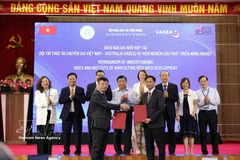
The signing of an MoU between the Department of Digital Technology and Artificial Intelligence and the Institute for Agricultural Research and Development at the forum. (Photo: VNA)

Vietnam, Australia step up digital technology, AI cooperation

An Australian diplomat said Australian businesses are keen to engage in Vietnam’s digital development, particularly in semiconductors, AI and cybersecurity. They also hope to share expertise and support Vietnamese companies in technology and investment.

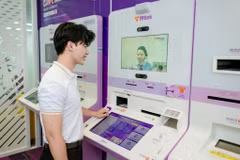
A customer uses the LiveBank 24/7 service of Tien Phong Commercial Joint Stock Bank (TPBank). (Photo: TPBank)

AI adoption in banking requires strict supervision

Banks are increasingly applying AI in data analysis, personalised services, fraud detection and risk management. In August, the Joint Stock Commercial Bank for Foreign Trade of Vietnam (Vietcombank) launched its One Data Platform (ODP) project to support advanced analytics and lay the groundwork for AI and machine learning applications.

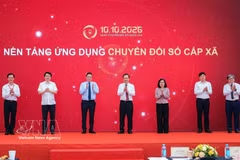
Delegates launch the commune-level digital transformation application on October 9 (Photo: VNA)

Commune-level digital transformation app launched

The app is designed to help grassroots officials, businesses, household businesses and citizens find suitable solutions, acquire relevant skills and access consultancy during their digital transformation journey.

Project to build big data database on law approved

Project to build big data database on law approved

The project is expected to help reform lawmaking and law enforcement, advance smart legal governance, promote a culture of legal compliance and make the law a national competitive advantage in the new era.

Vietnam targets modern pharmaceutical chemical industry by 2045. (Illustrative photo: baochinhphu.vn)

Vietnam targets modern pharmaceutical chemical industry by 2045

By 2030, Vietnam aims to master, acquire and transfer advanced technologies and produce selected essential and strategic pharmaceutical ingredients, prioritising active pharmaceutical ingredients (APIs), starting materials, chemical intermediates and excipients.

Martyr remains samples from the northern province of Cao Bang are handed over to the Military Institute of Forensic Medicine for DNA analysis. (Photo: VNA)

DNA testing capacity expanded to identify over 207,000 martyrs’ remains

By September 2026, Steering Committee 515 had collected samples from the remains of 207,656 martyrs, achieving 98.15% of the goal. Nearly 120,000 samples have been received and preserved. Additionally, authorities gathered 265,761 DNA samples from martyrs’ relatives, with about 100,000 analysed and around 80,000 results entered into the database.

Unmanned aerial vehicle used to inspect power lines. (Photo: VNA)

Hanoi’s power grid modernised through science, technology and data

As the national political and administrative centre and a major hub for economic, scientific, technological and innovation activities, Hanoi is seeing growing demand for energy infrastructure. Rapid urbanisation and the development of industry, services, modern transport, data centres and the digital economy require the capital’s power system to ensure not only daily consumption but also reliable electricity for production and business activities, operations of central agencies, and major political and diplomatic events.​

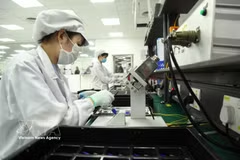
Electronic component production at Star Engineers Vietnam Co., Ltd. in Binh Xuyen Industrial Park, Phu Tho province. (Photo: VNA)

Vietnam turns AI ambitions into tangible business results

AI has become a high or top priority for 69% of surveyed Vietnamese businesses, while 84% expect their use of AI to increase over the next year. Although 61% of adopters remain at the experimentation stage, 71% said their AI investments have already broken even or generated returns.

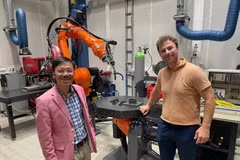
Assoc. Prof. Vu Viet Hung (left) visits a robotic 3D printing facility. (Photo published by VNA)

Vietnam, Canada look to turn strategic partnership into tech projects

Canada's research strength paired with Vietnam's manpower, market size and speed of adoption could address national-level challenges and help small- and medium-sized enterprises modernise production and tap into the international innovation ecosystem, said Assoc. Prof. Vu Viet Hung.

The Better Choice Awards 2026 Gala is a key activity in response to the National Innovation Day 2026 (Photo: qdnd.vn)

Better Choice Awards 2026 honours innovative Vietnamese businesses, tech products

The fourth edition of the awards featured a complete restructuring into four award tracks: Innovative Choice Awards, Smart Choice Awards, Car Choice Awards and the newly introduced Nation Builders Awards. The latter honours businesses contributing to national development by building infrastructure, energy systems and technological capacity for the national economy.

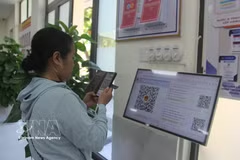
A resident scans a QR code to get a queue number at the public administrative service centre in Hoa Xuan ward, Da Nang city (Photo: VNA)

Localities apply AI, data to drive practical digital transformation

In the central province of Quang Tri, an AI-powered “People’s Assistant” is being piloted from October 1 to 31 at the provincial Public Administration Service Centre and the centres of this kind in Dong Thuan and Dong Ha wards. The system provides information on procedures, required documents, forms and fees, while also supporting declaration and preliminary checks.

Science, technology and innovation products on display. (Photo: VNA)

Businesses must be at heart of innovation: Deputy PM

“Businesses must be placed at the centre of this process,” he said, noting that enterprises understand market demand, formulate practical requirements, invest resources, adopt and master technologies, organise production and bring products to consumers.