Da Nang identifies key sectors for international financial centre

VIFC-DN aims to develop sectors with distinct competitive advantages and strong links to emerging growth areas, connecting international capital with projects, businesses and investment opportunities in Da Nang, the central region and Vietnam as a whole.

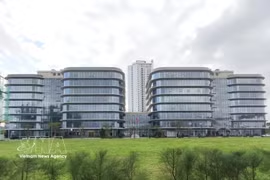
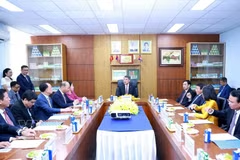
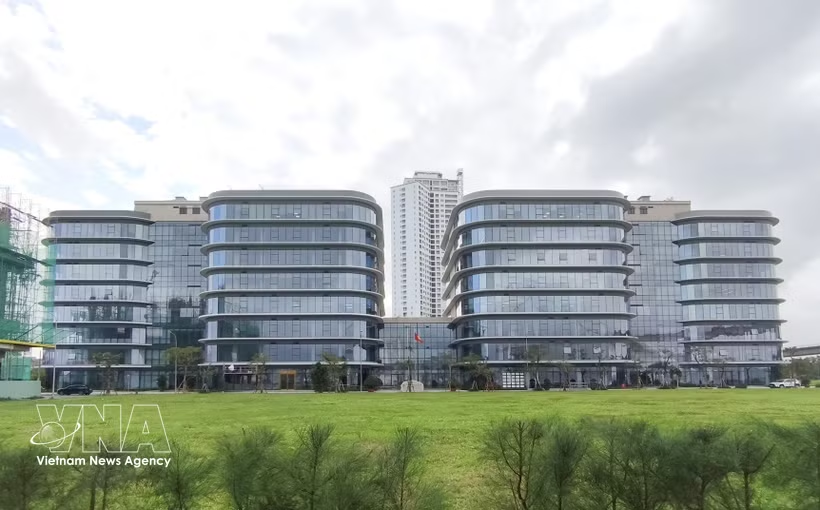
The headquaters of the VIFC-DN Executive Agency (Photo: VNA)

Da Nang (VNA) – From its inception, the Vietnam International Financial Centre in Da Nang (VIFC-DN) has been designed as a new-generation international financial centre, rather than one seeking to compete directly with major regional hubs in terms of market size.

Instead, it aims to develop sectors with distinct competitive advantages and strong links to emerging growth areas, connecting international capital with projects, businesses and investment opportunities in Da Nang, the central region and Vietnam as a whole.

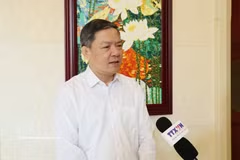
Dang Dinh Duc, Standing Vice Chairman of the VIFC-DN Executive Agency, said Da Nang has developed three plans for developing key products during the centre’s initial phase. These include mobilising foreign investment for development by attracting asset management companies and investment funds to VIFC-DN; establishing and piloting a commodity exchange; and piloting a voluntary carbon credit trading platform for international transactions linked to environmental assets and climate finance instruments.

In recent months, VIFC-DN has held discussions with fund management organisations, asset managers, foreign sovereign wealth funds and foreign banks interested in providing fund custody and asset safekeeping services. These engagements aim to secure the necessary conditions for project implementation and obtain concrete commitments.

Through asset management companies and investment funds, VIFC-DN aims to mobilise and disburse international capital for key infrastructure projects in Da Nang and across Vietnam, as well as large-scale private-sector projects in energy, ports and logistics, digital infrastructure, semiconductors, artificial intelligence, financial technology and supply chain finance linked to the Da Nang Free Trade Zone.

At the same time, Duc noted, VIFC-DN has consulted relevant partners, importers, exporters, and localities with abundant raw materials on plans to establish a commodity exchange at the centre. The proposed exchange will initially facilitate physical trading, either on the spot market or through registered forward contracts, in products such as Robusta coffee, pepper and wood pellets.

VIFC-DN is also gradually studying and finalising the conditions needed to expand trading to strategic commodities, including rubber, rice, cashew nuts and cocoa, as well as high-value Vietnamese speciality products such as Ngoc Linh ginseng and edible bird’s nests, once all regulatory requirements are met, he went on.

Beyond mobilising capital, VIFC-DN also aims to become a hub for structuring and channelling financial flows to support Vietnam’s green transition, the official said, adding that it is working with partners to study a pilot programme for developing environmental assets in Da Nang, with plans to expand it across the Central Highlands and central regions, which boast substantial forest resources and renewable energy potential.

The centre is also developing plans to establish a carbon credit exchange, focusing on two priority product groups: voluntary carbon credits and carbon removal credits.

Going forward, VIFC-DN will continue submitting proposals to relevant authorities for new policy mechanisms needed to develop the international financial centre. It will also proactively attract reputable domestic and international fund management companies and partner banks to participate in priority sectors.

In addition, VIFC-DN will also develop commodity markets linked to trade and supply chain finance, pilot carbon credit projects of an appropriate scale to facilitate transactions involving investors, international registries and major global buyers, and establish the legal framework and technical infrastructure for a regulatory sandbox for asset tokenisation, according to the Standing Vice Chairman./.

VNA

See more

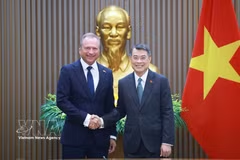
Prime Minister Le Minh Hung (right) and Luxembourg Minister of Finance Gilles Roth at their meeting in Hanoi on October 12, 2026 (Photo: VNA)

PM calls for stronger Vietnam–Luxembourg cooperation in green finance

Prime Minister Le Minh Hung proposed that Luxembourg share experience in institutional development, fund and asset management, green finance and financial supervision, while supporting human resources training and connecting Luxembourg’s financial institutions with Vietnam International Financial Centre’s ecosystem.

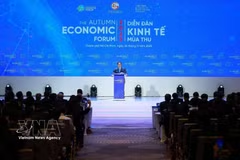
Then Prime Minister Pham Minh Chinh addresses the Autumn Economic Forum 2025 on November 26 last year. (Photo: VNA)

World Economic Forum to co-brand Autumn Economic Forum 2026 in Ho Chi Minh City

On October 27, the forum will host 16 thematic sessions across three parallel venues, focusing on AI – quantum, finance – digital economy – autonomy, and manufacturing – sustainability – next generation. Two sessions will be jointly organised with the WEF, addressing “Repositioning Vietnam and ASEAN in Global Value Chains” and “From AI Deployment to Future Manufacturing Workforce Readiness”.

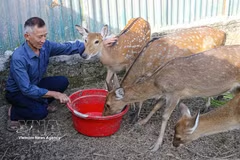
Nguyen Dinh Kien, Secretary of the Sam Mun commune Party cell in Dien Bien province, builds wealth through spotted deer farming. (Photo: VNA)

📝OP-ED: Party Central Committee’s 4th plenum offers new thinking encouraging Party members to engage in business

Accordingly, the plenum reached a consensus on several key principles, including shifting from a mindset of “permission” to one of “encouragement and facilitation” for Party members engaging in the private sector; protecting their lawful economic activities; and maintaining strict oversight of those exercising control and benefiting from such activities.

AVAC ASF LIVE vaccine developed and manufactured by AVAC Vietnam Joint Stock Company. (Photo: avac.com.vn)

Vietnam ships first commercial ASF vaccine order to Philippines

Nguyen Van Diep, General Director of AVAC Vietnam, said this was the company’s first commercial export order following the Philippines’ approval of the vaccine for unrestricted circulation. The Philippine Department of Agriculture is expected to issue usage guidelines next week, paving the way for wider distribution and application.

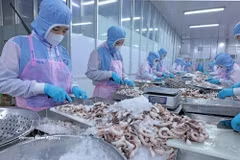
Workers process octopus for export to the Japanese market at Huy Nam Company in An Giang province. (Photo: VNA)

Fisheries sector strives for 12 billion USD in exports amid rising costs

The 12-billion-USD export target remains achievable given solid output growth and generally favourable market conditions. However, any fourth-quarter slowdown would not necessarily reflect raw material shortages but also impacts on economic efficiency amid rising material and fuel costs.

Commercial Counsellor at the Vietnamese Embassy in China Nong Duc Lai (Photo: VNA)

Vietnam-China trade growing rapidly, substantive: Commercial Counsellor

According to the Vietnam Customs data, bilateral trade hit 253.1 billion USD in the first nine months of this year, up 37.6% annually. Vietnam’s exports to China rose 32.9% to 65.8 billion USD while imports climbed 39.3% to 187.3 billion USD. China accounted for around 41.3% of Vietnam’s imports and 15.2% of its total exports.

Vietjet Air leaders and flight crew pose for a photo with guests at the launch ceremony. (Photo: VNA)

Vietjet launches Prague–Hanoi route

Vietjet Air operates the Prague–Hanoi route twice a week using Airbus A330-300 aircraft with a capacity of 377 passengers. Flights depart Prague at 8:55 p.m. every Tuesday and Saturday and arrive in Hanoi at 4:20 p.m. the following day, local time. In the opposite direction, flights leave Hanoi at 8:25 a.m. and arrive in Prague at 6:55 p.m. The route includes a stop in Almaty, Kazakhstan.

At Yen Phong II-C Industrial Park in Bac Ninh province (Photo: VNA)

Tax policy stability now key to keeping foreign investors: Officials

Companies must ensure records and data truthfully reflect the substance of transactions and engage in dialogue early when complex issues arise. Tax authorities, in turn, need to publish policies, give clear guidance, enforce rules consistently and deliver information in a timely manner.

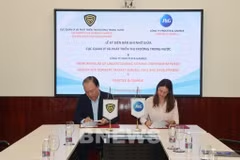
The MoU signing ceremony between the gency for Domestic Market Surveillance and Development and Procter & Gamble (P&G). (Photo: Ministry of Industry and Trade)

Vietnam steps up fight against counterfeits, IP violations

The renewed memorandum between Vietnam's domestic market surveillance force and Procter & Gamble (P&G) is expected to build on the results achieved since 2023, strengthen IP enforcement, safeguard the legitimate rights and interests of businesses and consumers, and contribute to a more transparent and fair business environment.

A Jatropha cultivation area of Star Japan Co., Ltd in My Son commune, Khanh Hoa province (Photo of Star Japan Co., Ltd)

Vietnam – a potential regional supply hub for Jatropha seed oil

Japan’s research on non-edible oil feedstocks showed that Jatropha is highly drought-tolerant and could grow well on wasteland, eroded sandy land and infertile soil. Given this, areas in central Vietnam, including Ninh Thuan, Binh Thuan and the Central Highlands, have climatic, sunlight and soil conditions suitable for achieving high seed yields and oil content.

Officials launch the Expo Platform on September 29. It will be officially put into use on October 20, two days before the opening of HCMC Export 2026. (Photo: VNA)

Technology opens new routes for Vietnamese exports

As global markets impose increasingly stringent requirements on standards, traceability, sustainability and green transformation, digitalising product data and bringing buyers closer to production sites can help Vietnamese businesses demonstrate their capabilities and meet market-specific requirements.

Phuong Dinh Anh, Deputy Chief of the Office of the Central Coordination Office for the National Target Programme, speaks at the event.( VNA)

Turning OCOP products into rural tourism experiences

Experts stressed that rural tourism can develop sustainably only when local communities actively participate and benefit from it. Investment in transport, accommodation and attractions must go hand in hand with clean water, waste treatment, hygiene, traditional craft preservation and environmental protection.