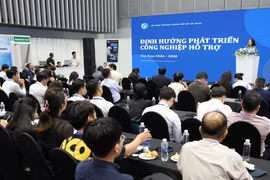
Hanoi (VNA) – Vietnam is seeking to strengthen links between foreign-invested enterprises and domestic suppliers to boost supporting industries and help local businesses move up the value chain.
After nearly four decades of economic opening, Vietnam has made significant progress in attracting foreign direct investment (FDI). However, links between foreign-invested enterprises and domestic businesses remain limited.
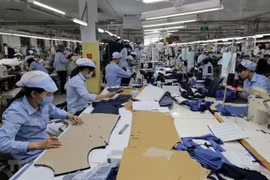
Many Vietnamese supporting-industry firms are still mainly involved in processing and assembly, while their capacity to supply components, develop technology and participate in higher-value segments of supply chains remains below potential.
As global supply chains undergo major changes and environmental standards and digital technology requirements become more demanding, developing supporting industries has become essential to improving the competitiveness of the economy. This requires coordinated efforts by the Government, multinational corporations and domestic businesses.
Bui Thu Thuy, Deputy Director of the Foreign Investment Agency under the Ministry of Finance, said Vietnam has long focused on attracting FDI, but its capacity to absorb, master and disseminate technology throughout the economy remains limited.
Although Vietnam is among the region’s notable FDI destinations, the localisation rate in production chains of foreign-invested enterprises stands at only around 20-25%. Technology transfer largely remains within companies, mainly in the form of technical support, and has yet to generate sufficient spillover effects to enable more domestic private businesses to enter higher-value segments.
According to Thuy, stronger links between foreign-invested enterprises and domestic businesses are being considered in a draft revision of the Law on Investment. Authorities are studying incentive mechanisms in line with international practices for projects that commit to transferring technology and developing local suppliers.
Management is also expected to place greater emphasis on assessing whether investors fulfil their commitments during project implementation. This approach aims to improve the effectiveness of investment incentives and ensure that FDI makes a more substantive contribution to the economy.
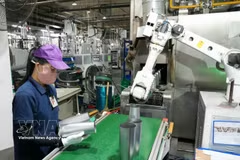
At the business level, Samsung Vietnam is implementing programmes to strengthen the production capacity of domestic supporting-industry enterprises.
Cha Ji Ho, Deputy General Director in charge of Samsung Vietnam’s Procurement Centre, said the company was expanding consultancy programmes on smart factories and smart moulds in industrial centres, including Phu Tho, Hai Phong and Thai Nguyen, in addition to locations covered previously, such as Bac Ninh and Ho Chi Minh City.
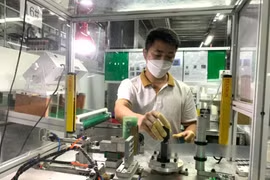
The programmes focus not only on upgrading machinery, equipment and production processes but also on training specialists at Vietnamese partner companies. Building technical expertise and the ability to sustain improvements independently is essential to increasing productivity, meeting partners’ requirements and maintaining a long-term presence in supply chains, he said.
Beyond technology and equipment, workforce quality and consistent production standards also require attention. Jackson Woo, Managing Director of SGS Vietnam, said domestic enterprises could continue to face difficulties even after receiving training and obtaining international certifications. Staff turnover and the loss of technical expertise may undermine their ability to maintain consistent quality, affecting opportunities to work with global buyers.
These challenges show that developing supporting industries requires more than investment in factories and technology. A coordinated support system is also needed, including appropriate financial policies, easier procedures for importing machinery and technology, and closer cooperation among the Government, training institutions and businesses to develop a skilled workforce.
According to experts, over the next decade, Vietnam needs to pursue a coordinated approach: establishing transparent, stable and targeted policies; linking investment incentives to the fulfilment of commitments; encouraging multinational corporations to develop local suppliers and expand technical assistance, training and management knowledge transfer; and urging domestic enterprises to invest in technology, improve workforce skills and strengthen management systems to meet international standards.
For Vietnamese businesses, deeper participation in supply chains depends not only on securing orders but also on consistently meeting requirements for quality, delivery schedules, costs and technical specifications. With support from policies and business partners, they need to develop investment plans suited to their financial capacity, gradually upgrade production processes and build a skilled workforce./.
See more
Measures taken to remove barriers to digital transformation for SMEs
Ho Chi Minh City has introduced policies and programmes to provide practical support for SMEs, gradually building an ecosystem that helps businesses access policies, evaluate their digital readiness, implement solutions and scale up effective models.
Reference exchange rate goes up on October 13
With the current trading band of +/- 5%, the ceiling rate applicable for commercial banks during the day is 26,915 VND/USD, and the floor rate 24,351 VND/USD.
Buon Ma Thuot Coffee Festival to reach national level in 2027
The festival aims to promote the Buon Ma Thuot coffee brand, advance Vietnamese specialty coffee, attract investment to deep processing and showcase the cultural identities of local ethnic groups.
Vietnam Hardware & Hand Tools Expo 2026 to return to Ho Chi Minh City
The 11th Vietnam Hardware & Hand Tools Expo (VHHE HCMC 2026) will run in Ho Chi Minh City on December 3-5, drawing about 380 exhibitors from 15 countries and territories.
PM orders power plan overhaul to meet double-digit growth
Securing adequate power supply is an urgent priority and a prerequisite to successfully achieve socio-economic development goals 2026, a foundational year for accelerating progress, with breakthroughs to follow in 2027 and the goals for the full term to be delivered, said Prime Minister Le Minh Hung.
Top leader pledges support for firms, presses tech self-reliance
The country needs more firms that master technologies, build trusted brands and run production networks able to compete globally. Progress over the next five to 10 years must show up in productivity, job quality and market position, said top leader To Lam.
Hung Yen must tap new development space to become dynamic growth pole: PM
Hung Yen must focus on breakthroughs in strategic infrastructure and regional connectivity, linking industrial parks, economic zones, urban and production hubs and services with expressways, seaports and transport hubs, said PM Le Minh Hung.
Vietnam’s economic transformation opens up major cooperation opportunities with EU: PM
European companies were keen to increase investment and partnerships in green transition, supply chains, transport, strategic infrastructure, critical raw materials, science and technology, defence and security, and other areas of mutual interest.
Can Tho, Italy seek to expand cooperation in healthcare, climate change response
Can Tho city sees significant room for expanding trade and investment ties with Italy. Stronger business connections and trade promotion are expected to help both sides make better use of their respective strengths and build more substantive and sustainable economic cooperation.
Da Nang identifies key sectors for international financial centre
VIFC-DN aims to develop sectors with distinct competitive advantages and strong links to emerging growth areas, connecting international capital with projects, businesses and investment opportunities in Da Nang, the central region and Vietnam as a whole.
OCOP-tourism links boost value of Vietnamese farm products
Producers are suggested to bring visitors to farms and workshops to experience cultivation, processing and local traditions, rather than simply selling products at tourist destinations.
World Economic Forum to co-brand Autumn Economic Forum 2026 in Ho Chi Minh City
On October 27, the forum will host 16 thematic sessions across three parallel venues, focusing on AI – quantum, finance – digital economy – autonomy, and manufacturing – sustainability – next generation. Two sessions will be jointly organised with the WEF, addressing “Repositioning Vietnam and ASEAN in Global Value Chains” and “From AI Deployment to Future Manufacturing Workforce Readiness”.
📝OP-ED: Party Central Committee’s 4th plenum offers new thinking encouraging Party members to engage in business
Accordingly, the plenum reached a consensus on several key principles, including shifting from a mindset of “permission” to one of “encouragement and facilitation” for Party members engaging in the private sector; protecting their lawful economic activities; and maintaining strict oversight of those exercising control and benefiting from such activities.
Vietnam ships first commercial ASF vaccine order to Philippines
Nguyen Van Diep, General Director of AVAC Vietnam, said this was the company’s first commercial export order following the Philippines’ approval of the vaccine for unrestricted circulation. The Philippine Department of Agriculture is expected to issue usage guidelines next week, paving the way for wider distribution and application.
Fisheries sector strives for 12 billion USD in exports amid rising costs
The 12-billion-USD export target remains achievable given solid output growth and generally favourable market conditions. However, any fourth-quarter slowdown would not necessarily reflect raw material shortages but also impacts on economic efficiency amid rising material and fuel costs.
Reference exchange rate down 8 VND at week’s beginning
With the current trading band of +/- 5%, the ceiling rate applicable for commercial banks during the day is 26,902 VND/USD, and the floor rate 24,340 VND/USD.
Hung Yen ranks seventh nationwide in GRDP growth
Hung Yen province posted an estimated GRDP growth of 11.22% year on year in the first nine months of 2026, ranking seventh among the 34 provinces and cities.
Vietnam-China trade growing rapidly, substantive: Commercial Counsellor
According to the Vietnam Customs data, bilateral trade hit 253.1 billion USD in the first nine months of this year, up 37.6% annually. Vietnam’s exports to China rose 32.9% to 65.8 billion USD while imports climbed 39.3% to 187.3 billion USD. China accounted for around 41.3% of Vietnam’s imports and 15.2% of its total exports.
Vietjet launches Prague–Hanoi route
Vietjet Air operates the Prague–Hanoi route twice a week using Airbus A330-300 aircraft with a capacity of 377 passengers. Flights depart Prague at 8:55 p.m. every Tuesday and Saturday and arrive in Hanoi at 4:20 p.m. the following day, local time. In the opposite direction, flights leave Hanoi at 8:25 a.m. and arrive in Prague at 6:55 p.m. The route includes a stop in Almaty, Kazakhstan.
Tax policy stability now key to keeping foreign investors: Officials
Companies must ensure records and data truthfully reflect the substance of transactions and engage in dialogue early when complex issues arise. Tax authorities, in turn, need to publish policies, give clear guidance, enforce rules consistently and deliver information in a timely manner.