Vietnam strengthens financial cooperation at IMF-World Bank annual meetings

The Vietnamese Governor underscored the complementary roles of global and regional financial cooperation mechanisms, including the Chiang Mai Initiative Multilateralisation (CMIM) and the ASEAN+3 Macroeconomic Research Office (AMRO). He also highlighted the importance of technical assistance in fintech, digital transformation, cybersecurity and risk management.

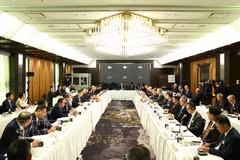
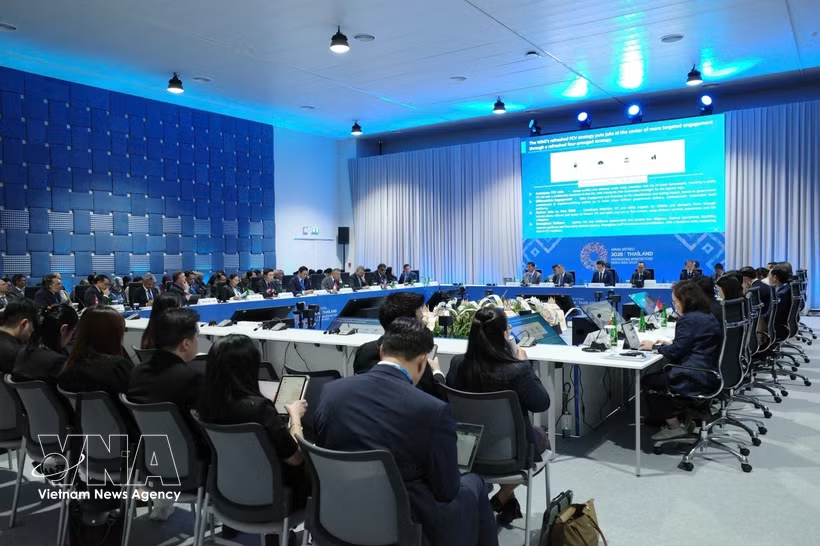
An overview of the meeting between IMF Managing Director Kristalina Georgieva and ASEAN Finance Ministers and Central Bank Governors (Photo: VNA)

​Bangkok (VNA) – A delegation from the State Bank of Vietnam (SBV), led by Governor Pham Duc An, participated in key activities in Bangkok, Thailand, on October 13-14 within the framework of the ongoing 2026 Annual Meetings of the International Monetary Fund (IMF) and the World Bank (WB) Group.

Taking place from October 12-18, the meetings bring together finance ministers, central bank governors and representatives of 191 member economies. Their return to Bangkok for the first time in 35 years highlights Asia’s growing importance in the global economy and financial system.

At a roundtable between IMF Managing Director Kristalina Georgieva and ASEAN finance ministers and central bank governors, An and other participants discussed global and regional economic prospects, the impacts of geopolitical, trade and energy fluctuations, and policies to strengthen economic resilience.

The discussions highlighted four key messages. The global economy remains resilient but recovery is uneven; vulnerable economies face mounting challenges; government borrowing costs are rising; and growing global public debt makes it urgent to rebuild fiscal buffers.

Participants stressed the need to maintain macroeconomic stability, strengthen policy space, accelerate structural reforms, seize opportunities from digital transformation and artificial intelligence (AI), and enhance multilateral cooperation to withstand external shocks.

ASEAN central bank governors and finance ministers praised the IMF’s role in economic surveillance, policy advice and capacity building, while calling for stronger analysis of spillover effects, greater experience-sharing and recommendations tailored to individual countries.

The Vietnamese Governor underscored the complementary roles of global and regional financial cooperation mechanisms, including the Chiang Mai Initiative Multilateralisation (CMIM) and the ASEAN+3 Macroeconomic Research Office (AMRO). He also highlighted the importance of technical assistance in fintech, digital transformation, cybersecurity and risk management.

At the 57th Joint Governors’ Meeting of the IMF-WBG Southeast Asia Voting Group (SEAVG), participants discussed reforms to the two institutions and ways to improve their support for member economies. The IMF focused on macroeconomic surveillance, policy advice, technical assistance and governance and quota reforms, while the WB prioritised resource mobilisation, private investment, infrastructure, digital transformation and sustainable growth.

During a meeting with Head of the IMF Asia and Pacific Department Krishna Srinivasan, An exchanged views on global, regional and Vietnamese economic prospects and policy challenges. He affirmed that the SBV will continue to manage monetary policy proactively and flexibly to control inflation, maintain macroeconomic stability and safeguard banking system security. He also appreciated the IMF’s support and expressed a desire to deepen policy dialogue and technical assistance.
vnanet_nhnn1.jpg
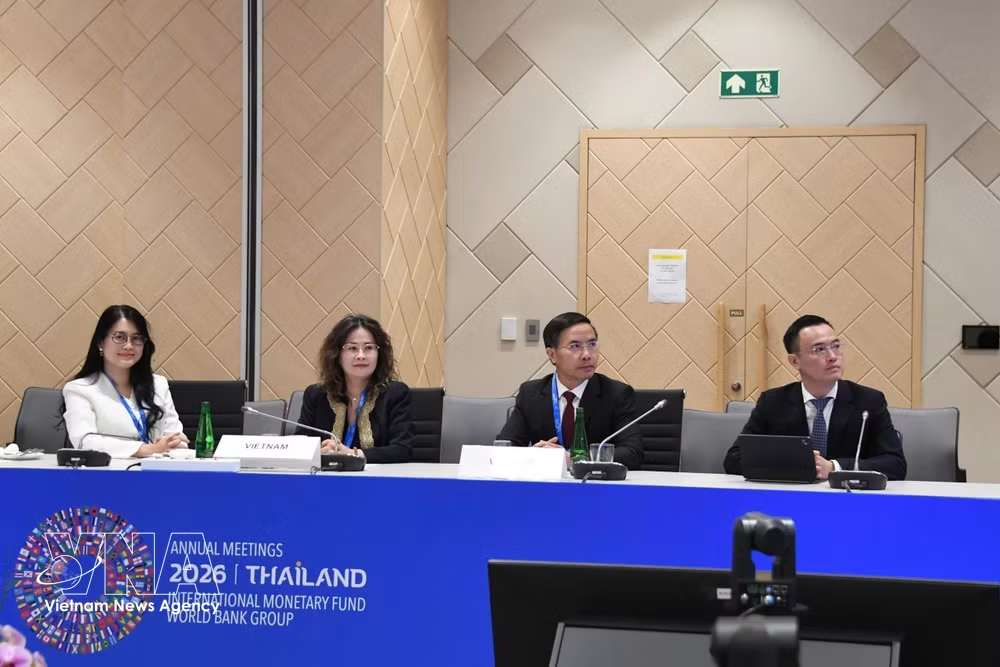
Governor of the State Bank of Vietnam Pham Duc An (second from right) attends the roundtable meeting between IMF Managing Director Kristalina Georgieva and ASEAN finance ministers and central bank governors (Photo: VNA)

At a meeting with Managing Director of the Monetary Authority of Singapore (MAS) Chia Der Jiun, the two sides reviewed existing and potential cooperation, particularly in cross-border payment connectivity, digital banking, fintech and financial inclusion. An expressed his wish to advance bilateral and ASEAN initiatives to improve financial services for people and businesses.

Meeting with Bank of France Governor Emmanuel Moulin, the Vietnamese Governor discussed policy management amid global uncertainty, banking system resilience and emerging financial risks. They also exchanged views on digital currencies, fintech, payment infrastructure innovation and prospects for closer professional cooperation between the two central banks.

At a meeting with the IFC’s Regional Vice President for Asia and the Pacific Sarvesh Suri, Governor An acknowledged the IFC’s contributions to Vietnam’s private-sector development and called for continued support in mobilising long-term capital, strengthening financial institutions and promoting investment in manufacturing, agriculture, financial inclusion and infrastructure. He also discussed measures to attract international capital and expand private-sector participation.

Meeting with President of the Asian Development Bank (ADB) Masato Kanda, An explored cooperation opportunities in infrastructure development, green and digital transitions, and private-sector growth.

During the trip, the SBV governor also visited the Vietnamese Embassy in Thailand and met Ambassador Pham Viet Hung to discuss ways to boost bilateral financial and banking cooperation and support Thai banks' operations in Vietnam. He stressed closer coordination and information-sharing between the SBV and the embassy to address difficulties, expand cooperation opportunities and deepen Vietnam-Thailand economic and financial ties./.

​

VNA

See more

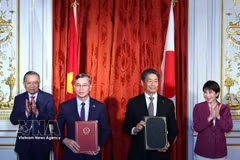
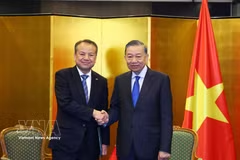
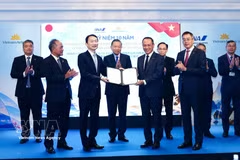
General Secretary and President To Lam and Japanese Prime Minister Takaichi Sanae witness the exchange of cooperation documents in Tokyo on November 9, 2026. (Photo: VNA)

Vietnam, Japan exchange three loan and grant aid documents

The exchange of the three documents on loans and grant aid reaffirms Japan's position as one of Vietnam's leading economic partners and reflects the strong commitment of both governments to translating high-level agreements into concrete cooperation projects, contributing to further strengthening the Vietnam-Japan Comprehensive Strategic Partnership.

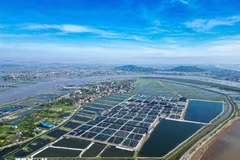
North central region targets marine hub status with 10.5% growth goal

North central region targets marine hub status with 10.5% growth goal

The region’s GRDP rose 8.37% in 2025 and contributed 6.47% to national growth. Drivers are increasingly complementary. Ha Tinh’s industry and construction sector grew 24.25% in the first half; Nghe An’s industrial production index rose 23.02% and exports hit 3.1 billion USD, up 58.4%.

The conference on Vietnam-Cambodia trade connectivity will be held in AN Giang province on November 13, 2026. (Suource: Bnews)

Vietnam, Cambodia to boost trade connectivity

The Vietnam–Cambodia trade connectivity conference is part of a scheme to boost cross-border trade and exports to Cambodia in 2026, aiming to help raise bilateral trade to 20 billion USD by 2030.

Deputy Prime Minister Ho Quoc Dung (right) receives Per Narvinger, President and CEO of Swedish telecommunications equipment maker Ericsson, in Hanoi on November 9. (Photo: VNA)

Vietnam, Sweden step up cooperation in telecom infrastructure, cybersecurity

Vietnam is accelerating institutional reforms, improving its investment and business environment, developing infrastructure and enhancing human resources quality. The Government stands ready to cooperate with leading global corporations investing in sectors of strategic importance to the country's development.

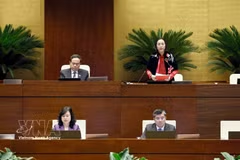
Vice President of the National Assembly Nguyen Thi Thanh speaks at the NA agenda on November 9. (Photo: VNA)

NA approves 2027 central budget allocation plan

The National Assembly (NA) on November 9 adopted a resolution on the allocation of the 2027 central budget, with all 469 deputies present voting in favour. Under the resolution, total central budget revenue in 2027 is estimated at more than 1.7 quadrillion VND (66.62 billion USD), while total expenditure is projected at over 2.3 quadrillion VND.

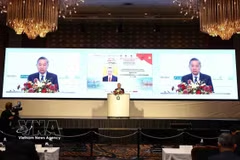
General Secretary of the Communist Party of Vietnam Central Committee and President To Lam attends the Vietnam-Japan Public-Private Forum on Economic, Science and Technology Cooperation in Tokyo on November 9, as part of his official visit to Japan. (Photo: VNA)

Vietnam-Japan relations evolve amid changing economic landscape: Nikkei Asia

Vietnam and Japan are seeking to improve the quality and added value of cooperation. During Party General Secretary and President Lam’s visit, they are expected to promote collaboration in artificial intelligence (AI), small modular reactor (SMR) technology, nuclear power and human resource training, Nikkei Asia reported.

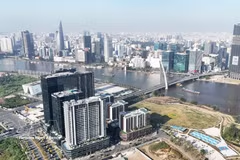
The APEC Convention Centre and related facilities are taking shape on Phu Quoc special zone, An Giang province. (Photo published by VNA)

Phu Quoc special zone envisioned as new growth engine

For 2026–2030, the Phu Quoc special economic zone will focus on high-value-added services, marine ecotourism and the digital economy. Total investment across society is expected to surpass 195 trillion VND.

Production line at Hana Micron Vina Co., Ltd in Bac Ninh city (Photo: VNA)

Processing and manufacturing continue to drive industrial growth

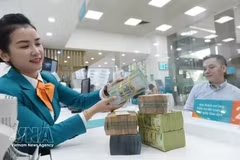
The sector’s industrial production index (IIP) rose 13% year on year, contributing 10.2 percentage points to overall industrial growth. Mining increased 7.1%, adding 1.1 percentage points, while electricity generation and distribution grew 10.6%, contributing one percentage point. Water supply, waste and wastewater management and treatment expanded 9.2%.

Vietnamese workers at a Japanese oyster processing factory (Photo: VNA)

Vietnam-Japan trade machine has room to run

Economic, trade and investment cooperation remains the core pillar and the main engine of comprehensive, sustainable bilateral ties. General Secretary of the Communist Party of Vietnam Central Committee and President To Lam’s official visit to Japan is therefore a key moment to reinforce political trust, deepen the Comprehensive Strategic Partnership and open new cooperation opportunities in the next growth phase.

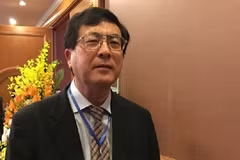
Prof. Kenichi Ohno from Japan’s National Graduate Institute for Policy Studies (GRIPS) (Photo: vietnamfinance.vn)

Vietnam, Japan poised to shape new economic partnership: Japanese expert

Vietnam's progress in income levels and technological capabilities has opened up a new phase in economic ties with Japan, with both countries shifting from a model centred on Japanese support for Vietnam to one of jointly developing and operating business activities, he said, noting that this shift reflected Vietnam's development achievement.