RoK tops Vietnam’s foreign investors with nearly 103 billion USD in registered capital

Two-way trade topped 80 billion USD in the first eight months of 2026, the highest for that period in any previous year. That builds momentum toward a goal of exceeding 100 billion USD for the first time this year and reaching 150 billion USD by 2030.

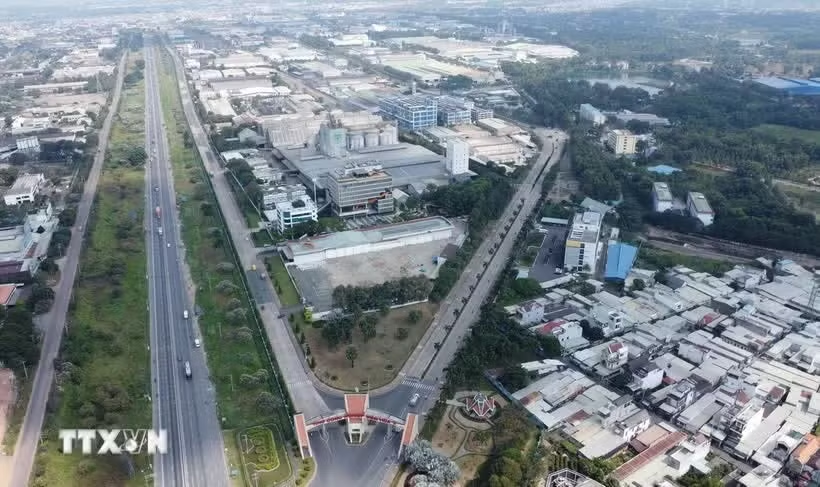
Part of Bien Hoa 2 Industrial Park in Dong Nai city (Photo: VNA)

Dong Nai (VNA) – The Republic of Korea (RoK) is now Vietnam’s largest foreign investor, with nearly 10,600 projects and almost 103 billion USD in registered capital, while ranking as Vietnam’s third-largest trade partner, said Deputy Minister of Foreign Affairs Ngo Le Van.

Speaking at the Meet Korea conference, co-hosted by the Vietnamese Ministry of Foreign Affairs and the Korean Embassy in Dong Nai city on October 15, Van said the 2026-2027 period offers a chance for new breakthroughs ahead of the 35th founding anniversary of diplomatic ties on December 22.

Two-way trade topped 80 billion USD in the first eight months of 2026, the highest for that period in any previous year. That builds momentum toward a goal of exceeding 100 billion USD for the first time this year and reaching 150 billion USD by 2030, he noted.

Local-level cooperation and people-to-people exchanges have also picked up in recent years. In 2025, the two countries recorded more than 5 million visits, with over 350,000 Vietnamese living in the RoK and about 200,000 Koreans residing in Vietnam.

Van said Vietnam is overhauling its growth model around science, technology, innovation and a quality workforce, aiming for double-digit growth. It is prioritising investment in high-value sectors, including artificial intelligence, semiconductors, smart infrastructure and clean energy, which the RoK has considerable expertise in and leave substantial room for cooperation.

The official said he hopes Korean companies will join activities within APEC Year 2027 hosted by Vietnam and contribute to a connected, innovative and prosperous Asia-Pacific region.

Vo Tan Duc, Vice Secretary of the municipal Party Committee, said Dong Nai holds a strategic position linking the southeastern region with international markets and is one of Vietnam’s longest-established industrial localities. It has all five transport modes (road, air, rail, maritime and inland waterways) and key assets, including Long Thanh International Airport, Phuoc An Port and 10 expressway routes that are completed, under construction or planned.

Duc said the Politburo’s Resolution 16-NQ/TW on the construction of development of Dong Nai gives the city strategic direction to capitalise on its advantages and widen its development space. It casts Dong Nai as a key growth pole for the southeastern region and the country, and as a global and regional connectivity hub and a centre for industry, services, logistics and innovation.

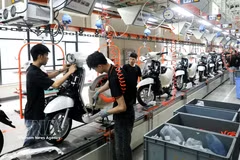
Dong Nai has drawn investment from 51 countries and territories, with about 2,300 projects worth more than 47 billion USD. The RoK is its largest foreign investor, with nearly 470 active projects and almost 8.4 billion USD in registered capital.

Korean Ambassador Lee Miyun said Dong Nai is the first locality in Vietnam she has visited on an official working trip, after presenting her credentials to the Vietnamese Party and State leader in early October.

Lee said Dong Nai is a typical example of Korean companies’ overseas investment, particularly in manufacturing, components and spare parts, and logistics. She hoped that Korean firms will continue expanding in advanced components and materials, smart logistics and cities, critical minerals and defence industry.

The ambassador also called on the Vietnamese Government, Dong Nai authorities and other cities and provinces to keep investment policies stable, predictable and consistently enforced in actual business and trade activities.

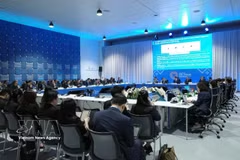
At the event, delegates discussed ways to enhance the Vietnam-RoK Comprehensive Strategic Partnership, with a focus on breakthroughs in trade, sustainable investment and workforce training for the digital era. They also deliberated ways to advance science, technology and cultural industries amid digital transformation, and fostering green, sustainable and inclusive growth.

Vietnamese agencies and their Korean partners also signed memoranda of understanding on cooperation./.

VNA
See more

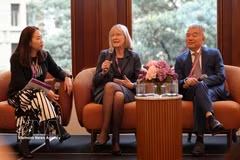
Speakers at the conference (from left): AVPI Advisory Board Chair Dr Le Thu Huong, Australian Ambassador to Vietnam Gillian Bird, and Vietnamese Consul General in Sydney Nguyen Thanh Tung. (Photo: VNA)

Vietnam, Australia turn momentum into practical cooperation

Vietnam and Australia should focus on promoting two-way investment, expanding cooperation linked to APEC 2027 and making better use of people-to-people connections. Vietnam needs capital, skills, technology, infrastructure, and energy transition expertise - areas where Australia could offer valuable support.

The interface of the National E-Procurement System. (Photo: muasamcong.mpi.gov.vn)

Vietnam to move PPP bidding online from 2027

From January 1, 2027, PPP project proposals must be submitted through the National E-Procurement System. From September 1, 2027, investor selection for PPP projects tendered through open bidding will move fully online.

An automated robot-based production line at CAYI Technology Vietnam Co., Ltd. in Yen Phong II-C Industrial Park, Bac Ninh city (Photo: VNA)

EuroCham: Business Confidence Index in Vietnam remains high at 78.3 in Q3

The survey found that 64% of respondents described their current business conditions as good or very good, while 28% maintained a neutral or cautious outlook, reflecting a wait-and-see attitude as international demand remains flat and businesses look for policy momentum to translate into faster procedures and more predictable outcomes.

Workers manufacture handheld power tools at the Keystone Electrical Vietnam factory in Lien Ha Thai Industrial Park, Thai Thuy commune, Hung Yen province (Photo: VNA)

Vietnam seeks to turn FDI inflows into domestic value added

Vietnam is shifting its FDI attraction strategy from expanding investment volumes to prioritising capital inflows that brings technology, knowledge, modern management practices and stronger links with domestic businesses, particularly in semiconductors, artificial intelligence (AI), chips and renewable energy.

At Yadea Vietnam’s smart manufacturing plant in Tan Hung Industrial Park, Bac Ninh province (Photo: VNA)

Vietnam ties FDI incentives to local supplier commitments

Incentives will increasingly hinge on investors’ performance and commitments, not just on landing projects. Key commitments include transferring technology to Vietnamese firms, training workers, providing technical support and opening FDI supply chains to domestic companies.

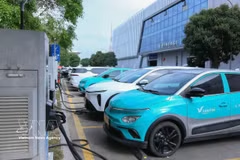
Green SM has launched all-electric taxi service in the US. (Illustrative photo: VNA)

Green SM launches all-electric taxi service in US

The move brings Green SM into one of the world’s most dynamic and demanding markets. It also marks another step in the international expansion of the Vietnamese mobility brand, following its rapid growth across markets in Asia and Europe.

An overview of the meeting between IMF Managing Director Kristalina Georgieva and ASEAN Finance Ministers and Central Bank Governors (Photo: VNA)

Vietnam strengthens financial cooperation at IMF-World Bank annual meetings

The Vietnamese Governor underscored the complementary roles of global and regional financial cooperation mechanisms, including the Chiang Mai Initiative Multilateralisation (CMIM) and the ASEAN+3 Macroeconomic Research Office (AMRO). He also highlighted the importance of technical assistance in fintech, digital transformation, cybersecurity and risk management.

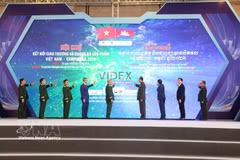
Representatives of the organising committee at the opening ceremony of the fair (Photo: VNA)

Vietnam-Cambodia trade expo promotes bilateral economic cooperation

The Vietnam-Cambodia Business Networking and Product Promotion Exposition has become a key trade promotion event, creating business and investment opportunities while strengthening mutual understanding and trust between the two countries’ armies, people and enterprises.