Hanoi (VNA) - Foreign direct investment (FDI) is flowing into Vietnam at a rapid clip, but turning pledges into real spending depends on how fast investors can get land, clear sites and plug into infrastructure.
The Government is prioritising cleared land, digitalised data and streamlined land procedures to draw a new generation of foreign investors.
Ready land, legal certainty
Registered FDI reached 50.36 billion USD as of September 30, up 76.4% from a year earlier. New commitments totaled 29.24 billion USD across 3,108 projects, while disbursements rose 12.1% to an estimated 21.07 billion USD, the highest for the first nine months of any year in the past five, reported the Ministry of Finance.
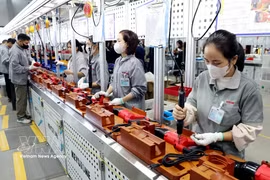
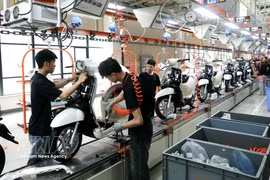
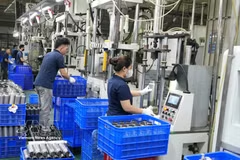
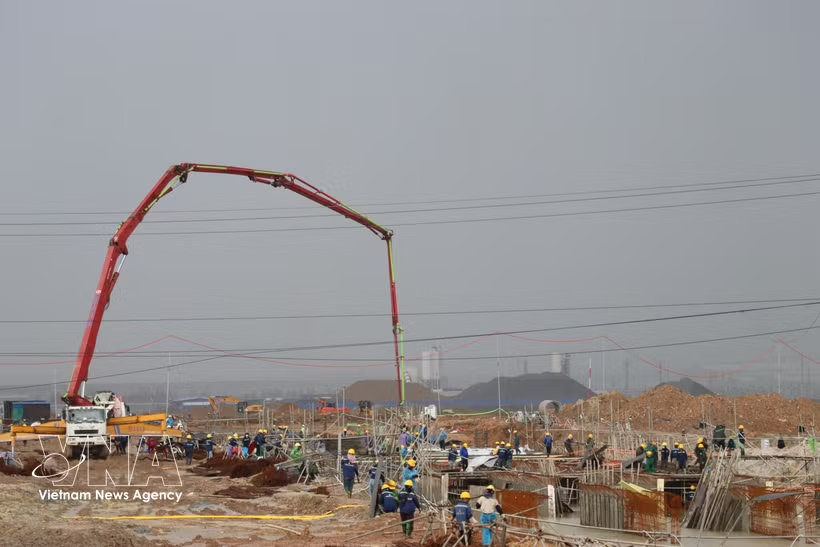
Manufacturing and processing absorbed the bulk of the cash, with disbursements of nearly 17.4 billion USD, or 82.6% of the total. The sector also needs large tracts of industrial land, plus integrated power, water, logistics and transport links.
For a multinational company, the decision to invest in Vietnam is only the first step. The harder part is picking a location, securing zoning, completing site clearance and land procedures, obtaining construction and environmental approvals, and connecting to infrastructure.
The bottleneck, then, isn’t necessarily a shortage of land. Investors’ bigger concern is getting timely access to suitable sites so projects can start on schedule.
Experts said a cheaper site can lose its appeal if clearance is unfinished, legal status is unresolved or multiple procedures must be completed in sequence. A pricier plot that is ready to build may well win out.
Between April and the end of September, authorities settled problems at 2,535 projects, freeing up more than 1.76 quadrillion VND (67.6 billion USD ) of capital and putting 86,600ha of land into use. In total, 3,557 projects covering more than 139,000ha have been cleared of obstacles.
The 2024 Land Law clarified how foreign-invested economic entities can access land. Even so, they must still navigate overlapping rules on investment, planning, construction, environmental protection and infrastructure.
Rather than waiting for investors to show up, local authorities should prepare investment-ready land in advance. That means publicly disclosing zoning plans, legal status, site clearance schedules, power and water availability, transport links and financial obligations, experts said.
That matters all the more as Vietnam courts capital in semiconductors, artificial intelligence, data centres, electronics, logistics and green technology. Such projects need not just land but reliable electricity, digital infrastructure, skilled labour and access to supply chains.
Resolution 10 shifts FDI race to quality
The Politburo’s Resolution 10-NQ/TW, dated June 8, 2026, targets about 200-300 billion USD in registered FDI over 2026-2030. It also shifts the emphasis from raw capital toward technology, knowledge, innovation and productivity gains.
Su Ngoc Khuong, Senior Director of Investment Advisory at Savills Vietnam, said the resolution’s real value lies not in the headline FDI figure but in the growth model it sets out, one built on technology, knowledge and innovation.
Khuong said the question going forward is not just how much capital Vietnam can attract, but how much technology, knowledge and value added it can bring into the economy.
As Vietnam courts technology-intensive projects, investors will look beyond land rental prices. They will weigh the total time needed to secure a site, the certainty of its legal status, infrastructure quality and room to expand.
Local authorities, too, must move past simply having land to lease and build full investment packages covering land, infrastructure, services and administrative procedures. The easier it is for investors to estimate costs and timelines, the faster they can commit.
In the race for new-generation FDI, Vietnam’s edge therefore goes beyond cost. Transparent land availability, clear legal frameworks, predictable procedures and well-prepared infrastructure can help companies manage risk and cut the time it takes to get projects running./.