Hanoi (VNA) - High-quality foreign direct investment (FDI), coupled with the growing global standing of national trade, offers a pathway for Vietnam to move from an “assembly workshop” to a “high-value link” in global supply chains.
Vietnam is shifting its FDI attraction strategy from expanding investment volumes to prioritising capital inflows that bring technology, knowledge, modern management practices and stronger links with domestic businesses, particularly in semiconductors, artificial intelligence (AI), chips and renewable energy.
Rising inflows of technology investment
Resolution No. 10 issued by the Political Bureau on developing the foreign-invested economy targets 200–300 billion USD in registered FDI by 2030, with 75% of newly registered capital coming from developed economies with strengths in technology, capital and modern governance. It also aims to attract at least three global technology corporations to establish research and development (R&D) centres in Vietnam and bring 10,000 domestic enterprises into multinational corporations’ supply and value chains.
According to the National Statistics Office (NSO), total registered foreign investment, including newly registered and adjusted capital and capital contributions and share purchases, reached 40.63 billion USD by the end of August, up 55.4% year on year. Disbursed FDI stood at approximately 17.25 billion USD, up 12% and the highest level for the first eight months in five years.
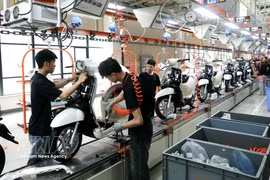
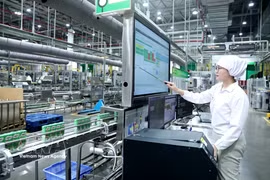
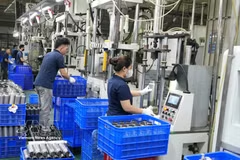
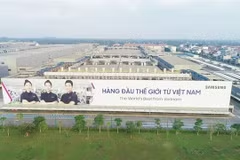
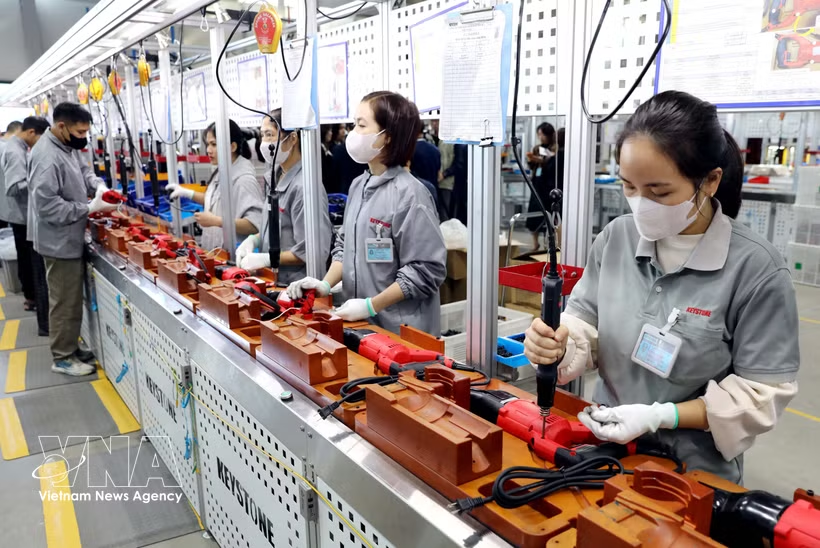
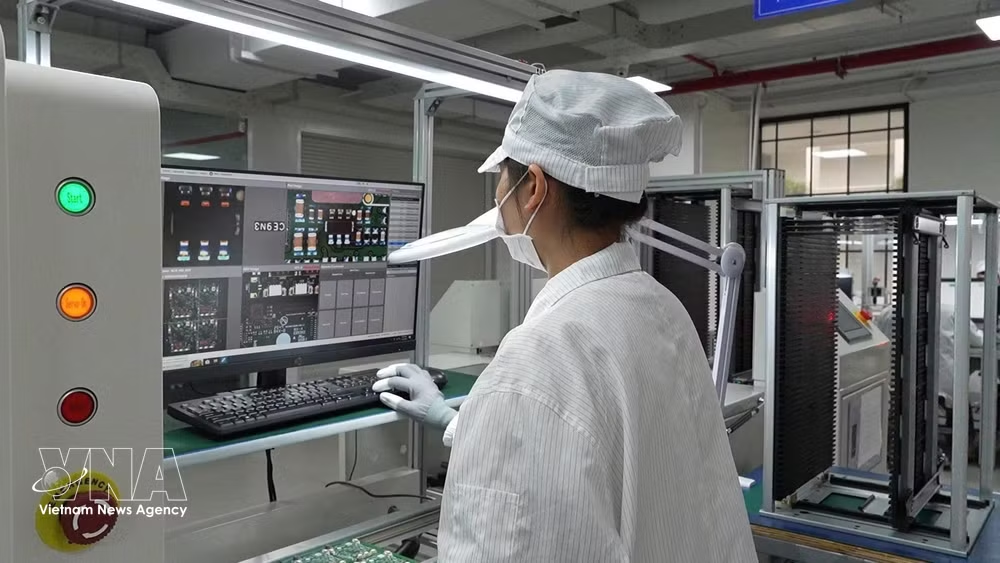
Manufacturing and processing led newly registered investment with 12.15 billion USD, accounting for 56%. Alongside traditional manufacturing, an increasing number of projects are emerging in electronics, semiconductors, high technology and other segments with higher value added.
The country also aims to develop its semiconductor industry, targeting at least 100 design enterprises, one small-scale chip fabrication plant and 10 packaging and testing plants by 2030. In the 2040–2050 period, Vietnam aims to master research and development in the semiconductor and electronics industries.
Measures sought to join global value chains
While FDI connects Vietnam to global supply chains, trade reflects the depth of its economic integration. After years of opening up and joining free trade agreements (FTAs), Vietnam has become one of the world’s top 20 economies by import-export turnover.
Assoc. Prof. Dr. Nguyen Thuong Lang from the Institute of Trade and International Economics at the National Economics University (NEU) said Vietnam’s challenge is to convert part of its trillion-dollar trade turnover into domestic value added. FDI attraction must therefore go hand in hand with trade upgrading.
Moving beyond contract manufacturing to product design, high-tech components, software, technical services, logistics, branding and international distribution will enable Vietnamese businesses to retain more value domestically. Otherwise, export growth could largely reflect the expansion of foreign-led production networks, he said.
He also stressed that leveraging export markets, free trade agreements (FTAs) and multinational corporations’ networks to support Vietnamese businesses will help turn trillion-dollar trade into a driver of domestic industrial development.
Prof. Vu Minh Khuong from the Lee Kuan Yew School of Public Policy at the National University of Singapore (NUS) said FDI should be viewed as a strategic lever for upgrading Vietnamese enterprises and the economy, rather than as a separate sector alongside domestic businesses.
Despite attracting major international corporations, Vietnam has yet to fully realise the potential for linkages between foreign-invested and domestic firms. Vietnamese businesses should be viewed as partners that can drive innovation, cut costs and boost global competitiveness.
This requires domestic enterprises to invest in technology, human resources, digitalisation, AI, green transition, R&D and management capacity. FDI attraction policies must therefore be closely linked with domestic enterprise development, allowing stronger capabilities to drive deeper participation in global value chains.
Leveraging FDI to strengthen national capacity
Khuong said Vietnam’s ability to connect with many economies and technology ecosystems is a major strategic asset for the country.
FDI must become a major school for technology, management, standards and markets; trade must provide pressure and motivation for businesses to upgrade; and integration must help Vietnam access the world’s best knowledge, talent, technologies and networks, he said.
Lang also stressed that FDI attraction and domestic enterprise development must be addressed together to help Vietnam build an autonomous economy, create breakthoughs and become a developed country by 2045. Priorities should be given to developing supporting industries, improving technical skills and strengthening links between foreign-invested and domestic businesses.
Domestic suppliers must meet multinational corporations’ standards to compete for contracts, he said, calling for targeted support for businesses to upgrade technology, train managers and conduct R&D.
He also proposed linking tax and land-rental incentives for foreign investors to commitments on domestic sourcing, while creating a priority supplier list to connect qualified Vietnamese businesses directly with foreign-invested corporations’ procurement departments.
Such measures would help translate foreign investment and international integration into stronger domestic capabilities, supporting sustainable growth and long-term prosperity./.