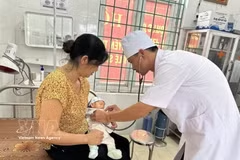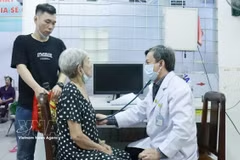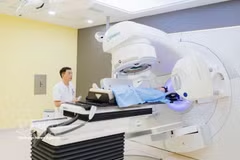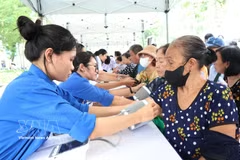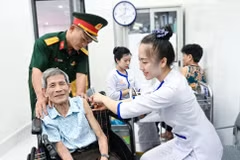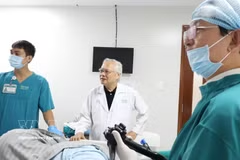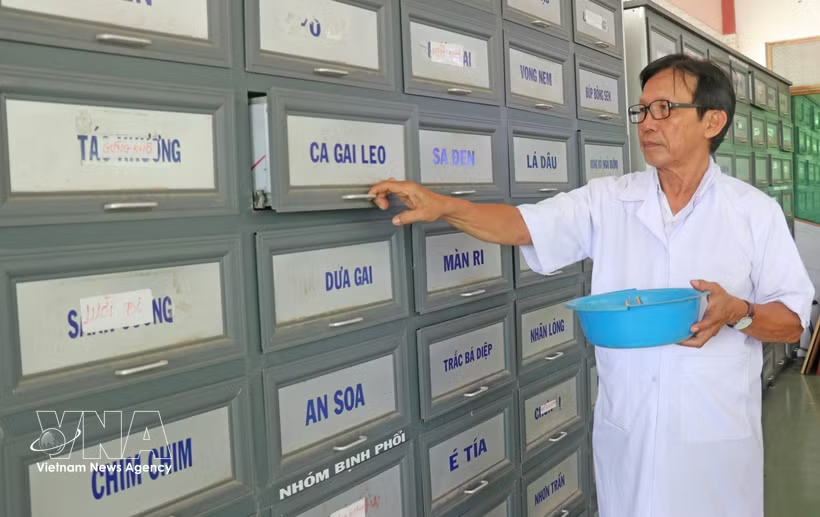
Hanoi (VNA) – Vietnam aims to develop a comprehensive, modern and science-based traditional medicine sector with stronger international integration, making it an important part of the national healthcare system by 2030, according to a newly-approved national strategy.
Deputy Prime Minister Pham Thi Thanh Tra signed Decision No. 1976/QD-TTg on October 13, approving the national strategy for traditional medicine development through 2030, with a vision to 2045.
The strategy seeks to develop a coordinated system covering medical examination and treatment, training, scientific research, technology, medicinal materials and the medicinal materials industry. It also aims to create a traditional medicine economy with high valued added, support health tourism, help enhance the national soft power, and build Vietnam’s national brand in traditional medicine.
By 2030, all provinces and cities are expected to have traditional medicine hospitals, with at least 70% of these hospitals having 300 beds or more. All geriatric hospitals must have traditional medicine departments, while geriatric departments in provincial-level general hospitals are expected to integrate traditional medicine into elderly care and rehabilitation.
Setting targets for traditional medicine services, the strategy expects treatment combining traditional and modern medicine to account for at least 10% of services at specialised-level facilities, 20% at basic-level facilities and 30% at primary-level facilities. All commune-level health stations are expected to have the capacity to provide traditional medicine services.
Health insurance spending on examination and treatment using traditional medicine is targeted to at least double from its 2025 level.
Vietnam also aims to ensure self-sufficiency for at least 20% of domestic demand for medicinal materials, while the output value of the medicinal materials, traditional medicines and herbal medicine industries is expected to grow by at least 10% annually. Exports of these products are also hoped to increase by an average of at least 10% a year.
The strategy calls for an annual increase of at least 15% in scientific research, technology and innovation projects in traditional medicine. Biotechnology-related research into medicinal materials and their products is expected to account for 20% of these projects.
By 2030, at least 90% of commune-level health stations should have at least one staff member trained in traditional medicine, and 20% should have a traditional medicine doctor. All undergraduate programmes in health-related fields must include traditional medicine modules.
Vietnam also aims to digitise at least 70% of its traditional medicine knowledge that has been surveyed, collected and verified while researching, standardising and applying at least 30 traditional remedies, treatment methods or bodies of knowledge in healthcare or product development. National brands are to be developed for 30 products made from medicinal materials, traditional medicines and herbal medicines.
Five integrated service and product lines combining traditional medicine and healthcare are also planned for tourists, linking health services with the preservation and promotion of traditional culture and indigenous knowledge.
By 2035, at least 90% of provincial-level traditional medicine hospitals are expected to have 300 beds or more, and each socio-economic region should have at least one specialised traditional medicine hospital.
The target shares for traditional medicine services that include treatment combining traditional and modern approaches will rise to 15% at specialised-level facilities, 25% at basic-level facilities and 40% at primary-level facilities.
Domestic production is expected to meet at least 25% of demand for medicinal materials. All commune-level health stations should have at least one staff member trained in traditional medicine, while 30% should have a traditional medicine doctor.
By 2045, Vietnam envisions a traditional medicine sector that preserves national identity while achieving advanced regional and global standards. Traditional and modern medicine is expected to become closely integrated in mainstream healthcare, supported by science, technology, digital transformation and a highly qualified workforce.
The strategy outlines nine groups of measures, including improving policies, strengthening traditional medicine across all stages of life, developing the medicinal materials industry, promoting research and digitalisation, training skilled personnel, preserving traditional knowledge, protecting intellectual property, expanding markets and international cooperation, raising public awareness, and strengthening inspection and supervision.
It also calls for upgrading infrastructure and equipment at traditional medicine hospitals and departments, encouraging investment in high-quality facilities, improving services at grassroots healthcare facilities, and developing pilot models of non-drug healthcare at the commune, ward and special-zone levels.
Nationally standardised professional guidelines and technical procedures combining traditional and modern medicine will also be developed for consistent application across healthcare facilities./.
See more
Phu Tho builds hospital culture to improve patient satisfaction
In recent years, alongside efforts to improve the quality of medical examinations and treatment, Phu Tho province’s health sector has focused on creating civilised, friendly hospital environments and strengthening healthcare workers’ sense of responsibility and service-oriented attitudes, with the aim of earning patients’ trust and satisfaction.
Science, technology seen as lever for medicinal plant industry
Vietnam is one of the world’s biodiversity-rich countries, with more than 5,100 medicinal plant and fungal species, along with hundreds of animal and mineral species used in traditional medicine.
Vietnam reaches out to WHO after death of Russian lab worker
Deputy PM suggests studying long-term development of hospital ship model
Vietnam is one of VAMED’s important partners in Southeast Asia. The group plans to invest 1.2 billion EUR in Vietnam over the next five years, creating jobs for thousands of workers and promoting knowledge and technology transfer. It also wishes to expand cooperation through preferential credit projects, public-private partnerships (PPPs) and partnerships with private enterprises; and supply medical products from Austria and Germany for Vietnamese partners.
Can Tho builds foundation for high-quality healthcare development
As demand for healthcare services in the city and across the Mekong Delta continues to rise, upgrading medical infrastructure is considered an important condition for developing high-quality healthcare in the region.
Vietnam hosts discussion on older persons’ right to health care
Participants discussed ways to better protect older persons’ right to health through concrete policies and action at national, regional and international levels.
Free periodic health check-ups focus on effectiveness, cost efficiency
The Ministry of Health is compiling implementation results and developing guidelines for disease-specific screening, while promoting the use of existing medical data to avoid unnecessary repeat tests.
Vietnam advances radiopharmaceutical production capacity for cancer diagnosis, treatment
Vietnam has mastered the production of various radiopharmaceuticals and radioisotopes for cancer diagnosis and treatment, helping reduce reliance on imports.
Ho Chi Minh City: Over 5 million people receive health check-ups
Notably, 49 communes and wards have achieved a health check-up rate of at least 50% of their population, with Thanh An commune reaching 100%.
AI, technological innovation help improve healthcare quality
Da Nang: Satellite hospitals prove effective at grassroots level
The model is an important component of the roadmap to turn Da Nang into a specialised medical centre for the central and Central Highlands regions, with a number of key specialties, in line with the spirit of Politburo Resolution No. 72-NQ/TW dated September 9, 2025, on breakthrough solutions to strengthen the protection, care and improvement of people's health.
Vietnam, Laos strengthen healthcare cooperation through interventional radiology
The newly inaugurated interventional radiology unit is expected to become a reputable medical facility in Vientiane and a bridge for stronger cooperation in training and technology transfer between Vietnam and Laos, said Vietnamese Ambassador to Laos Nguyen Minh Tam.
Ho Chi Minh City digitises 99.4% of hospital records
As of July 2026, 163 of the city's 164 hospitals, or 99.4%, adopted electronic medical records, the report said. About 64% of public hospitals and 65% of private hospitals now run the technology across their entire operations
Hong Ngoc General Hospital emerges as a trusted cardiovascular care destination for international patients in Hanoi
The Cardiology and Interventional Cardiology Department at Hong Ngoc General Hospital features a team of experienced physicians who have worked at leading cardiovascular centers in Vietnam.
Ho Chi Minh City eyes more foreign medical tourists
Director of the municipal Department of Health Tang Chi Thuong said a key prerequisite for attracting foreign patients is a strategy to develop centres of medical excellence. He proposed selecting hospitals and specialties with strong expertise for investment towards international standards, particularly in competitive fields such as cardiology, oncology, robotic surgery, assisted reproduction, paediatrics, dentistry, cosmetic medicine, specialised health check-ups, traditional medicine and rehabilitation.
Health cooperation adds fresh momentum to Vietnam-US relations
Through this MOU, the US Department of State, working with Congress, plans to provide 98.75 million USD in life-saving global health assistance over the next five years, including 21.385 million USD in dedicated Global Health Security funding, to support Vietnam’s transition to full country ownership of its HIV/AIDS and tuberculosis programmes while strengthening its capacity to detect and respond to emerging and re-emerging infectious disease threats.
Vietnam, US launch five-year health cooperation
The cooperation will also support Vietnam in strengthening its healthcare capacity and gradually enhancing self-reliance in HIV/AIDS and tuberculosis prevention and control programmes, as well as in responding to emerging and re-emerging infectious diseases.
Ho Chi Minh City strengthens grassroots healthcare workforce
Ho Chi Minh City's Department of Health on September 10 reviewed a pilot programme combining hospital-based practice with work at grassroots health stations and organised the fourth healthcare job fair, attracting nearly 1,000 candidates and 94 recruiters offering 806 positions.
Vietnam to screen students nationwide for five health risks from 2028
Vietnam will launch nationwide screening for five groups of school-related diseases and health conditions among students from preschool through high school from 2028, including overweight and obesity, refractive errors, spinal curvature, oral diseases and mental health disorders.
HCM City-based hospital performs first living-donor liver transplant surgery
Assoc Prof Dr Lê Dinh Thanh, Director of Thong Nhat Hospital, said the transplantation was the result of long-term preparation, spanning the development of medical protocols, training, infrastructure upgrades, and interdisciplinary coordination.