Hai Phong city seeks to boost inland waterway transport

According to the Hai Phong Maritime Administration, inland waterways carry coal, agricultural products, ores, stone, cement and other bulk cargoes, helping ease pressure on roads, particularly those connecting seaports and industrial parks.

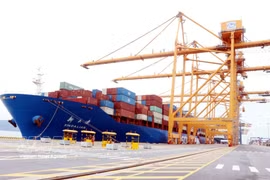
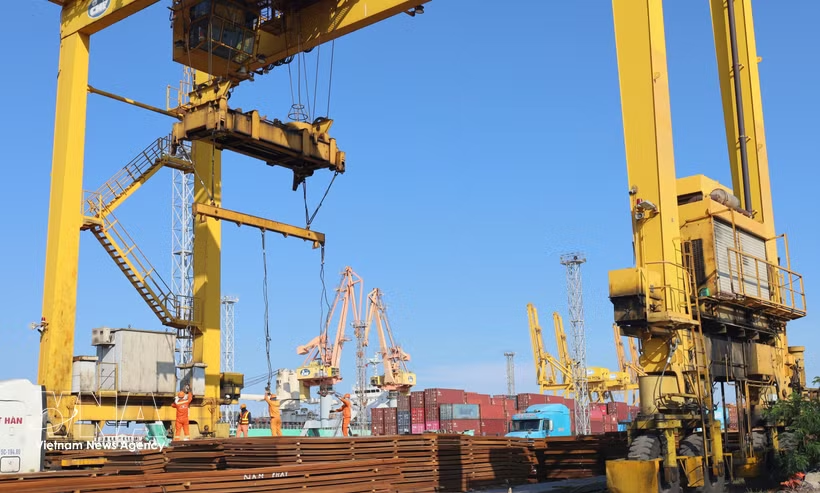
Loading and unloading steel products at Hoang Dieu–Chua Ve Port, Hai Phong city (Photo: VNA)

Hai Phong (VNA) – Hai Phong city, with its strategic position as a northern gateway for international trade, extensive seaport system and inland waterway network, is seeking to better tap its waterways to boost the marine economy and become a modern regional logistics hub.

Untapped waterway potential

According to the Hai Phong Maritime Administration, inland waterways carry coal, agricultural products, ores, stone, cement and other bulk cargoes, helping ease pressure on roads, particularly those connecting seaports and industrial parks.

However, container transport by waterway accounts for only about 5.6% of total container throughput in Hai Phong's seaport area. Most containers are still transported by road, contributing to high logistics costs and traffic congestion.

Key obstacles include limited bridge clearance, channel depth, navigation aids and transport organisation. Low bridges restrict vessel capacity, while transit times, warehouse and factory connections, and transshipment costs affect businesses' choices.

Do Van Tan, Deputy Director of Tan Cang Waterway Transport JSC under the Saigon Newport Corporation, said waterways offer advantages in cost, carrying capacity and infrastructure efficiency. A single barge can replace hundreds of container trucks with a crew of around five, reducing fuel, labour and per-container transport costs. Waterway transport also helps avoid road congestion and ease pressure on the national transport network.

However, fragmented infrastructure investment and low bridge clearance continue to hamper container barge operations, he said.

Le Manh Cuong, Vice Chairman of the Hai Phong Logistics Association, said Vietnam's import-export turnover is expected to exceed 1 trillion USD in 2026, while containerised trade continues to grow by more than 10% annually.

As deep-water ports in Ho Chi Minh City, Da Nang and Hai Phong expand, Vietnam could attract more of the world's largest container ships and become a transshipment destination for neighbouring countries, including China, Laos and Cambodia. Developing a modern container fleet with suitable designs, greater capacity and cleaner fuels is therefore increasingly important.

Cuong also highlighted the need to review regulations on pilotage and tugboat services, which can increase logistics costs and carbon emissions while constraining maritime, coastal and inland waterway container transport.

Coordinated development solutions

The Hai Phong Maritime Administration said Resolution No. 20-NQ/TW, issued by the 14th Party Central Committee on July 28, 2026, sets targets for Vietnam's fleet to handle around 20% of maritime transport by 2030 and reduce logistics costs to approximately 12% of GDP.

Fleet development should be aligned with cargo demand from industrial parks, economic zones, seaports and import-export networks. Regulations on river and sea transport vessels, pilotage and tugboat services should ensure safety while avoiding unnecessary business costs.

Tan called for coordinated infrastructure investment, policy reform and digital transformation. Priorities include maintaining and dredging key channels, raising bridge clearance along routes linking Hai Phong's ports with northern industrial parks, and developing dedicated barge berths, particularly in the Lach Huyen area.

A shared digital platform connecting transport operators, ports, customs authorities and regulators will streamline procedures, improve vessel scheduling and reduce costs.

He also proposed incentives for waterway container transport, lower handling and delivery surcharges at selected ports, and support for investment in cleaner vessels powered by electricity or biofuels.

A representative of HATECO Hai Phong International Container Terminal said expanding barge transport will help maximise the city's port capacity, ease road congestion, reduce logistics costs and cut carbon emissions.

Hai Phong and neighbouring localities aim to increase cargo and container volumes transported by barge by 8% in 2027, 10% in 2028, 15% in 2029 and 20% in 2030, helping reduce pressure on roads./.
​

VNA

See more

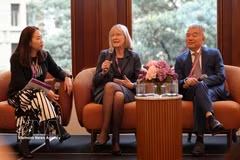
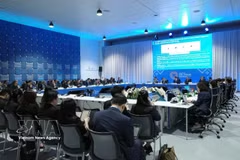
Speakers at the conference (from left): AVPI Advisory Board Chair Dr Le Thu Huong, Australian Ambassador to Vietnam Gillian Bird, and Vietnamese Consul General in Sydney Nguyen Thanh Tung. (Photo: VNA)

Vietnam, Australia turn momentum into practical cooperation

Vietnam and Australia should focus on promoting two-way investment, expanding cooperation linked to APEC 2027 and making better use of people-to-people connections. Vietnam needs capital, skills, technology, infrastructure, and energy transition expertise - areas where Australia could offer valuable support.

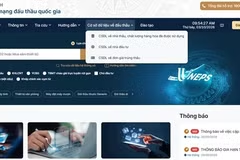
The interface of the National E-Procurement System. (Photo: muasamcong.mpi.gov.vn)

Vietnam to move PPP bidding online from 2027

From January 1, 2027, PPP project proposals must be submitted through the National E-Procurement System. From September 1, 2027, investor selection for PPP projects tendered through open bidding will move fully online.

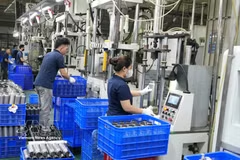
An automated robot-based production line at CAYI Technology Vietnam Co., Ltd. in Yen Phong II-C Industrial Park, Bac Ninh city (Photo: VNA)

EuroCham: Business Confidence Index in Vietnam remains high at 78.3 in Q3

The survey found that 64% of respondents described their current business conditions as good or very good, while 28% maintained a neutral or cautious outlook, reflecting a wait-and-see attitude as international demand remains flat and businesses look for policy momentum to translate into faster procedures and more predictable outcomes.

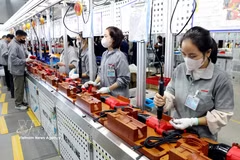
Workers manufacture handheld power tools at the Keystone Electrical Vietnam factory in Lien Ha Thai Industrial Park, Thai Thuy commune, Hung Yen province (Photo: VNA)

Vietnam seeks to turn FDI inflows into domestic value added

Vietnam is shifting its FDI attraction strategy from expanding investment volumes to prioritising capital inflows that brings technology, knowledge, modern management practices and stronger links with domestic businesses, particularly in semiconductors, artificial intelligence (AI), chips and renewable energy.

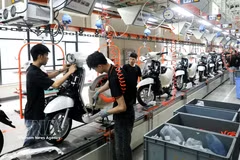
At Yadea Vietnam’s smart manufacturing plant in Tan Hung Industrial Park, Bac Ninh province (Photo: VNA)

Vietnam ties FDI incentives to local supplier commitments

Incentives will increasingly hinge on investors’ performance and commitments, not just on landing projects. Key commitments include transferring technology to Vietnamese firms, training workers, providing technical support and opening FDI supply chains to domestic companies.

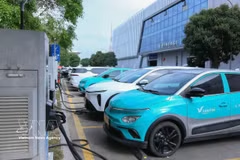
Green SM has launched all-electric taxi service in the US. (Illustrative photo: VNA)

Green SM launches all-electric taxi service in US

The move brings Green SM into one of the world’s most dynamic and demanding markets. It also marks another step in the international expansion of the Vietnamese mobility brand, following its rapid growth across markets in Asia and Europe.

An overview of the meeting between IMF Managing Director Kristalina Georgieva and ASEAN Finance Ministers and Central Bank Governors (Photo: VNA)

Vietnam strengthens financial cooperation at IMF-World Bank annual meetings

The Vietnamese Governor underscored the complementary roles of global and regional financial cooperation mechanisms, including the Chiang Mai Initiative Multilateralisation (CMIM) and the ASEAN+3 Macroeconomic Research Office (AMRO). He also highlighted the importance of technical assistance in fintech, digital transformation, cybersecurity and risk management.

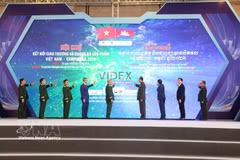
Representatives of the organising committee at the opening ceremony of the fair (Photo: VNA)

Vietnam-Cambodia trade expo promotes bilateral economic cooperation

The Vietnam-Cambodia Business Networking and Product Promotion Exposition has become a key trade promotion event, creating business and investment opportunities while strengthening mutual understanding and trust between the two countries’ armies, people and enterprises.