Vietnam attends inaugural World Atomic Week in Moscow

The first-ever World Atomic Week (WAW) provides an opportunity for Vietnam to explore cooperation prospects not only with Russia but also with other countries.

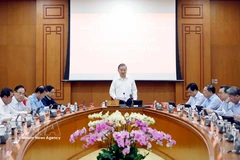
Russian President Vladimir Putin addresses the World Atomic Week. (Photo: VNA)

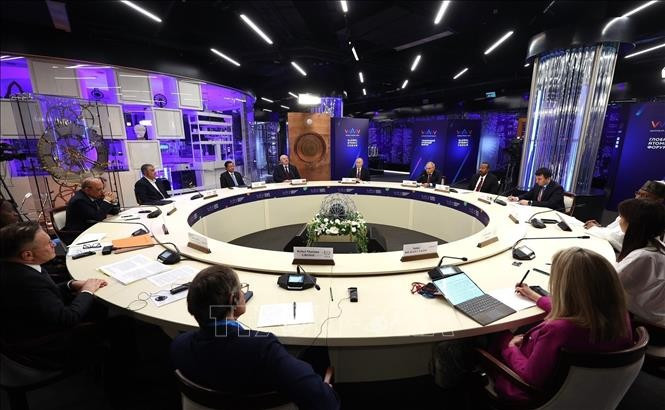
Moscow (VNA) – Vietnam is taking part in the first-ever World Atomic Week (WAW), which opened on September 25 at the VDNKh Exhibition Centre in Moscow, bringing together global leaders, experts, and youth to chart the future of nuclear energy and green technologies.

The event, one of the largest of its kind, runs until September 28 and coincides with the 80th anniversary of Russia’s nuclear industry. It has drawn more than 10,000 delegates from 118 countries, nearly 250 international speakers, and over 18,000 young participants. WAW serves not only as a showcase for the latest technological achievements but also as a forum for policymakers, scientists, enterprises, and international organisations to discuss sustainable energy strategies for decades ahead.

Vietnam is attending the event as an important partner of Russia in the nuclear sector. The Vietnamese delegation includes representatives from the Ministry of Science and Technology; the Vietnam Academy of Science and Technology; and the Vietnam Atomic Energy Institute. The delegation is scheduled to actively contribute to panel discussions during the event.

Senior Russian officials, including Deputy Prime Minister Aleksandr Novak and Presidential Administration Deputy Chief Sergey Kirienko, highlighted the role of nuclear energy as a reliable, environmentally friendly, and safe energy source. They emphasised that agreements forged at WAW could shape the planet’s energy future for the next century.
vna-potal-khai-mac-tuan-le-nguyen-tu-the-gioi-lan-thu-nhat-tai-moskva-stand-1.jpg
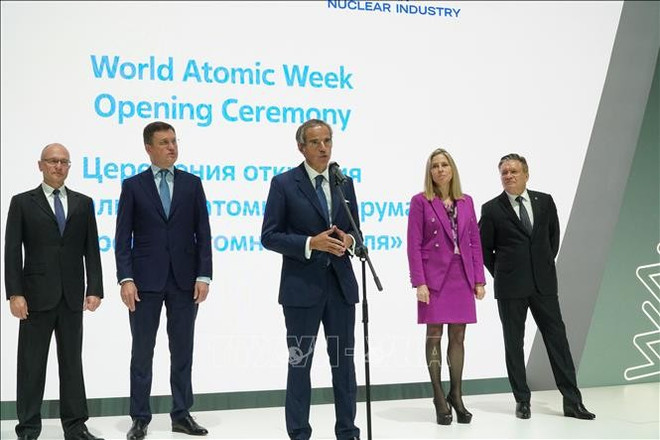
IAEA Director General Rafael Grossi speaks at the opening of the World Atomic Week. (Photo: VNA)

Leaders of the International Atomic Energy Agency (IAEA) and the World Nuclear Association (WNA) also underlined the importance of peaceful, safe, and responsible nuclear development, pointing to trends such as small modular reactors and integration with artificial intelligence.

Addressing the forum, Russian President Vladimir Putin announced that by 2030, Russia will launch the world’s first closed nuclear fuel cycle power system in Tomsk province, allowing 95% of used fuel to be reused. This innovation is expected to significantly reduce radioactive waste and ensure uranium supply security.

Speaking with the Vietnam News Agency, Dr. Tran Chi Thanh from the Vietnam Atomic Energy Institute said the forum provides an opportunity to explore cooperation prospects not only with Russia but also with other countries. He recalled that during Russian President Vladimir Putin’s 2024 visit to Vietnam, leaders of the two countries agreed to resume nuclear energy cooperation, followed by the January 2025 agreement to establish a nuclear research centre.

He stressed that Russia remains a crucial partner and expressed hope for expanded collaboration in training high-quality human resources to prepare for Vietnam’s future nuclear industry./.
VNA

See more

Experience virtual reality technology at Nha Trang Center shopping mall (Khanh Hoa). (Photo: VNA)

Experts give ideas to build AI economy from data

According to Nguyen Trung Chinh, Chairman and Executive President of CMC Technology Group, Vietnam’s economic growth over past decades has largely relied on labour expansion, capital accumulation, export promotion and deep global trade integration. However, as the country enters a higher development stage, this model is showing limitations, including declining low-cost labour advantages, slower improvements in capital efficiency, and increasing competition centred on productivity, technology and innovation.

VINASA Vice Chairwoman and Secretary General Nguyen Thi Thu Giang (right) and SEPC General Director Abhay Sinha sign the MoU on cooperation in New Delhi on March 25. (Photo: VNA)

Vietnam, India ink deal to step up IT cooperation

Under the terms of the MoU, the two sides will jointly push trade and investment in IT and services, arrange business delegations and business-to-business meetings, share market and policy information, and help companies access partnership opportunities and expand into new markets.

The Ninh Thuan 1 Nuclear Power Plant project is planned to be built in Khanh Hoa province (Photo: VNA)

Vietnam approves atomic energy development strategy, targeting civil applications

Tran Chi Thanh, Director of the Vietnam Atomic Energy Institute under the Ministry of Science and Technology, underscored that in the coming period, the institute and its affiliated units will continue promoting their strengths to promote the safe and secure application of atomic energy, contributing effectively to socio-economic development goals.

Students at FPT Ha Nam Inter-level High School practice their lessons directly by applying digital technology software (Photo: VNA)

FPT joins top 35 global AI application development service providers

The recognition reflects FPT’s end-to-end AI capabilities, spanning strategic consulting, solution design, application development, and the integration and deployment of AI systems in real-world operations. Notably, the company has developed IvyHub, an integrated agentic AI platform that enables enterprises to design, deploy and manage AI agents at scale.

The High-Frequency Systems and Microchip Laboratory at Ho Chi Minh City University of Technology, Vietnam National University, Ho Chi Minh City. (Photo: VNA)

Ho Chi Minh City sets sights on becoming semiconductor hub

A central component of the plan is expanding cooperation with global technology leaders such as AMD, NVIDIA and Qualcomm. These partnerships are expected to support technology transfer, strengthen chip design capabilities and help the city move further up global semiconductor value chains.

The modern nanotechnology research laboratory of Vietnam National University, Ho Chi Minh City. (Photo: VNA)

Resolution 57 delivers tangible outcomes from local practice

In the course of implementing this resolution, the northern province of Quang Ninh has emerged as one of the early movers in translating strategic orientations into comprehensive development models linked to innovation and digital transformation.

Delegates at the launch of the new version of Ho Chi Minh City technology exchange platform. (Photo: VNA)

Ho Chi Minh City launches upgraded technology exchange platform

The upgraded platform represents a comprehensive shift from a simple information-sharing model to a managed online technology trading system, enabling monitoring and measurement of real transaction outcomes. It is built on three pillars, namely new tradable technology products, a modern digital platform, and an improved operational model.

A Viettel 5G base station provides coverage at the April 16 Square area in Dong Hai ward, Khanh Hoa province. (Photo: VNA)

Conquering 6G networks helps Vietnamese businesses master strategic technologies

The global 6G alliance marks not only a technological milestone but also an opportunity for Vietnamese enterprises to strengthen their position on the global technology landscape. With the involvement of FPT, Viettel and VNG, Vietnam is gradually emerging as an early mover in the development and application of 6G technology.

At the Online Product Safety Summit in Hanoi on March 18. (Photo: dms.gov.vn)

Hanoi summit advances operation of ASEAN product safety portal

The Online Product Safety Summit in Hanoi on March 18 focused on practical enforcement solutions for identifying and removing non-compliant goods from online marketplaces, thereby strengthening consumer protection amid the rapid growth of e-commerce.

Illustrative image (Photo: VNA)

Resolution 57 charts directions for Vietnam’s technology ecosystem

Vietnam's sci-tech sector must evolve from a manufacturing base toward mastering technologies and ultimately developing original products independently, which requires shifting away from outsourcing and assembly models to one where domestic scientists lead in design, development and ownership of core technologies.

Party General Secretary To Lam (centre), Prime Minister Pham Minh Chinh (left), and Chairman of the Party Central Committee’s Commission for Internal Affairs Phan Dinh Trac mark the start of work on a high-tech semiconductor manufacturing plant in Hanoi on January 16, 2026. (Photo: VNA)

Resolution 57 refines technology priorities for new growth phase

The Ministry of Science and Technology is seeking feedback on a draft Prime Minister decision outlining four key categories: priority high technologies for investment, encouraged high-tech products, strategic technologies, and strategic tech products. The move is intended to capture emerging technology trends while strengthening the policy framework for high-tech development.

Professor Geert Angenon of Vrije Universiteit Brussel (Photo: VNA)

European experts highlight potential for AI cooperation with Vietnam

Experts believe that as demand for technological innovation grows and international partnerships expand, Vietnam has big opportunities to deepen cooperation with European partners in high-tech agriculture, healthcare, digital transformation and artificial intelligence.