Vietnam, China explore opportunities in Asia-Pacific community building

Discussions focused on China’s modernisation process, the interconnected development between Vietnam and China, the promotion of their Comprehensive Strategic Cooperative Partnership in the new era, and the enhancement of economic corridor connectivity and cross-border industrial chain cooperation.

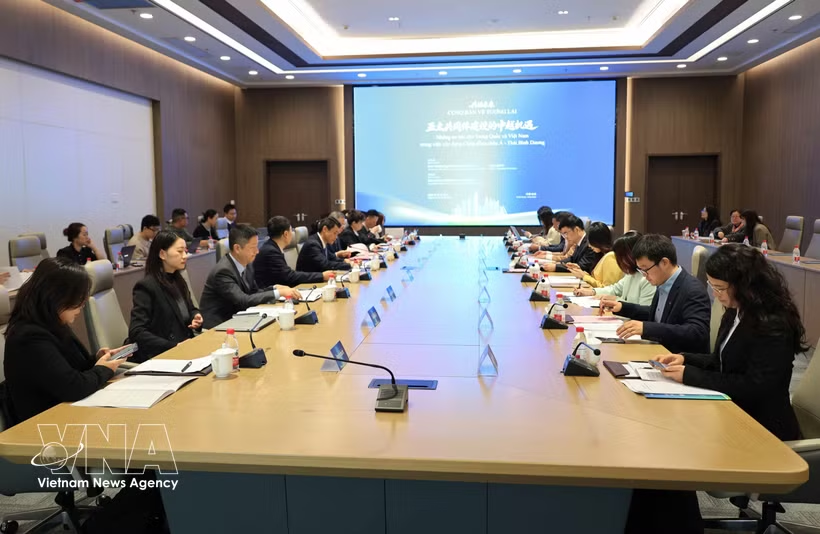
The Vietnam–China dialogue discussing opportunities for the two countries in building an Asia-Pacific community is held in Zhejiang province, China, on November 13. (Photo: VNA)

Beijing (VNA) – A Vietnam–China dialogue discussing opportunities for the two countries in building an Asia-Pacific community was held in Zhejiang province, China, on November 13, bringing together leading experts and scholars from both countries.

The event took place ahead of the 33rd APEC Economic Leaders’ Meeting, scheduled for November 18–19 in Shenzhen. It provided a platform for experts, media representatives and businesses from the two countries to exchange in-depth views on issues of shared interest, promote mutual understanding and contribute their knowledge and experience to regional community development.

Discussions focused on China’s modernisation process, the interconnected development between Vietnam and China, the promotion of their Comprehensive Strategic Cooperative Partnership in the new era, and the enhancement of economic corridor connectivity and cross-border industrial chain cooperation.

Participants also examined the changing regional and global context, the current state of bilateral trade and investment, connectivity, and prospects for cooperation between the two countries in building an Asia-Pacific community.

In his opening remarks, Vice President at Zhejiang University of Technology Chen Yao, who is also Director of its Institute for Regional and National Studies (ASEAN Research Centre), said China, as the host of APEC 2026, has chosen “Building an Asia-Pacific Community to Prosper Together” as the theme of its APEC chairmanship, with three key priorities: openness, innovation and cooperation.

Meanwhile, Vietnam will assume the APEC host role in 2027, creating a close connection between the two consecutive host economies on shared responsibilities and opportunities for advancing Asia-Pacific cooperation, he noted.

Chen stressed that Vietnam–China cooperation has a solid and practical foundation, adding China has remained Vietnam’s largest trading partner for more than two decades.

More importantly, bilateral economic ties are undergoing a structural shift. While Chinese investment in Vietnam previously focused largely on labour-intensive sectors such as textiles and garments, it has increasingly expanded into information technology, electronics, semiconductors, artificial intelligence (AI) and green energy.

Vietnam has clearly identified high technology, research and development (R&D), digital transformation and clean energy as priority areas for attracting investment. It also expects Chinese businesses to help increase local content and facilitate substantive technology transfer.

These developments reflect a shift in bilateral cooperation from simply expanding its scale towards creating synergies across industrial supply chains, which Chen described as one of the most valuable forms of cooperation for the development of the Asia-Pacific community.

From the Vietnamese side, Assoc. Prof. Dr Duong Van Huy, senior research fellow at the Institute for Asia-Pacific Studies under the Vietnam Academy of Social Sciences, said building an Asia-Pacific community is a shared goal of regional countries amid growing global uncertainty and divisions.

The idea has been promoted for many years and is now receiving renewed impetus, with the APEC forum playing an important role in advancing this vision, he said.

Addressing Vietnam–China relations and their contributions to regional community building, Huy emphasised that bilateral ties go beyond the scope of the two countries’ development.

Vietnam and China are active members of various regional multilateral cooperation mechanisms and are playing an increasingly constructive role in promoting cooperation among regional countries. Both affirmed that bilateral relations are gradually becoming a factor that may strongly influence developments across all fields in the Asia-Pacific region.

Therefore, the continued development of Vietnam–China relations is making a significant contribution to advancing the building of an Asia-Pacific community in the future, Huy added./.
VNA

See more

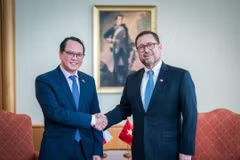
Vietnamese Ambassador to Chile Nguyen Viet Cuong and Chilean Minister of Foreign Affairs Jose Francisco Perez Mackenna (Photo published by VNA)

Chilean President’s Vietnam visit expected to deepen bilateral ties

The upcoming official visit to Vietnam by Chilean President José Antonio Kast would provide an opportunity for leaders of both countries to review 55 years of relations, set directions for the next stage of their comprehensive partnership and improve the effectiveness of existing cooperation mechanisms.

Deputy Minister of Foreign Affairs Dang Hoang Giang. Photo: VNA

Vietnam aims to promote ASEAN unity, resilience and practical cooperation: Deputy FM

Prime Minister Le Minh Hung's attendance at the 49th ASEAN Summit and related summits in Manila, the Philippines, from November 14-17 aims to concretise Vietnam's foreign policy of independence, self-reliance, resilience, multilateralisation and diversification, and reaffirm ASEAN's position as Vietnam's foremost strategic priority in its foreign policy.

Valentina Matviyenko, Chairwoman of the Federation Council of the Federal Assembly of Russia, pays tribute to President Ho Chi Minh at his Mausoleum (Photo: VNA)

Chairwoman of Russian Federation Council wraps up official visit to Vietnam

Valentina Matviyenko, Chairwoman of the Federation Council of the Federal Assembly of Russia, affirmed the Federation Council's special regard for Vietnam and support for strengthening the Comprehensive Strategic Partnership between the two countries. She also pledged to work with the Vietnamese NA to advance the implementation of high-level agreements, particularly in the fields of economy, trade, energy and oil and gas.

Minister of Science and Technology Vu Hai Quan presents the explanatory report and summary of the revision of the Metrology Law. Photo: VNA

National Assembly adopts amended Law on Metrology

The vote took place during the morning sitting of the 16th legislature’s second session under the chairmanship of National Assembly Vice President Nguyen Hong Dien. The law will take effect on March 1, 2027.

Acting Representative of the International Organisation of La Francophonie (OIF) for Asia-Pacific Rigobert Pinga-Pinga (Photo: VNA)

Vietnam’s development inspires Francophone community: OIF Representative

The IOF official recalled that the Francophonie Summit in Hanoi in 1997 marked a turning point for the organisation, with leaders establishing the position of OIF Secretary-General and placing economic cooperation at the centre of its agenda. Nearly three decades later, the Francophonie Summit is returning to Asia, with Phnom Penh hosting the summit under the theme “Reinvesting in Peace for Shared Prosperity and Lasting Stability”.

Ambassador Ton Thi Ngoc Huong, Permanent Representative of Vietnam to ASEAN (right) in an interview with Vietnam News Agency correspondent in Indonesia (Photo: VNA)

Vietnam actively contributes to ASEAN unity, resilience and connectivity: Ambassador

In an interview with the Vietnam News Agency ahead of the 49th ASEAN Summit in Manila, the Philippines, Ambassador Ton Thi Ngoc Huong, Permanent Representative of Vietnam to ASEAN, highlighted the expected key priorities of the event, Vietnam’s contributions to intra-bloc cooperation and the significance of Prime Minister Le Minh Hung’s attendance, reaffirming Vietnam’s commitment to strengthening the group’s central role amid regional and global uncertainties.

Residents wait to complete administrative procedures at the Public Administrative Service Centre in Chau Thanh commune, Tay Ninh province (Photo: VNA)

Tay Ninh province to assess performance of 111 agencies and units

The Department and Commune Competitiveness Index is designed to assess the leadership and management capacity of the provincial departments and agencies and commune-level People's Committees, while gathering feedback from people and businesses on the attitude and quality of guidance and services provided by public officials and civil servants.

Nguyen Minh Hung (left), Vice Chairman of the People's Committee of Hai Phong city, presents a gift to Lt. Col. Jean-Christophe Dherbécourt, captain of the ship (Photo: VNA)

Vietnam–France friendship strengthened through naval visit

The visit by the French Navy’s frigate Vendémiaire will make a practical contribution to building trust and consolidating friendship between the people of Vietnam and France, thereby contributing to the Vietnam–France Comprehensive Strategic Partnership.