Vietnam pledges active role in global efforts for children

Congratulating Regional Director of UNICEF's Asia-Pacific Regional Office (APRO) Sanjay Wijesekera on his new appointment, Deputy Prime Minister Pham Thanh Tra highlighted the historic achievements of five decades of cooperation between Vietnam and UNICEF, describing the partnership as one built on close coordination, mutual trust and effective collaboration in protecting, caring for, educating and promoting the development of children.

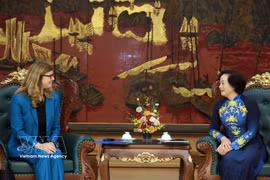
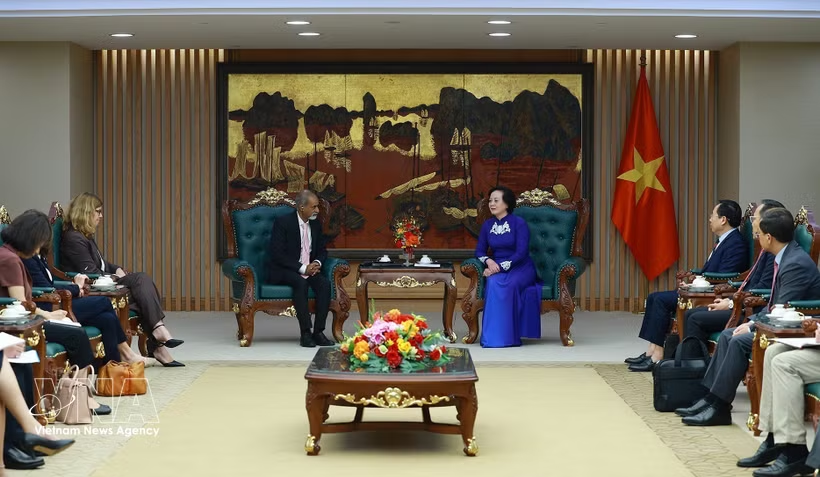
Deputy Prime Minister Pham Thi Thanh Tra (right) receives Regional Director of UNICEF's Asia-Pacific Regional Office (APRO) Sanjay Wijesekera in Hanoi on August 24. (Photo: VNA)

Hanoi (VNA) – Deputy Prime Minister Pham Thi Thanh Tra received Regional Director of UNICEF's Asia-Pacific Regional Office (APRO) Sanjay Wijesekera in Hanoi on August 24, affirming that Vietnam is committed to being an active member of global efforts for children, and expressing her confidence that the trusted and effective partnership between Vietnam and UNICEF will continue to flourish.

Congratulating Wijesekera on his new appointment, Tra highlighted the historic achievements of five decades of cooperation between Vietnam and UNICEF, describing the partnership as one built on close coordination, mutual trust and effective collaboration in protecting, caring for, educating and promoting the development of children.

She stressed that child protection, care and education have always been identified by the Party and State as an especially important strategic priority, as children represent the future of the nation. Investment in children is investment in the future and a cornerstone for achieving the Sustainable Development Goals.

The Deputy PM highlighted Vietnam’s recent achievements, including completing universal lower-secondary education and working towards universal upper-secondary education; reducing child malnutrition to its lowest level; continuously improving policies and institutions; and substantially narrowing development gaps among regions and disparities affecting vulnerable children, particularly those in ethnic minority and mountainous areas.

For his part, Wijesekera said Vietnam is the first country he has chosen to visit after taking up his new post. He praised Vietnam for being the first Asian country to sign the UN Convention on the Rights of the Child (CRC) in 1990, as well as for its strong political commitment and sustained, prudent investment in children over the past decades.

These long-term efforts have delivered remarkable progress in reducing child mortality and improving nutrition, healthcare, education and child protection, he said, adding that Vietnam’s experience offered valuable lessons for other countries in the region.

Wijesekera said UNICEF and its Vietnamese partners have been working to develop a new Country Programme, affirming UNICEF’s strong commitment to supporting the programme and Vietnam’s development vision on the basis of the solid foundation established through their longstanding partnership.

He outlined several priority areas for future cooperation, including expanding livelihood, employment and skills-development opportunities for young people after leaving the education system; jointly addressing climate change; improving the effectiveness of public financial management for investment in children while ensuring such investment does not create a public debt burden; and, particularly, strengthening cooperation in digital technology and artificial intelligence (AI) to improve development outcomes and protect children online from cyber threats.

Acknowledging UNICEF’s strategic recommendations, Tra noted that despite its major achievements, Vietnam still faces a number of challenges. The country has nearly 25 million children, with ethnic minority children accounting for 18.3%, while 8.4% of children live in multidimensional poverty and about 2.3% are in special circumstances.

To ensure fair, balanced and inclusive development opportunities for all children, Vietnam will review and assess the implementation of Party resolutions on social policies closely related to children, she said.

As Vietnam and UNICEF work towards adopting their 2027-2031 Country Programme, the Deputy PM proposed that the two sides focus on three strategic priorities.

First, on sharing experience and improving institutions and policies, she called on UNICEF to continue drawing on its global expertise to support Vietnam in strengthening its legal and institutional framework for children. New policies should provide multi-layered, flexible, comprehensive and inclusive support, shifting from a primarily assistance-based approach towards proactive investment in the younger generation to develop high-quality human resources and a sustainable society.

Second, on addressing technological challenges and protecting children online, she urged both sides to proactively harness opportunities offered by the digital era and AI to support children’s education and health, while preventing risks and minimising negative impacts on their mental health, nutrition and cognitive development arising from harmful online content and activities.

Third, on strengthening development and child governance capacity, Tra stressed the need to consolidate, strengthen and improve the skills of officials working on child-related issues from the central to provincial and commune levels following the restructuring of the administrative apparatus. She also called for a comprehensive and integrated child data system to support more effective management./.

VNA
See more

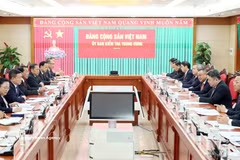
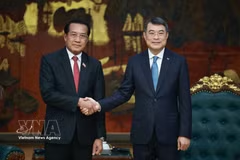
At the talks between Politburo Member and Chairman of the Communist Party of Vietnam (CPV) Central Committee’s Commission for Inspection Tran Sy Thanh and a visiting delegation of the Lao People’s Revolutionary Party (LPRP)'s Inspection Commission led by its Chairman Vanhxay Phongsavanh in Hanoi on August 25, 2026. (Photo: VNA)

Inspection-supervision cooperation helps nurture Vietnam-Laos ties

The Communist Party of Vietnam (CPV) Central Committee’s Commission for Inspection and its Lao counterpart will continue to effectively implement their 2022-2026 cooperation agreement, maintain high-level and professional delegation exchanges, and focus on sharing professional experience in inspection and supervision.

Singaporean Senior Minister of State for Defence Desmond Choo sees Standing Member of the CPV Central Committee’s Secretariat Tran Cam Tu off at Changi International Airport. (Photo: VNA)

Key Vietnamese leader concludes successful official visit to Singapore

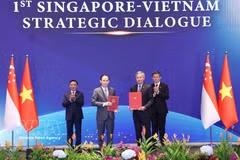
Politburo Member and Standing Member of the Communist Party of Vietnam (CPV) Central Committee’s Secretariat Tran Cam Tu and a high-ranking CPV delegation left Singapore on August 25 afternoon, concluding their successful official visit to Singapore and co-chairing of the first Vietnam-Singapore Strategic Dialogue on August 24–25.

Politburo Member, Deputy Secretary of the Central Military Commission, Deputy Prime Minister, and Minister of National Defence General Phan Van Giang (R) and outgoing French Ambassador to Vietnam Olivier Brochet in Hanoi on August 25, 2026. (Photo: chinhphu.vn)

Vietnam, France boost defence cooperation across multiple areas

Vietnam attaches importance to cooperation with France, an important member of the European Union (EU) and Vietnam’s first comprehensive strategic partner within the EU. Bilateral relations have made effective progress in a wide range of areas, including economy and trade, science and technology, education and training, culture and tourism, as well as defence and security.

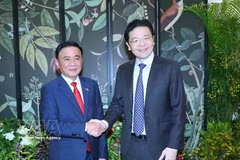
Politburo member and Standing member of the Communist Party of Vietnam Central Committee’s Secretariat Tran Cam Tu (L) meets with Secretary-General of the People’s Action Party and Prime Minister of Singapore Lawrence Wong on August 25. (Photo: VNA)

Vietnamese, Singaporean leaders agree to deepen bilateral ties

The two sides agreed that the dialogue will help establish a direct, regular and strategic channel for exchanges between the two Parties, through which they can conduct in-depth discussions on Party building, policy making, governance and national development, while sharing views on strategic issues of mutual concern, thereby strengthening the Party-to-Party channel’s role in providing strategic orientations for the bilateral ties.

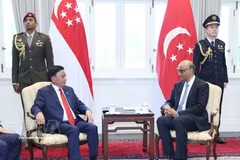
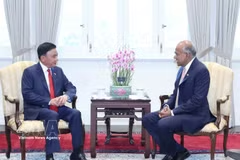
Politburo Member and Standing Member of the Communist Party of Vietnam (CPV) Central Committee’s Secretariat Tran Cam Tu (L) and Singaporean President Tharman Shanmugaratnam in Singapore on August 25, 2026. (Photo: VNA)

Key Vietnamese leader meets Singaporean President

Vietnam consistently attaches importance to its relations with Singapore, one of its top partners in the region. The establishment of the Strategic Partnership in 2013 and its upgrade to a Comprehensive Strategic Partnership in 2025 were important milestones, reflecting the maturity of bilateral ties and the shared vision of the two countries’ leaders for long-term cooperation.

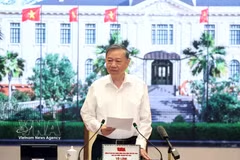
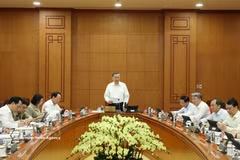
General Secretary of the Communist Party of Vietnam Central Committee and President To Lam speaks at the working session in Hanoi with the Government’s Party Committee and relevant agencies on the implementation of social welfare policies. (Photo: VNA)

Top leader calls for ensuring every citizen access to essential services, development opportunities

According to the top leader, by 2030, Vietnam should basically establish a multi-layer, inclusive and digitalised social welfare system that guarantees minimum social protection for all citizens. By 2045, the system should approach the standards of developed, high-income countries, featuring quality services, sustainable financing, transparent governance and the capacity to respond rapidly to emerging risks.

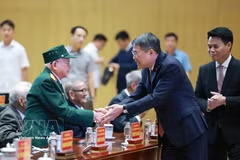
Prime Minister Le Minh Hung (R) with a veteran Party member of the Hai Phong Party Organisation at the event. (Photo: VNA)

Prime Minister calls for better care for veteran Party members

Prime Minister Le Minh Hung affirmed that every badge presented to Party members in Hai Phong on the occasion served as a reminder that the Party has grown from the people, fought for the people, sacrificed for the people, and pursued reform and development for the people.

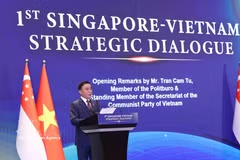
Politburo Member and Standing Member of the Communist Party of Vietnam (CPV) Central Committee’s Secretariat Tran Cam Tu speaks at the first Vietnam-Singapore Strategic Dialogue in Singapore on August 25, 2026. (Photo: VNA)

Vietnam, Singapore pursue resilient shared future

The first Vietnam-Singapore Strategic Dialogue helped translate political trust between the two Parties into practical cooperation orientations and programmes, contributing to substantive and sustainable development of the Vietnam-Singapore Comprehensive Strategic Partnership and meeting the development needs of both countries in the new era.

Vietnam's Politburo member and Minister of Foreign Affairs Le Hoai Trung (first row, left) and Singaporean Minister for Foreign Affairs Vivian Balakrishnan exchange the Vietnam-Singapore Joint Statement on Technology Connectivity Strategy. (Photo: VNA)

Vietnam, Singapore issue Joint Statement on Technology Connectivity Strategy

Building on the Plan of Action to Implement the Comprehensive Strategic Partnership between Singapore and Vietnam, signed on October 28, 2025, both countries reaffirm their mutual interest and commitment to deepen cooperation in the areas of science and technology, innovation, connectivity, and the digital economy.

General Secretary of the Communist Party of Vietnam Central Committee and President To Lam speaks at the August 25 meeting that reviews the first year of implementing Resolution No. 71-NQ/TW. (Photo: VNA)

Top leader orders substantive education reform

The sector should reduce rote and exam-oriented learning and promote self-study, practical experience, independent thinking, creativity and problem-solving, while cutting administrative and formalistic burdens on teachers.