Vietnam, RoK shift towards strategic high-tech, innovation partnerships

Stronger SME ties could become the main pillar in shifting Vietnam–RoK relations from quantitative growth towards qualitative development, according to KOVECA Vice Chairman Kwon Sung Taek.

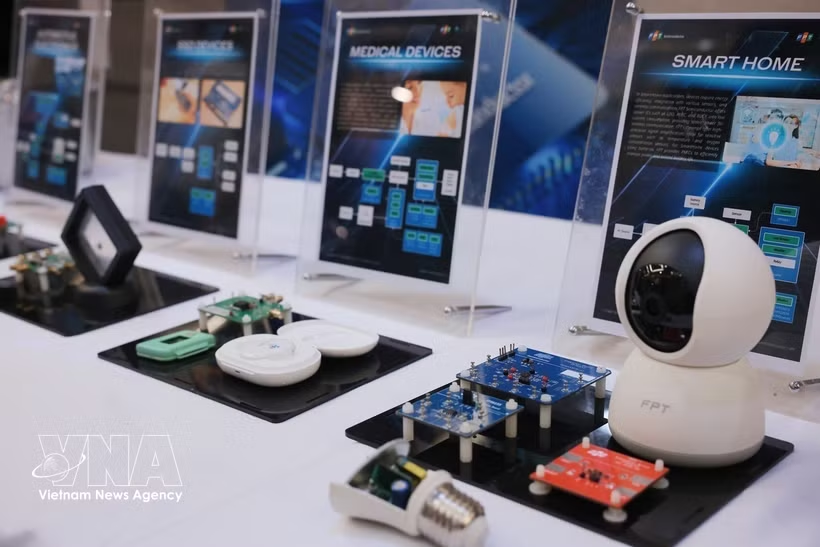
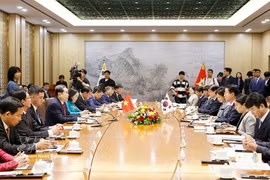
Vietnam is prioritising emerging sectors such as semiconductors, AI, clean energy and green transition. (Illustrative photo: VNA)

Hanoi (VNA) – Vietnam and the Republic of Korea (RoK) are poised to enter a breakthrough phase in economic cooperation, with the two sides aligning development strategies and shifting from traditional production-based ties towards strategic partnerships in high technology, innovation and joint value creation.

With the RoK’s accumulated investment in Vietnam nearing 100 billion USD and bilateral trade reaching around 90 billion USD, economic relations between the two countries are entering a deeper and more substantive stage.

Vietnam is prioritising emerging sectors such as semiconductors, artificial intelligence (AI), clean energy and green transition, which offer significant potential for expanding cooperation with Korean partners.

Beyond attracting investment, it is seeking to transform itself from a manufacturing destination into a regional hub for innovation and technology development by promoting institutional reforms, improving the investment and business environment, developing digital infrastructure and high-quality human resources, and advancing strategic technology sectors.

With globally recognised strengths in technology, research and development (R&D) and innovation ecosystem, the RoK is viewed as an important partner for Vietnam in capitalising on these opportunities.

As Korean technology firms step up investment in Southeast Asia to diversify supply chains and leverage cost advantages, Vietnam, with its strategic location and abundant workforce, remains a key destination. Major groups of the RoK such as Samsung Electronics, SK Group, POSCO and Hanwha Group are expanding their presence in Vietnam beyond manufacturing into high technology, energy and strategic infrastructure.

Businesses under the LG Group are also accelerating production expansion in Vietnam, accompanied by large-scale recruitment plans to meet rising global orders, particularly in high-tech sectors.

Kwon Sung Taek, Vice Chairman of the Korea–Vietnam Economic and Cultural Association (KOVECA), said the two countries’ economic ties could see a shift in the next 30 years.

He noted that while economic relations over the past three decades had developed “vertically”, led by major corporations such as Samsung, LG, Hyosung and Hyundai Motor, the next three decades could see stronger “horizontal” cooperation, with greater participation by small- and medium-sized enterprises (SMEs) from both countries, thus laying the foundation for healthier and higher-quality growth in economic relations.

Such cooperation could go beyond component supply chains to encompass technology transfer, joint ventures and digital transformation, he said, noting that Korean SMEs with skilled capabilities could help localise and upgrade supply chains through partnerships with Vietnamese companies, strengthening the latter’s autonomy while enabling Korean firms to stabilise their global production bases.

Kwon said closer cooperation could also help promising businesses develop into “global unicorns” through joint R&D, combining the RoK’s planning capabilities with Vietnam’s infrastructure and human resources to facilitate technology transfer.

Korean SME brands, particularly in cosmetics and food, could also gain greater direct access to Vietnamese consumers through the Southeast Asian country’s rapidly growing e-commerce market, he added.

He likened major corporations that have paved the way to “main arteries”, while SMEs serve as “capillaries” that connect and spread value throughout the economy. In particular, the participation of Korean information technology companies in the digital transformation of Vietnamese SMEs is considered an effective cooperation model.

According to Kwon, stronger SME ties could become the main pillar in shifting Vietnam–RoK relations from quantitative growth towards qualitative development.

The two countries thus have substantial opportunities to move from production-based cooperation towards technology and innovation partnerships, with technology, innovation and strategic trust emerging as new drivers of substantive and effective development of their Comprehensive Strategic Partnership./.
VNA

See more

Workers produce leather shoes for export at Lefaso Tra Vinh Investment and Production Joint Stock Company in Tra Cu commune, Vinh Long province. (Photo: VNA)

Vietnamese exporters pivot to ease pressure from US tariffs

Pressure from the new US tariff policy is prompting Vietnamese exporters to reassess their strategies. Rather than pursuing volume-driven growth, many are shifting towards higher-value orders, tighter cost control, greater productivity and a more balanced allocation of markets to reduce reliance on a single destination.

A worker handles and stacks goods. Nearly 138,100 businesses were newly founded from January to August, up 7.7% over the same period last year, while more than 40,800 businesses completed dissolution procedures, a jump of 125.5%. (Photo: VNA)

Firm entry and exits point to continued restructuring pressure

Updates from the National Statistics Office last week showed that nearly 138,100 businesses were newly founded from January to August, up 7.7% over the same period last year, while more than 40,800 businesses completed dissolution procedures, a jump of 125.5%.

A Vietnamese business introduces durian cakes to Chinese visitors at the 22nd China-ASEAN Expo (CAEXPO) in 2025. (Photo: VNA)

Vietnam steps up trade, investment promotion at China-ASEAN Expo

According to the CAEXPO Secretariat, Vietnam will once again lease an entire exhibition area of about 3,000sq.m, featuring 170 booths, making it one of the ASEAN countries with the largest exhibition spaces at this year’s event. Nearly 100 Vietnamese businesses have confirmed their participation, including major brands such as Trung Nguyen Group, TH Group, Saigon Coffee and Biti’s.

An overview of the VIFC's Executive Council meeting on September 7 (Photo: VNA)

Six groups of products, services proposed at Vietnam International Financial Centre

Deputy Minister of Finance Nguyen Thi Bich Ngoc said the products and services include investment funds and asset management, asset-backed digital assets, international carbon credits, commodity trading and derivatives infrastructure linked to trade and supply-chain financing, financial technology, and bonds issued at the centre. As these groups are at different stages of readiness, they will be rolled out in phases rather than simultaneously.

The meeting between the Quang Ninh delegation and Siemens Mobility (Photo published by VNA)

Quang Ninh seeks cooperation, investment opportunities in Germany

A Quang Ninh official praised the collaboration between Siemens Mobility and VinSpeed in developing the Hanoi–Quang Ninh high-speed railway and expressed his hope that the project will pave the way for future cooperation between Siemens Mobility and Quang Ninh in modern railway development and workforce training.

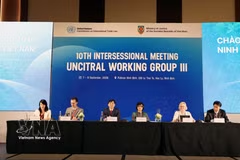
At the 10th intersessional meeting of UNCITRAL Working Group III in Ninh Binh province on September 7, 2026. (Photo: VNA)

Vietnam hosts UNCITRAL Working Group III intersessional meeting for first time

By hosting the 10th UNCITRAL Working Group III intersessional meeting, Vietnam wishes to continue playing an active and proactive role in UNCITRAL in general and Working Group III in particular, working alongside the international community to strengthen cooperation, share experience and contribute to the development of the international legal framework.

An Asian customer with a Vietnamese coconut product served with straws (Photo: VNA)

Vietnam’s agricultural exports: Shifting from volume to value

Vietnam has about 1.2 million hectares of fruit-growing areas, producing around 13 million tonnes a year. Its fruits are exported to more than 60 countries, including major markets such as the US, the EU, Japan, the Republic of Korea and China. The country is also among the world’s leading exporters of rice, cashew nuts, pepper and coffee, with its products reaching more than 150 countries, including markets with stringent standards.

A modern production line at Hana Micron Vina Co. Ltd., a wholly invested by the Republic of Korea, in Van Trung Industrial Park in Bac Ninh province (Photo: VNA)

Northern Vietnam attracts 80.5% of new manufacturing FDI in first half

John Campbell, Director and Head of Industrial Services at Savills Vietnam, said investment in electronics and semiconductors continued to concentrate in northern localities, which have developed relatively complete manufacturing ecosystems encompassing industrial infrastructure, technical labour and supplier networks.

At the 2025 K–Vietnam Pop-up Festa in Dalat (K-Market Vietnam 2025) held in the central province of Lam Dong on November 8, 2025. The event features a series of cultural and trade exchange activities between Vietnam and the RoK, with more than 100 Lam Dong and Korean enterprises showcasing typical products from both sides. (Photo: VNA)

Vietnam, RoK seek to expand trade cooperation

The Ministry of Industry and Trade’s Department of Foreign Markets said Korean companies showed strong interest in Vietnam International Sourcing (VIS 2026), covering food, logistics, digital technology, mechanics, shipbuilding, seafood and distribution.

According to the Vietnam Coffee Cocoa Association (Vicofa), Vietnam exported nearly 1.7 million tonnes of coffee in the first eight months of 2026, earning more than 6 billion USD. (Photo: VNA)

Vietnamese coffee exports poised for strong finish toward year-end

According to the Vietnam Coffee Cocoa Association (Vicofa), Vietnam exported nearly 1.7 million tonnes of coffee in the first eight months, earning more than 6 billion USD. Export volume rose by over 10% year on year, while export value fell by 11.2% due to lower export prices.

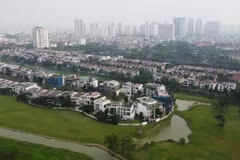
Ciputra is one of the landmark projects representing the presence of Indonesian investment in Vietnam since the first wave of FDI. (Photo: bietthu-ciputra.vn)

Foreign capital seeks stronger foothold in Vietnam through M&A

Foreign investors carried out 1,815 capital contribution and share purchase transactions in Vietnam in the first seven months of 2026, with total capital exceeding 6.5 billion USD. While the number of transactions fell 8.4% year-on-year, their value rose 61.6%.

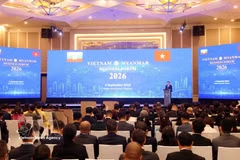
At the Vietnam- Myanmar Business Forum in Hanoi on September 6 (Photo: VNA)

Myanmar President pledges to facilitate Vietnamese investment

Myanmar calls for Vietnam's cooperation in digital infrastructure development, cybersecurity, digital transformation, public services, information technology, and digital payment systems, as well as in fostering an innovation-driven business environment.