Vietnam seeks to strengthen digital economy through hi-tech ties with India

Vietnamese businesses are eager to learn from India’s technological solutions, experience, and modern governance practices to pursue green development and digitalisation, said a Vietnamese official.

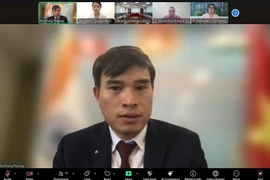
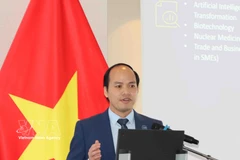
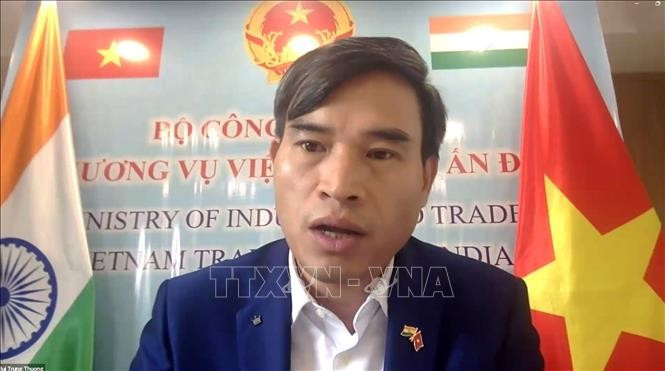
Trade Counsellor Bui Trung Thuong speaks at the forum. (Photoo: VNA)

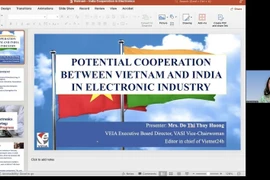
New Delhi (VNA) – A Vietnam – India innovation and digital transformation forum was held online by the Trade Office of the Vietnamese Embassy in India on August 20, demonstrating a strong commitment to promoting innovation cooperation between the two countries amid global digital transformation.

The event drew representatives from associations and around 80 businesses and startups from both countries operating in various technological sectors.

In his opening remarks, Trade Counsellor Bui Trung Thuong said the forum aimed to strengthen bilateral ties in innovation, startups, digital transformation, and business process restructuring. Vietnam and India are strategic partners in the digital economy, working closely in sectors such as AI, the Internet of Things, smart city building, hi-tech agriculture, health care, renewable energy, and education.

Thuong emphasised that the forum offered a valuable opportunity for the two countries to share visions, foster synergy, and explore new directions for bilateral cooperation.

Dao Duy Anh, Deputy Director of the Department of Innovation, Green Transformation, and Industrial Promotion under the Ministry of Industry and Trade (MoIT), emphasised that Vietnam sees science, technology, and innovation as a key driver for economic restructuring and enhancing national competitiveness. Vietnamese businesses are eager to learn from India’s technological solutions, experience, and modern governance practices to pursue green development and digitalisation.

He added Vietnam also encourages businesses from both countries to engage in major events, including the Bangalore Tech Summit 2025 in India’s “Silicon Valley”, one of the most prestigious technology and innovation forums in Asia.

Le Toan Thang from the National Startup Support Centre (NSSC) stated that Vietnam has enhanced its collaboration with prominent technology institutes in India, shaping a prerequisite for a shared startup ecosystem. The NSSC aims to develop an innovation ecosystem by 2028 which will focus on digital transformation, green transactions, and open innovation to promote sustainable cooperation.

Do Thanh Binh, Director of the international cooperation division at the Vietnam Software and IT Services Association (VINASA), affirmed that the Vietnamese Government regards information technology as a pillar, as reflected in Resolutions 57-NQ/TW and 68-NQ/TW, and the National Digital Transformation Programme through 2025 with a 2030 vision that focuses on digital government, digital economy, and digital society.

He emphasised that Vietnam’s technology investment environment is increasingly open, calling on Indian businesses to strengthen partnership. He also underlined VINASA’s commitment to supporting global technology enterprises.

Sudhanshu Mittal, head director for technical solutions at the National Association of Software and Service Companies (Nasscom) of India, emphasised the country’s successes in utilising AI in health care to enhance diagnostic accuracy and support treatment. He pointed out that these accomplishments present opportunities for collaboration with Vietnam, particularly in hi-tech health care and AI application for cancer treatment. He expressed the wish for broader cooperation in the production and healthcare sectors.

Anjali Gupta Nair, head of international relations for the Bangalore Tech Summit’s organisation board, introduced the 2025 tech conference as a way to connect and expand cooperation opportunities. She emphasised that Vietnam, with its strong digital technology policies, will have ample opportunities to engage with international partners, expand cooperation, and access technology transfer.

The organisers of the Bangalore Tech Summit 2025 have invited Vietnam to participate as the “Focus Country” at the event./.

VNA
See more

(Photo: Organising board)

AI contest to be organised in Vietnam

Jointly organised by Sea Limited and OpenAI, the contest is expected to provide participants with hands-on experience in artificial intelligence, while also offering a platform to exchange ideas and connect with members of the country’s fast-growing AI and developer community.

The meeting between the delegation from the CPV Central Committee’s Commission for Policy and Strategy and Station F (Photo: VNA)

Vietnam, France step up cooperation in science, innovation

A delegation from the Communist Party of Vietnam (CPV) Central Committee’s Commission for Policy and Strategy paid a working visit to France from September 13-16, focusing on exchanging experience in science and technology, innovation, startup ecosystems and human resources development.

Delegates at the workshop pose for a group photo (Photo: VNA)

Digital transformation promotes sustainable development in Mekong Delta

Experts said the Mekong Delta region does not lack data, but valuable information collected by government agencies, universities, businesses, projects and communities is scattered across different locations and formats, making it difficult to access, compare and use effectively.

Soldiers from the Dien Bien provincial Military Command offer incense at the graves of fallen soldiers at A1 Martyrs’ Cemetery before exhuming remains to collect samples (Photo: VNA)

Population data, DNA technology aid efforts to identify fallen soldiers

Under the direction of the Government and the Ministry of Public Security, the ministry’s Police Department for Administrative Management of Social Order (C06) has led efforts to review and standardise information on martyrs and their relatives, collect DNA samples from relatives, and build and manage a DNA database. It also coordinates with forensic agencies to compare DNA data and identify the remains of fallen soldiers.

Students practice microcontroller programming at the Viet - Han College of Technology in Bac Ninh province (Photo: VNA)

Vietnam steps up semiconductor talent training to meet market demand

Vietnam needs to step up semiconductor workforce training to meet growing market demand and enhance its capacity to participate in the global technology value chain, experts said, highlighting the importance of closely linking training with businesses, production and technological research.

Vietnam seeks to boost education and technology cooperation with France

Vietnam seeks to boost education and technology cooperation with France

Education and training, science and technology, and high-quality human resources are key areas of cooperation in Vietnam-France relations, said Politburo Member, Secretary of the Communist Party of Vietnam Central Committee, and Chairman of its Commission for Organisation Nguyen Duy Ngoc while visiting the Institut Polytechnique de Paris on September 11.

General Secretary of the Communist Party of Vietnam Central Committee and President To Lam witnesses the exchange of cooperation agreements between the two countries. (Photo: VNA)

Vietnam, France deepen cooperation in science, technology, workforce training

The University of Science and Technology of Hanoi (USTH), under the Vietnam Academy of Science and Technology (VAST), and the French Alternative Energies and Atomic Energy Commission (CEA) exchanged two cooperation agreements in Paris on September 11, in the presence of General Secretary of the Communist Party of Vietnam Central Committee and President To Lam.

A display area for unmanned aerial vehicles (UAVs) at a workshop in Da Nang city on June 12, 2026. (Photo: VNA)

Vietnam eyes UAV industry as key driver of low-altitude economy

For Vietnam, the opportunity presented by unmanned aerial vehicles (UAVs) lies not only in expanding their applications but, more importantly, in gradually building industrial capacity, mastering technologies and engaging more deeply in global value chains.

A semiconductor chip by TSMC (Photo: VCG)

Vietnam seeks deeper integration into global semiconductor value chains

Nguyen Anh Tuan, Director of the National Centre for Pilot Semiconductor Chip Manufacturing Support under the Ministry of Science and Technology, said that amid increasingly intense global technological competition, the semiconductor industry is not only a high-value-added economic sector but also a foundation for technological self-reliance, national security and economic competitiveness.

Demonstration of an autonomous electric street sweeper. (Photo: VNA)

Hanoi approves controlled pilot of two technology projects

The two projects involve an intelligent autonomous transportation system developed by Phenikaa-X JSC and a technology for producing mixed rare-earth oxides with a purity of over 95% on a semi-industrial scale developed by the Mining Technology and Construction Consultancy JSC.

Prof. Dr. Tran Hong Thai, President of the Vietnam Academy of Science and Technology (VAST), has a working session with leaders of Russia’s State Atomic Energy Corporation Rosatom. (Photo: VNA)

Vietnam, Russia develop quantum technology cooperation roadmap

Quantum technology is an emerging field undergoing rapid breakthroughs and requiring enormous investment resources. Learning from the experience of pioneering countries such as Russia will enable Vietnam to significantly shorten the time needed to build its workforce and develop endogenous capabilities.

Senior Vice-President of Latin America and Asia at Thales Group Guy Bonassi (L) at a meeting with Vietnamese Ambassador to France Trinh Duc Hai (Photo published by VNA)

Vietnam, France should expand cooperation in strategic fields: business leader

General Secretary of the Communist Party of Vietnam Central Committee and President To Lam’s visit to France, Guy Bonassi, Senior Vice-President of Latin America and Asia at Thales Group, said the upgrade of bilateral ties to a Comprehensive Strategic Partnership reflects their shared desire to deepen and broaden cooperation, with technological autonomy, resilience and human resources development assuming increasingly important roles.