Vietnam to have 16 more railway lines by 2030

Vietnam’s railway network planning expects to have 16 new national lines with a total length of about 4,802km by 2030.
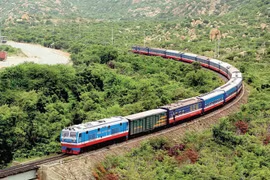
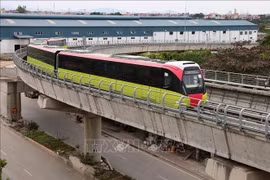
Vietnam to have 16 more railway lines by 2030 ảnh 1Illustrative photo (Source: VNA)
Hanoi (VNA) – Vietnam’s railway network planningexpects to have 16 new national lines with a total length of about4,802km by 2030.

According to the Ministry of Transport, the planning for2021-2030 will also upgrade seven existing lines, whose total lengthamounts to 2,440km.

By 2050, the number of new rail lines will be 25, which togetherare 6,354km long.

The completely upgraded and expanded network following theplanning will connect strategic economic areas and corridors, urban centres,international sea ports, border gates, and airports nationwide, said a leader ofthe ministry.

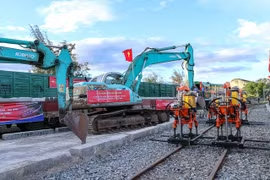
Vietnam to have 16 more railway lines by 2030 ảnh 2Illustrative photo (Source: baogiaothong.vn)
Rail transport boasts several advantages.It requires less land areas, leaves little impact on the environment, andcarries a large amount of goods and passengers. It is also fast, safe, and lowcost.

However, the railway investment budget is enormous, whilethe State budget resources are limited. Due to the low financial efficiency ofrailway investment, it is difficult for the sector to attract capital from society./.
VNA

See more

A key traffic route connecting Da Nang city's downtown zone with new designed Free Trade Zone (Photo courtesy of Quoc Vuong)

Da Nang approves Free Trade Zone 7 investment plan

The Da Nang Special Economic Zone Authority (DSEZA) said the project, the last location of the 1,881ha Da Nang FTZ, would start construction from the fourth quarter of 2027 and begin full operation in 2032.

The 2026 Vietnam–China international trade fair opens in Vietnam’s Tuyen Quang province on October 24. (Photo: VNA)

Vietnam–China international trade fair opens in Tuyen Quang

This year’s fair features 300 booths across 10,000 square metres, including 250 Vietnamese booths and 50 run by Chinese partners. They showcase a wide range of products, including agricultural produce, food, medicinal herbs, consumer goods, machinery, equipment, and handicrafts.

Germany’s Karcher Group puts its cleaning equipment manufacturing plant into operation at the the Tam Hiep Port and Logistics Industrial Park in Nui Thanh commune, Da Nang city (Photo: VNA)

Da Nang boosts FDI attraction to drive industrial growth

The central city of Da Nang is ramping up efforts to attract foreign direct investment, leveraging its upgraded infrastructure and welcoming business environment to boost industrial growth and establish a new economic driver.

Vietnamese Ambassador to Mozambique Tran Thi Thu Thin (third from right) poses with IAM Director and staff (Photo published by VNA)

Vietnam, Mozambique seek stronger agricultural ties

Vietnamese Ambassador to Mozambique Tran Thi Thu Thin praised the industry’s potential and its contribution to the economy, livelihoods and exports in the southeastern African nation. She also shared Vietnam’s experience in developing the industry, particularly in boosting processing capacity and adding value to products.

A solar power system installed on the roof of a factory operating in the rice sector in Truong Xuan commune, Dong Thap province. (Photo: VNA)

Rooftop solar power helps businesses go green

Dong Thap Power Company reported that as of September 2026, the province had 6,150 rooftop solar customers, with total installed capacity of 287.09 MWp. Of these, 751 customers operated self-produced and self-consumed systems with a combined capacity of 42.76 MWp.

Tourists shop at Ngoc Hien Pearl Farm in Phu Quoc city, An Giang province. (Photo: VNA)

Vietnam seeks to boost shopping tourism

Shopping tourism remains underdeveloped in Vietnam despite its potential to attract visitors and boost revenue. Diversifying dining, shopping and entertainment services while extending stays would help increase tourist spending.