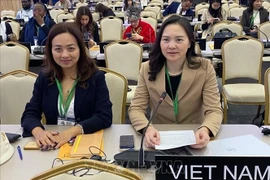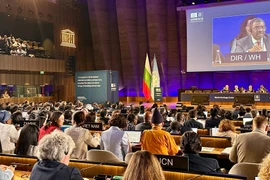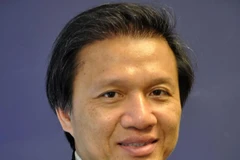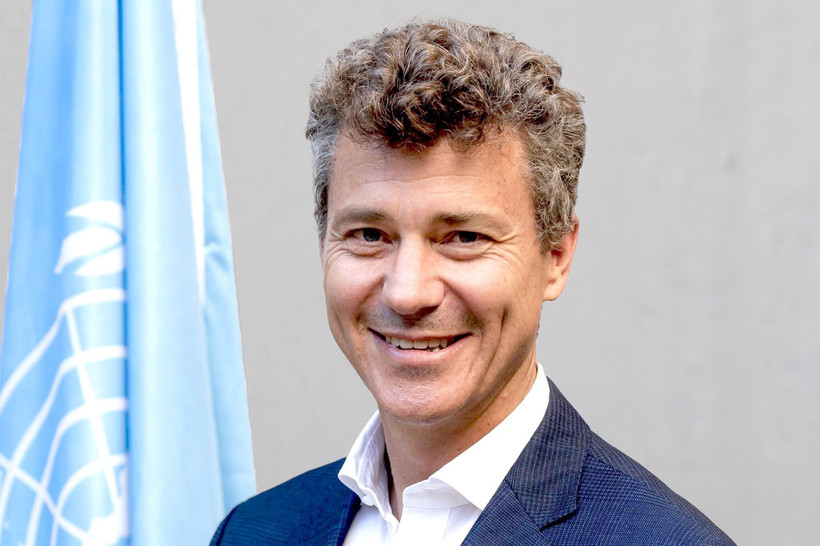
Hanoi(VNA) - UNESCO Representative to Vietnam Jonathan Wallace Baker said Vietnam’s election as Vice-President of the 43rd session of the UNESCO General Conference reinforces its image as a bridge between the Global South and the wider international community.
In an interview granted to the Vietnam News Agency (VNA), he also expressed his confidence that Vietnam will continue to be a voice for dialogue, peace, and creativity.
The following is the full text of the interview.
Reporter: How do you assess the significance of Vietnam being re-elected by Member States as Vice-President of the 43rd session of the UNESCO General Conference, especially at a time when UNESCO is undertaking major reforms toward sustainable development?
UNESCO Representative: Vietnam’s re-election as Vice-President of the 43rd session of the General Conference is a strong vote of confidence from UNESCO’s Member States in the country’s constructive diplomacy and consensus-building approach.
Being entrusted with this role for two consecutive terms speaks volumes about Vietnam’s growing reputation and reliability as a multilateral partner. It reflects international recognition of the country’s impressive development achievements and its increasingly active and substantive engagement with UNESCO and other global forums.
This also comes at a pivotal moment when UNESCO has solidified its global lead in education, culture, the sciences and communication. Vietnam’s best practices in connecting education, science, culture, and sustainable development makes it uniquely positioned to contribute to these efforts and help translate global priorities into real-world impact in Vietnam and in other countries around the world.
Vietnam’s election also reinforces its image as a bridge between the Global South and the wider international community.
Reporter: In your view, how has Vietnam demonstrated its role and contributions to UNESCO’s work in recent years, particularly in the fields of education, science, and culture?
UNESCO Representative: Vietnam has been a very active and responsible Member State within the UNESCO family, making tangible contributions across all of UNESCO’s fields of competence.
In education, Vietnam has shown remarkable leadership through bold reforms and a long-term vision aligned with the Education 2030 Agenda. The adoption of Resolution 71-NQ/TW sets ambitious goals for universal preschool and secondary education by 2030 and world-class universities by 2045, with education investment anchored at 20% of the State budget. The new Teachers Law and learner-centred approaches such as the Happy Schools framework and the Global Network of Learning Cities reflect Vietnam’s commitment to inclusion, teacher empowerment, and lifelong learning.
In the sciences, Vietnam demonstrates strong leadership through its engagement in UNESCO’s flagship programmes. The country now hosts 11 Biosphere Reserves and 4 Global Geoparks, and serves as a regional hub with two Category 2 Centres in Mathematics and Physics. Recent events hosted in Vietnam, such as the 8th Asia-Pacific Geoparks Network Symposium in Cao Bang (2024) and the 32nd Session of the Intergovernmental Hydrological Programme Regional Steering Committee (2025), underscore its active role in advancing regional cooperation. Vietnam’s progressive Water Resources Law (2023) and its national science, technology, and innovation (STI) agenda further illustrate how science and policy are being harnessed for sustainable development.
Most recently, Vietnam launched its AI Readiness Assessment under UNESCO’s Recommendation on the Ethics of Artificial Intelligence, which provides a comprehensive evaluation of Vietnam’s AI ecosystem and marks an important milestone in promoting ethical, human-centred, and inclusive AI governance.
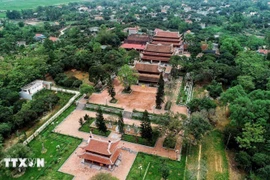
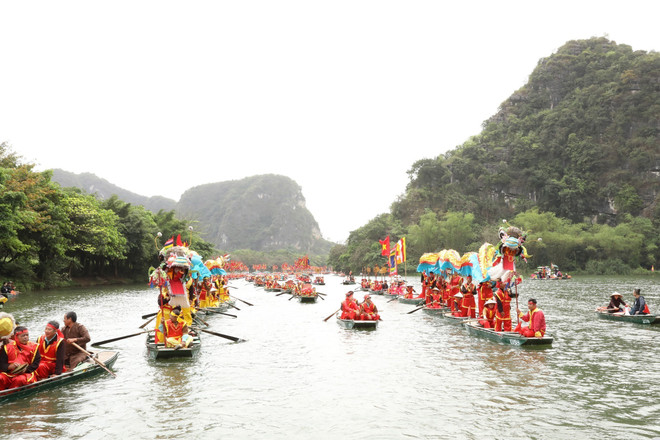
In culture, Vietnam’s partnership with UNESCO stands out as a model of cultural governance and creative vitality. The country now counts nine World Heritage Sites and 16 Intangible Cultural Heritage elements, alongside 4 Creative Cities: Hanoi, Hoi An, Da Lat, and Ho Chi Minh City. It has also integrated heritage protection into national legislation and leveraged designations such as the Trang An Landscape Complex to promote sustainable, community-based tourism.
Reporter: Looking ahead, what does UNESCO expect from Vietnam as Vice-President of the General Conference and as an active partner in promoting UNESCO’s core values of peace, inclusion, and creativity?
UNESCO Representative: As Vice-President of the General Conference, Vietnam is well-placed to help guide UNESCO’s collective action agenda at a time when multilateral cooperation is being tested worldwide.
We expect Vietnam to continue to play its hallmark role as a bridge-builder: linking regions, perspectives, and priorities between developed and developing countries. This role is crucial for ensuring that global decisions are inclusive and that no country is left behind in the implementation of the Sustainable Development Goals.
At the same time, Vietnam can help shape UNESCO’s future direction by sharing its practical experience in education reform, cultural preservation, and science-driven innovation. These national successes offer valuable lessons on how to turn policy into tangible progress for people and communities.
We are confident that Vietnam will continue to be a voice for dialogue, peace, and creativity.
Reporter: How do you assess the significance of UNESCO’s adoption of Vietnam’s draft resolution to launch an ‘International Decade on Culture for Sustainable Development’?
UNESCO Representative: UNESCO highly appreciates the adoption of the draft resolution proposed by Vietnam on the “International Decade on Culture for Sustainable Development” at the 43rd session of the General Conference. This initiative has received strong support from Member States and aligns closely with UNESCO’s strategic direction of further integrating culture into development policies.
The draft resolution underscores the crucial role of culture in addressing global challenges, raising awareness, strengthening political will, mobilising resources, and promoting investment in cultural and creative industries. Its adoption also reflects Vietnam’s active, responsible, and increasingly substantive contributions to UNESCO in recent years.
UNESCO Office in Hanoi will continue to work closely with Vietnam in advancing culture as a pillar of sustainable development.
Reporter: Thank you so much!