Vietnamese embassies across Asia commemorate former President Tran Duc Luong

Representatives of many Asian countries and international friends have shown their respects for former President Tran Duc Luong's contributions to Vietnam's development, relations with their countries, and integration into the region.

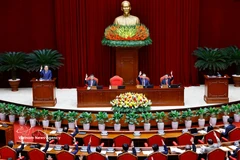
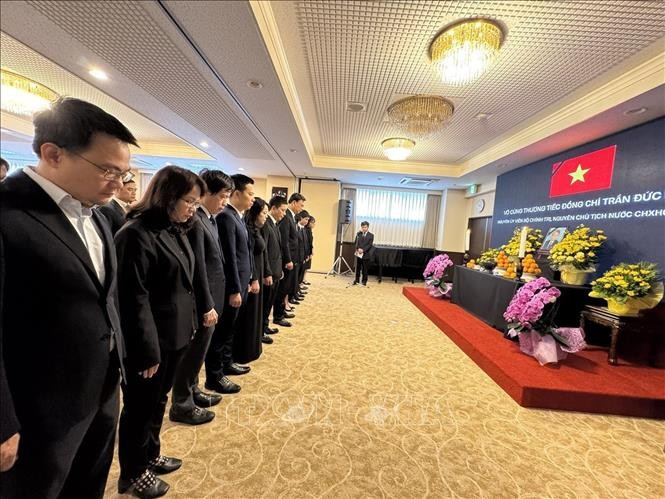
All officials and staff of the Vietnamese Embassy, representatives of Vietnamese agencies, and members of the Vietnamese community in Japan observe a minute’s silence in memory of former State President Tran Duc Luong. (Photo: VNA)

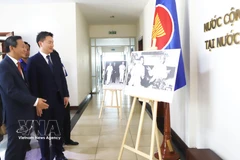
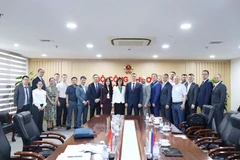
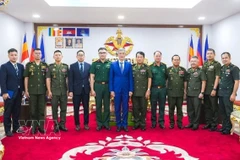
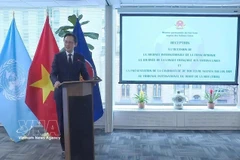
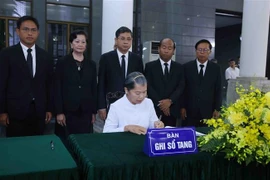
Hanoi (VNA) – The Vietnamese embassies in China, Japan, Singapore, Malaysia, and Thailand on May 24 held respect-paying ceremonies for former Politburo member and former State President Tran Duc Luong, who passed away on May 20 at the age of 88.

In Beijing, the ceremony was attended by senior representatives from various Chinese ministries, departments, associations, and organisations. They paid their respects and wrote in the book of condolence, recognising the significant contributions by the late leader to Vietnam’s national development and to the advancement of Vietnam – China relations. Particular emphasis was placed on his role in promoting the “16-word motto” and the “four-good spirit”, both of which have underpinned the strengthening of bilateral ties.

Over 30 ambassadors, chargés d’affaires, and representatives of diplomatic missions and international organisations in Beijing also attended the event or sent condolences to the embassy.
china-pham-phai-binh.jpg
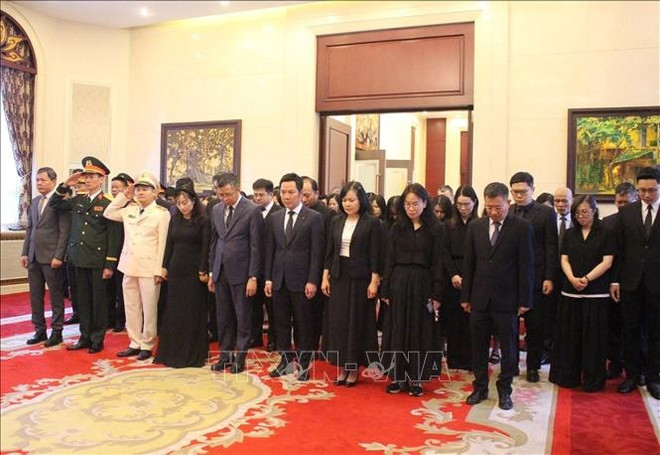
Staff of the Vietnamese Embassy in China, led by Ambassador Pham Thanh Binh, pays tribute to former State President Tran Duc Luong. (Photo: VNA)

Later that day, on behalf of the Chinese Party, Government, and people, Party General Secretary and President of China Xi Jinping conveyed a message of condolence to Vietnamese Party General Secretary To Lam and State President Luong Cuong. He described Tran Duc Luong as an outstanding leader of the Vietnamese Party and State, and acknowledged his crucial role in Vietnam’s national development and Doi moi (renewal) process.

The Consulate General of Vietnam in Hong Kong and Macau (China) also held a similar ceremony in Hong Kong. Attendees included Deputy Commissioner Pan Yundong of the Commissioner’s Office of the Chinese Ministry of Foreign Affairs in the special administrative region, Lao Consul General Ammala Saenchonghack, and representatives from the Indonesian Consulate General.

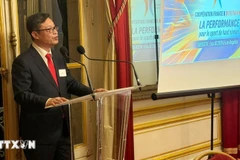
In Tokyo, the ambassadors of Cuba, Laos, and Sri Lanka, along with representatives from the Vietnamese Associations' Union, the Vietnamese Youth and Student Association in Japan, and other community organisations paid tribute to the late leader by offering incense and signing the condolence book.

In Singapore, Loy Hui Chien, Director-General for Southeast Asia II at the Ministry of Foreign Affairs of Singapore, joined the embassy’s ceremony. In the condolence book, he noted that former President Luong had ably steered Vietnam through the post-Doi moi period and the Asian financial crisis, while promoting the country’s integration with ASEAN and the wider global community.

Representatives and envoys from several embassies, including those of Laos, Cuba, China, India, Australia, Peru, and Myanmar, along with members of the Vietnamese community and student associations, also took part in the solemn occasion.

In Kuala Lumpur, alongside the Vietnamese embassy’s respect-paying event, the countries participating in the ASEAN Senior Officials’ Meeting (SOM), held on the same day, also extended condolences. Member states expressed their profound condolences to the Vietnamese Party, State, and people, and acknowledged Tran Duc Luong’s contributions to the region and to ASEAN, particularly in the first years of Vietnam’s membership.

Earlier, Malaysian Prime Minister Anwar Ibrahim had sent the Malaysian Government’s and people’s deepest condolences to the bereaved family and the people of Vietnam.

At the Vietnamese Embassy in Bangkok, the ambassadors from Russia, the Republic of Korea, Malaysia, Cambodia, Mongolia, Sri Lanka, Oman, and Nigeria came to pay their tribute. Representatives from the Thailand – Vietnam Friendship Association, along with executives from major Thai corporations such as the CP Group, Amata, and Central Group, were also in attendance./.
VNA

See more

Assaf Talgam, a historian and a journalist of Zo HaDerekh, the official newspaper of the Communist Party of Israel. (Photo: VNA)

CPV's leadership - central factor shaping Vietnam’s enduring stability, impressive achievements: Israeli historian

Talgam said that from a comparative and historical perspective, the CPV’s leadership has been the central factor underpinning the country’s enduring political stability and impressive development trajectory. In a world marked by rapid and unpredictable changes, few political organisations have been able to maintain continuity of leadership while simultaneously adapting their governance approach as effectively as the CPV.

Prime Minister Pham Minh Chinh presents Certificates of merit from the Government’s Party Committee to individuals with outstanding achievements. (Photo: VNA)

Prime Minister outlines five specific strategies for Government’s Party Committee

PM Chinh noted that the Government’s Party Committee exercised comprehensive leadership over the Government's operations, proactively and effectively responded to emerging issues, with a particular focus on socio-economic development. As a result, 2025 witnessed high economic growth, sustained macroeconomic stability and ensured major balances.

Politburo member, Standing member of the Party Central Committee’s Secretariat Tran Cam Tu attends the rehearsal. (Photo: VNA)

Security forces stage rehearsal for 14th National Party Congress

The People’s Public Security forces have been praised for their core role in closely working with the army and relevant ministries and agencies, with success in thwarting hostile plots at an early stage, drastically combating fake news and disinformation surrounding the 14th National Party Congress.

Senior Lieutenant General Le Quoc Hung (L), member of the Communist Party of Vietnam (CPV) Central Committee and Deputy Minister of Public Security, and General Vilay Lakhamfong, Politburo member and permanent member of the Secretariat of the Lao People’s Revolutionary Party (LPRP) Central Committee. (Photo: VNA)

Deputy Minister of Public Security congratulates Lao officials following succesful 12th National Party Congress

Deputy Minister of Public Security Senior Lieutenant General Le Quoc Hungconveyed the warmest congratulations of the Central Public Security Party Committee, the Ministry of Public Security leadership, and the Vietnamese People’s Public Security Forces to Lakhamfong and other Lao public security leaders on the congress’s success and their election to key leadership positions for the new term.

A session of the National Assembly Standing Committee. (Photo: VNA)

NA Standing Committee's key work agenda for 2026 approved

A major focus will be preparations for the election of deputies to the 16th NA and to People’s Councils at all levels for the 2026–2031 term. The NASC will coordinate with the National Election Council, the Government, the Vietnam Fatherland Front Central Committee, and relevant agencies and organisations to continue implementing the election plan, organise oversight of the electoral process, and carry out its duties and powers as prescribed.

Party General Secretary To Lam receives US Ambassador Marc Evans Knapper in Hanoi on January 9, 2026. (Photo: VNA)

Party leader receives outgoing US Ambassador

Vietnam always values its relationship with the US and looks forward to continuing close cooperation with the US government to deepen bilateral relations based on mutual respect for each other’s independence, sovereignty, territorial integrity, and political institutions, contributing positively to peace, stability, cooperation, and development regionally and globally.